First study investigating possible link between sunscreen ingredient and endometriosis
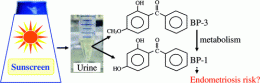
Scientists are reporting a possible link between the use of sunscreen containing a certain ingredient that mimics the effects of the female sex hormone estrogen and an increased risk of being diagnosed with endometriosis, a painful condition in which uterine tissue grows outside the uterus. They describe the report, published in ACS' journal Environmental Science & Technology, as the first to examine whether such a connection may exist.
Kurunthachalam Kannan and colleagues explain that some sunscreens and other personal care products contain benzophenone (BP)-type ingredients that are very effective in blocking potentially harmful ultraviolet rays from the sun. Small amounts of BPs can pass through the skin and be absorbed into the blood, where they mimic the effects of estrogen. Endometriosis, which affects up to 1-in-10 women of reproductive age, needs estrogen to develop. Despite those facts, scientists until now had not checked for a connection between the use of BP sunscreens and the likelihood of being diagnosed with endometriosis.
To fill that knowledge gap, the scientists analyzed BP levels in the urine of 625 women who underwent surgery for endometriosis. They found that high levels of one BP called 2,4OH-BP were associated with an increased risk of an endometriosis diagnosis. Women tended to have higher levels of BPs during the summer months and if they lived in sunny California, further suggesting a link with sunscreens. "Our results invite the speculation that exposure to elevated 2,4OH-BP levels may be associated with endometriosis," say the researchers.
More information: “Urinary Concentrations of Benzophenone-type UV Filters in U.S. Women and Their Association with Endometriosis” Environ. Sci. Technol., 2012, 46 (8), pp 4624–4632, DOI: 10.1021/es204415a
Abstract
Benzophenone (BP)-type UV filters are widely used in a variety of personal care products for the protection of skin and hair from UV irradiation. Despite the estrogenic potencies of BP derivatives, few studies have examined the occurrence of these compounds in human matrices. Furthermore, associations among exposure to these compounds and estrogen-dependent diseases (such as endometriosis) have not been examined previously. In this study, we determined the concentrations of five BP derivatives, 2-hydroxy-4-methoxybenzophenone (2OH-4MeO-BP), 2,4-dihydroxybenzophenone (2,4OH-BP), 2,2′-dihydroxy-4-methoxybenzophenone (2,2′OH-4MeO-BP), 2,2′,4,4′-tetrahydroxybenzophenone (2,2′,4,4′OH-BP), and 4-hydroxybenzophenone (4OH-BP), in urine collected from 625 women in Utah and California, using liquid chromatography (LC)-tandem mass spectrometry (MS/MS). The association of urinary concentrations of BP derivatives with an increase in the odds of a diagnosis of endometriosis was examined in 600 women who underwent laparoscopy/laparotomy (n = 473: operative cohort) or pelvic magnetic resonance imaging (n = 127: population cohort), during 2007–2009. 2OH-4MeO-BP, 2,4OH-BP, and 4OH-BP respectively were detected in 99.0%, 93.3%, and 83.8% of the urine samples analyzed, whereas the detection rates for 2,2′,4,4′OH-BP and 2,2′OH-4MeO-BP were below 6.0%. Significant regional differences (higher concentrations in California) and monthly variations (higher concentrations in July and August) were found for urinary concentrations of 2OH-4MeO-BP and 2,4OH-BP. In addition, urinary concentrations of 2OH-4MeO-BP and 2,4OH-BP tended to be higher in more affluent, older, and leaner women. Adjusted odds ratios (ORs) and 95% confidence intervals (CIs) were estimated for the urinary concentrations of BP derivatives and the odds of an endometriosis diagnosis; ORs increased across quartiles of 2OH-4MeO-BP and 2,4OH-BP concentrations, but a significant trend was observed only between 2,4OH-BP and the odds of an endometriosis diagnosis in the operative cohort (OR = 1.19; 95% CI = 1.01, 1.41). When women in the highest quartile of 2,4OH-BP concentrations were compared with women in the first three quartiles, the OR increased considerably (OR = 1.65; 95% CI = 1.07, 2.53). Given that 2,4OH-BP possesses an estrogenic activity higher than that of 2OH-4MeO-BP, our results invite the speculation that exposure to elevated 2,4OH-BP levels may be associated with endometriosis.


