Lowest fused vertebral level linked to motion in scoliosis
May 10, 2012 in Diseases, Conditions, Syndromes
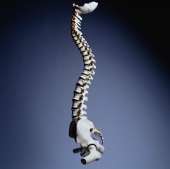
(HealthDay) -- For postoperative patients with adolescent idiopathic scoliosis (AIS), preservation of vertebral motion segments allows for greater distribution of functional motion, according to a study published in the May 1 issue of Spine.
Michelle Marks, P.T., from Rady Children's Hospital in San Diego, and associates conducted a cross-sectional prospective study of 100 patients with AIS to assess intervertebral segmental and cumulative motion in the distal unfused segments of the spine after instrumentation. Motion was assessed using standardized radiographs and intervertebral angles were measured at each level.
The researchers found that, in lateral bending, there was an association between the lowest fused vertebral level and the degree of motion at the distal unfused segments. There was significantly greater L2-L3, L3-L4, and L4-L5 segment motion with a more distal instrumented vertebrae. There was a similar trend noted at the L5-S1 level. With a more distal fusion, the summed motion from L3 to S1 also increased significantly. These results were not seen with forward bending.
"In a group of two- to five-year postoperative patients with AIS, evaluation of the distal unfused intervertebral motion showed that preservation of a greater number of vertebral motion segments allowed greater distribution of functional motion across the remaining unfused levels," the authors write.
The study was supported by the DePuy Spine fund. One or more authors disclosed financial ties related directly or indirectly to the study subject matter.
More information: Abstract
Full Text (subscription or payment may be required)
Copyright © 2012 HealthDay. All rights reserved.
-
Loss of motion after knee surgery may increase osteoarthritis risk, research suggests
Jul 09, 2011 |
not rated yet |
0
-
Study shows that modern surgery for scoliosis has good long-term outcomes
Apr 05, 2011 |
not rated yet |
0
-
Bone metabolism, vitamin D key in postkyphoplasty breaks
Apr 25, 2012 |
not rated yet |
0
-
Neuroscientists find greater complexity in how we perceive motion
Dec 05, 2011 |
not rated yet |
0
-
44 percent of postmenopausal women with distal radius fracture have low levels of vitamin D
Feb 07, 2012 |
not rated yet |
0
-
Motion perception revisited: High Phi effect challenges established motion perception assumptions
Apr 23, 2013 |
3 / 5 (2) |
2
-
Anything you can do I can do better: Neuromolecular foundations of the superiority illusion (Update)
Apr 02, 2013 |
4.5 / 5 (11) |
5
-
The visual system as economist: Neural resource allocation in visual adaptation
Mar 30, 2013 |
5 / 5 (2) |
9
-
Separate lives: Neuronal and organismal lifespans decoupled
Mar 27, 2013 |
4.9 / 5 (8) |
0
-
Sizing things up: The evolutionary neurobiology of scale invariance
Feb 28, 2013 |
4.8 / 5 (10) |
14
-
Classical and Quantum Mechanics via Lie algebras
Apr 15, 2011
- More from Physics Forums - Independent Research
More news stories
Researchers find genetic risk factor for pulmonary fibrosis
A paper recently published in the New England Journal of Medicine and co-written by physicians and scientists at the University of Colorado School of Medicine finds that an important genetic risk factor for pulmonary fibros ...
Diseases, Conditions, Syndromes
3 hours ago |
not rated yet |
0
Biomarkers discovered for inflammatory bowel disease
Using the Department of Defense Serum Repository (DoDSR), University of Cincinnati (UC) researchers have identified a number of biomarkers for inflammatory bowel disease (IBD), which could help with earlier diagnosis and ...
Diseases, Conditions, Syndromes
3 hours ago |
not rated yet |
0
CDC says high number of public pools contain microbes
(HealthDay)—Three-quarters of public schools in the metro Atlanta area contain microbes, including bacteria indicating the presence of fecal matter, according to research published in the May 17 issue of ...
Diseases, Conditions, Syndromes
4 hours ago |
not rated yet |
0
Study examines outbreak of spinal infections in Michigan
(HealthDay)—Factors such as increased case finding may explain why Michigan had half of the total spinal infections associated with contaminated methylprednisolone acetate in the recent fungal meningitis ...
Diseases, Conditions, Syndromes
4 hours ago |
not rated yet |
0
World not ready for mass flu outbreak, WHO says
The world is unprepared for a massive virus outbreak, the deputy chief of the World Health Organization warned Tuesday, amid fears that H7N9 bird flu striking China could morph into a form that spreads easily among people.
Diseases, Conditions, Syndromes
4 hours ago |
not rated yet |
0
If you can remember it, you can remember it wrong
(Medical Xpress)—Native peoples in regions where cameras are uncommon sometimes react with caution when their picture is taken. The fear that something must have been stolen from them to create the photo ...
New sleeping pill poised to hit US markets
An experimental sleeping pill from US drug company Merck is effective at helping people fall and stay asleep, according to reviewers at the US Food and Drug Administration, which could soon approve the new drug.
B vitamins could delay dementia
(Medical Xpress)—Despite spending billions of dollars on research and development, drug companies have been unable to come up with effective treatments for dementia and Alzheimer's Disease (AD). Now, A. ...
Reducing caloric intake delays nerve cell loss
Activating an enzyme known to play a role in the anti-aging benefits of calorie restriction delays the loss of brain cells and preserves cognitive function in mice, according to a study published in the May ...
Antidepressant reduces stress-induced heart condition
A drug commonly used to treat depression and anxiety may improve a stress-related heart condition in people with stable coronary heart disease, according to researchers at Duke Medicine.
Insight into the dazzling impact of insulin in cells
Australian scientists have charted the path of insulin action in cells in precise detail like never before. This provides a comprehensive blueprint for understanding what goes wrong in diabetes.