Learning and memory: The role of neo-neurons revealed
May 22, 2012 in Neuroscience

Learning and memory: the role of neo-neurons revealed

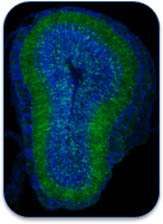
Section of a mouse brain observed using a fluorescence microscope. The green filaments represent neo-neurons in an organized network. Credit: Institut Pasteur

(Medical Xpress) -- Researchers at the Institut Pasteur and the CNRS have recently identified in mice the role played by neo-neurons formed in the adult brain. By using selective stimulation the researchers were able to show that these neo-neurons increase the ability to learn and memorize difficult cognitive tasks. This newly discovered characteristic of neo-neurons to assimilate complex information could open up new avenues in the treatment of some neurodegenerative diseases. This publication is available online on the Nature Neuroscience journal's website.

The discovery that new neurons could be formed in the created quite a stir in 2003 by debunking the age-old belief that a person is born with a set number of neurons and that any loss of neurons is irreversible. This was all the more incredible considering that the function of these new neurons remained undetermined. That is, until today.

Using mice models the team working under Pierre-Marie Lledo, head of the Laboratory for and Memory (Institut Pasteur/CNRS) recently revealed the role of these neo-neurons formed in the adult brain with respect to . With the help of an experimental approach using optogenetics, developed by this very same team and published in December 2010, the researchers were able to show that when stimulated by a brief flash of light these neo-neurons facilitate both learning and the of complex tasks. This resulted in mice models that were able to memorize information given during the learning activity more quickly and remember exercises even 50 days after experimentation had ended. The study also shows that neo-neurons generated just after birth hold no added advantages as relates to either learning or memory. In this respect it is only the neurons produced by the adult brain that have any considerable significance.

“This study shows that the activity of just a few neurons produced in the adult brain can still have considerable effects on cognitive processes and behavior. Moreover, this work helps to illustrate how the brain assimilates new stimulations seeing as normally electrical activity (which we mimic using flashes of light) is produced within the brain's attention centers”, explains the study's director Pierre-Marie Lledo.

Beyond simply discovering the functional contribution of these neo-neurons, the study has also reaffirmed the clear link between “mood” (defined here by a specific pattern of stimulation) and cerebral activity. It has been shown that curiosity, attentiveness and pleasure all promote the formation of neo-neurons and consequently the acquisition of new cognitive abilities. Conversely, a state of depression is detrimental to the production of new neurons and triggers a vicious cycle which prolongs this state of despondency. These results, and the optogenetics technologies that enabled this study, may prove very useful for devising therapeutic protocols which aim to counter the development of neurologic or psychiatric diseases.

More information: Activation of adult-born neurons facilitates learning and memory, published online on the Nature Neuroscience website, May 13, 2012, Mariana Alonso, et al.

Journal reference: Nature Neuroscience search and more info website

Provided by CNRS search and more info website

4.8 /5 (4 votes)  

Filter


Move the slider to adjust rank threshold, so that you can hide some of the comments.


Display comments: newest first

JVK
May 23, 2012

Rank: not rated yet
This report seems to confirm the role of nutrient chemicals in ecological niches that calibrate intracellular signaling and the development of social niches, which are standardized and controlled by pheromones. Because the molecular biology is the same across species with or without eyes or a central nervous system, olfaction and odor receptors provide a clear evolutionary trail that can be followed from unicellular organisms to insects to humans. The idea that ecological niches and social niches are the determinants of neurogenic niches, like those that develop with exposure to food odors and social odors is one that is important to consider whether we intend to look at pharmacogenomics or to better understand the development of human behavior in the context of epigenetic effects of odors on brain development. I look forward to reading the publication of their results, and to a review of past works by some of these authors.
Rank 4.8 /5 (4 votes)
Related Stories
Relevant PhysicsForums posts

More news stories

Reducing caloric intake delays nerve cell loss

Activating an enzyme known to play a role in the anti-aging benefits of calorie restriction delays the loss of brain cells and preserves cognitive function in mice, according to a study published in the May ...

Neuroscience created 15 hours ago | popularity 5 / 5 (5) | comments 0 | with audio podcast

B vitamins could delay dementia

(Medical Xpress)—Despite spending billions of dollars on research and development, drug companies have been unable to come up with effective treatments for dementia and Alzheimer's Disease (AD). Now, A. ...

Neuroscience created 19 hours ago | popularity 4.9 / 5 (14) | comments 0 | with audio podcast report

Waiting for a sign? Researchers find potential brain 'switch' for new behavior

You're standing near an airport luggage carousel and your bag emerges on the conveyor belt, prompting you to spring into action. How does your brain make the shift from passively waiting to taking action when ...

Neuroscience created 19 hours ago | popularity 5 / 5 (1) | comments 0 | with audio podcast

If you can remember it, you can remember it wrong

(Medical Xpress)—Native peoples in regions where cameras are uncommon sometimes react with caution when their picture is taken. The fear that something must have been stolen from them to create the photo ...

Neuroscience created 21 hours ago | popularity 4.2 / 5 (5) | comments 0 | with audio podcast report

Study shows where scene context happens in our brain

In a remote fishing community in Venezuela, a lone fisherman sits on a cliff overlooking the southern Caribbean Sea. This man –– the lookout –– is responsible for directing his comrades on the water, ...

Neuroscience created 23 hours ago | popularity 4 / 5 (1) | comments 0 | with audio podcast


A molecular explanation for age-related fertility decline in women

(Medical Xpress)—Scientists supported by the National Institutes of Health have a new theory as to why a woman's fertility declines after her mid-30s. They also suggest an approach that might help slow ...

Medical researchers discover new ways to target, develop and design drugs to prevent and treat viral infection

Researchers at the University of Alberta have discovered a new drug target, developed a new drug and identified a new way to design drugs—all of which could be a winning combination in the battle against viruses.

Beta-blockers may boost chemo effect in childhood cancer

Beta-blockers, normally used for high blood pressure, could enhance the effectiveness of chemotherapies in treating neuroblastoma, a type of children's cancer, according to a new study published in the British Jo ...

Cancer survivors need more support to stop smoking and drinking

Cancer survivors are no more likely to stop smoking, cut down on alcohol, or exercise more often than the general population, according to new research published in the British Journal of Cancer today (Wednesday)

Alcohol sales fall due to ban on multi-buy promotions

(Medical Xpress)—A report published today shows a 2.6% decrease in the amount of alcohol sold per adult in Scotland in the year following the introduction of the Alcohol etc. (Scotland) Act in October 2011.

Ethicists' behavior not more moral, study finds

(Medical Xpress)—Do ethicists engage in better moral behavior than other professors? The answer is no. Nor are they more likely than nonethicists to act according to values they espouse, according to researchers from the ...