New molecular structure offers first picture of a protein family vital to human health
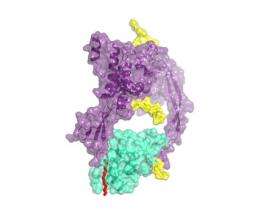
The 20 proteins in the Wnt family are some of the most important proteins in controlling how an organism develops and grows, but for 30 years scientists have not known what these vital proteins actually look like. The proteins have eluded standard visualization techniques, in large part because they do not dissolve well in the water-based liquids normally used for biochemical studies. But once Howard Hughes Medical Institute investigator K. Christopher Garcia, and Claudia Janda, a post-doctoral fellow in his Stanford University School of Medicine lab, thought of an approach to make the proteins behave better, they succeeded in solving the first structure of a Wnt protein.
Their work, published June 1, 2012, in the journal Science, reveals an unexpected three-dimensional shape that offers clues to how Wnt proteins function and clarifies the nature of its Frizzled receptor target for drug developers working to design anti-Wnt therapies for cancer and other diseases. "Having finally gained structural access to Wnts, I think this is going to open up a whole new era in molecularly dissecting the role of Wnt proteins in biological processes," says Garcia.
Wnt proteins were discovered 30 years ago by Harold Varmus, the current director of the National Cancer Institute, and Roel Nusse, who is now an HHMI investigator at Stanford University. They observed that Wnt1, the gene for a Wnt protein, was very active in breast cancer cells from mice. Over the past decades, researchers have shown that Wnt proteins play key roles in embryonic development, tissue regeneration, bone growth, stem cell differentiation, as well as many human cancers. In essence, Wnt proteins help give cells their identity and tell them how to behave.
"This is one of the most important ligand-receptor systems in both human and invertebrate biology. Wnts cut across every field, which is why I got involved. But many excellent groups have tried to express them in the lab and solve their structures, so we realized that something non-intuitive would be required to crack the problem," says Garcia.
In 2003, Nusse's team found out why scientists who had been trying to isolate Wnt proteins had been plagued with so many difficulties: the proteins contained lipids, fatty molecules that prevent the protein from dissolving in water-based solutions. Scientists realized they could stabilize the protein by instead keeping it in mixtures that contained detergents, helping pave the way for a plethora of biochemical experiments on isolated Wnts. But such detergent-containing mixtures still present obstacles for crystallizing and visualizing proteins by structural analysis techniques; simply put, the detergents get in the way.
"This really causes a great deal of difficulty in working with these proteins," says Garcia. But he and Janda had an idea: what if they expressed both a Wnt protein, and the receptor it bound to in the same cell? Perhaps, they thought, the receptor would shield the Wnt protein's exposed lipid, making it able to dissolve in the solution they needed.
The technique worked—they were able to produce Wnt8 bound to Frizzled-8, one of 10 Frizzled receptors that the 20 Wnt proteins bind to to carry out cellular effects.
"It's one of the most unusual protein structures I've ever seen," says Garcia. "It looks like a crab with its two pinchers reaching around and grabbing the Frizzled receptor. When we originally solved this, we could see no relationship between the structure of Wnt8 and any other structure that has ever been described. However, we are beginning to see the evolutionary origins of the Wnt fold. This story is developing."
Garcia expects the other Wnt proteins likely have similar structures, with the respective Frizzled receptors shielding the lipid attached to the protein, meaning their method should work on other Wnts. He now wants to delve into those structures, answering questions about which Wnt-Frizzled pairs are responsible for what biological roles, how co-receptors bind to the pairs, and how the structure can be changed to optimize the interactions.
"What we can see now are some clues in the structure as to why Wnts are so hard to express, because of the exposure of the lipid," says Garcia. "So now we can think about ways to remodel the protein that will solve the expression problem without altering function."
But it's not just basic science of Wnts that gets a boost with the new method for solving their structure, and the new structural data. Wnts have long been considered a potential drug target for cancers, as well as other diseases. Knowing the structure provides a huge advantage when trying to develop compounds that will bind to Wnts.
"There are already some drugs companies that have been developing anti-Wnt and anti-Frizzled antagonist antibodies as drugs," says Garcia. "But they're been working in the dark, with no knowledge of structure. So I really think this will open up a whole new era for not only of basic biology on these proteins, but also for their therapeutic potential. We are currently attempting to engineer Frizzled-specific Wnts in order to better understand the role of a particular Wnt in a biological and disease process, as well as assess the efficacy of selectively blocking or activating Wnt signaling pathways. "
More information: "Structural Casis of Wnt Recognition by Frizzled," by C.Y. Janda; Science, 2012.


