Even non-sexual social contact can raise body temperature
May 30, 2012 in Medical research
How the merest social contact with a man can make a woman glow
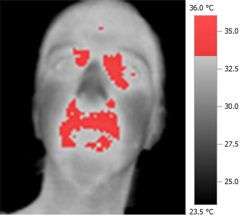
(Medical Xpress) -- Researchers at the University of St Andrews found that non-sexual social interactions with men caused a noticeable rise in the temperature of a woman's face, without them even noticing.
The research was conducted by Amanda Hahn, Carmen Lefevre and David Perrett from the University's Perception Lab. The team used thermal imaging to monitor temperature changes in women during interactions with a man or another woman.
The findings could be important for the development of thermal imaging in monitoring changes in levels of stress and emotion, for example in lie detection tests, where the merest increase in temperature would be picked up.
Lead author Amanda Hahn, explained, "We used a thermal camera to record skin temperature during a standard 'social interaction' where we measured participants' skin colour at 'non-personal' (i.e. the arm and palm of the hand) and 'personal' (i.e. the face and chest) locations on the body. The thermal response was dramatic when the male experimenter made contact at 'personal' locations."
While it may not be surprising that people have a physiological response to social contact, the size of the reaction was surprising. Hahn commented, "We observed some women whose facial temperature increased by an entire degree (Celsius) during interaction with the male experimenter.
"This thermal change was in response to simple social interaction, without any experimental change to emotion or arousal. Indeed our participants did not report feeling embarrassment or discomfort during the interaction."
The study, published later this month in Biology Letters, shows that gender alone influenced the reaction of women, who showed no response to interaction with other women.
Professor David Perrett, who runs the Perception Lab added, "This finding is interesting and important for future work. Thermal imaging is a relatively new technique employed to monitor emotion and stress. We are only just beginning to understand the potential uses of thermal imaging in medicine and it can be very useful in areas of national security, where changes in skin temperature can be gauged as part of lie detection tests."
The research teams next goal is to work out whether or not these physiological changes are detected by others and whether they affect social interactions. Study co-author Carmen Lefevre concluded, "We are currently exploring the link between changes in skin temperature and skin colour. A slight increase in blood flow may cause the skin temperature to rise; this increase in blood flow may also cause the skin to become redder. We do not yet know if these changes are evident to others or how they affect perceptions of attractiveness."
More information: Hot or not? Thermal reactions to social contact, Biology Letters, Published online before print May 30, 2012, doi: 10.1098/rsbl.2012.0338
Abstract
Previous studies using thermal imaging have suggested that face and body temperature increase during periods of sexual arousal. Additionally, facial skin temperature changes are associated with other forms of emotional arousal, including fear and stress. This study investigated whether interpersonal social contact can elicit facial temperature changes. Study 1: infrared images were taken during a standardized interaction with a same- and opposite-sex experimenter using skin contact in a number of potentially highintimate (face and chest) and lowintimate (arm and palm) locations. Facial skin temperatures significantly increased from baseline during the face and chest contact, and these temperature shifts were larger when contact was made by an opposite-sex experimenter. Study 2: the topography of facial temperature change was investigated in five regions: forehead, periorbital, nose, mouth and cheeks. Increased temperature in the periorbital, nose and mouth regions predicted overall facial temperature shifts to social contact. Our findings demonstrate skin temperature changes are a sensitive index of arousal during interpersonal interactions.
Journal reference:
Biology Letters
Provided by
University of St Andrews
-
Newly launched study to probe women's response to male odor
Feb 05, 2008 |
not rated yet |
0
-
Red in the Face: People use your skin colour to judge how healthy you are
Apr 01, 2009 |
not rated yet |
0
-
Adapting space-industry technology to treat breast cancer
Nov 02, 2009 |
not rated yet |
0
-
Vultures use face flushing technique for instant status updates
Oct 06, 2010 |
not rated yet |
0
-
New measure of sexual arousal found for both men and women
Feb 23, 2007 |
not rated yet |
0
-
Motion perception revisited: High Phi effect challenges established motion perception assumptions
Apr 23, 2013 |
3 / 5 (2) |
2
-
Anything you can do I can do better: Neuromolecular foundations of the superiority illusion (Update)
Apr 02, 2013 |
4.5 / 5 (11) |
5
-
The visual system as economist: Neural resource allocation in visual adaptation
Mar 30, 2013 |
5 / 5 (2) |
9
-
Separate lives: Neuronal and organismal lifespans decoupled
Mar 27, 2013 |
4.9 / 5 (8) |
0
-
Sizing things up: The evolutionary neurobiology of scale invariance
Feb 28, 2013 |
4.8 / 5 (10) |
14
-
Pressure-volume curve: Elastic Recoil Pressure don't make sense
May 18, 2013
-
If you became brain-dead, would you want them to pull the plug?
May 17, 2013
-
MRI bill question
May 15, 2013
-
Ratio of Hydrogen of Oxygen in Dessicated Animal Protein
May 13, 2013
-
Alcohol and acetaminophen
May 13, 2013
-
Marie Curie's leukemia
May 13, 2013
- More from Physics Forums - Medical Sciences
More news stories
Now we know why old scizophrenia medicine works on antibiotics-resistant bacteria
In 2008 researchers from the University of Southern Denmark showed that the drug thioridazine, which has previously been used to treat schizophrenia, is also a powerful weapon against antibiotic-resistant bacteria such as ...
Medical research
May 17, 2013 |
3.7 / 5 (3) |
0
|
SUMO wrestling cells reveal new protective mechanism target for stroke
Scientists investigating the interaction of a group of proteins in the brain responsible for protecting nerve cells from damage have identified a new target that could increase cell survival.
Medical research
May 17, 2013 |
5 / 5 (1) |
0
How serotonin receptors can shape drug effects, from LSD to migraine medication
New findings by researchers carrying out experiments at the U.S. Department of Energy Office of Science's Advanced Photon Source (APS) help explain why some drugs that interact with two kinds of human serotonin ...
Medical research
May 17, 2013 |
not rated yet |
0
|
Preventing blood poisoning
Peptide molecules derived from the body's natural immune system can help boost the body's defence against life-threatening blood poisoning, joint University research has uncovered.
Medical research
May 17, 2013 |
4 / 5 (1) |
0
|
New mechanism to prevent type 2 diabetes in obese individuals
A new Montréal study conducted by Dr. May Faraj, associate research professor at the Université de Montréal and invited scientist at the IRCM, along with her research team and medical collaborators, shows ...
Medical research
May 17, 2013 |
not rated yet |
0
|
Ketamine shows significant therapeutic benefit in people with treatment-resistant depression
Patients with treatment-resistant major depression saw dramatic improvement in their illness after treatment with ketamine, an anesthetic, according to the largest ketamine clinical trial to-date led by researchers from the ...
Consuming coffee linked to lower risk of detrimental liver disease, study finds
Regular consumption of coffee is associated with a reduced risk of primary sclerosing cholangitis (PSC), an autoimmune liver disease, Mayo Clinic research shows. The findings were being presented at the Digestive Disease ...
Research examines new methods for managing digestive health
Research presented at Digestive Disease Week (DDW) explores new methods for managing digestive health through diet and lifestyle.
New research identifies risks, interventions for children's GI health
An increasing number of U.S. children are experiencing gastrointestinal issues that require interventions to resolve, according to research presented at Digestive Disease Week (DDW).
New smartphone application improves colonoscopy preparation
The use of a smartphone application significantly improves patients' preparation for a colonoscopy, according to new research presented today at Digestive Disease Week (DDW). The preparation process, which begins days in ...
New research identifies practice changes to improve value and quality of GI procedures
There are significant cost and risk factors associated with two procedures commonly used to diagnose or treat gastrointestinal problems, according to research presented at Digestive Disease Week (DDW).
May 30, 2012
Rank: 3 / 5 (2)
May 30, 2012
Rank: 1 / 5 (1)