Some pollens are much more aggressive than others
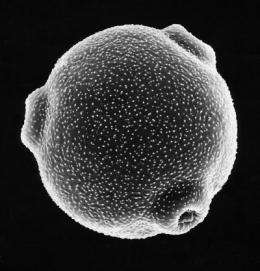
Scientists from across Europe investigated the allergic potential of pollens from the three main triggers of hay fever in Europe: Birch, grass and olive. As the Hialine study researchers have found, the allergenicity of the pollens varies. Depending on the time of year and region, the pollens produce different quantities of protein compounds, these being ultimately responsible for the allergic immune reaction.
From Finland to Italy and from Spain to Lithuania, thirteen research institutes from eleven European countries took part in the three-year Hialine study. The coordinator was Professor Dr Jeroen Buters of TUM's Chair of Molecular Allergology and the Center of Allergy & Environment (ZAUM). The mission was to study the three main causes of hay fever in Europe, i.e. the pollen (germ cells) of birch trees, grass and olive plants. Sufferers develop allergic symptoms when they come in contact with the allergen to which they are sensitized. Up until now, the only way to ascertain how seriously patients will be affected is by measuring the airborne pollen concentration.
However, this method gives very little indication of how aggressive the pollens are. Depending on their level of maturation, the pollens of a particular plant species not only produce different allergens, but the number of allergenic proteins present also varies. The researchers were therefore keen to find the connection between pollen count and amount of allergens released. They focused on the main allergen found in each of the three plant species: Bet v 1 (birch), Phl p 5 (grass) and Ole e 1 (olive). They discovered that the pollen count aligns closely with the number of allergens released.
However, some striking differences were noticed on certain days and at particular measuring stations, as study director Jeroen Buters explains: "The allergic potential varied by a factor of 10. In other words up to ten times more allergens were released on the 'intense' days than at other times." On comparison of the levels at the various measuring locations in Europe, the researchers noticed the greatest fluctuations in the grass pollens. With seven times the number of Phl p 5 allergens, the grass pollens in France were significantly more aggressive than those in Portugal. The birch pollens, by contrast, showed smaller variations. Interestingly, geographical distance seems to have played only a minor role: At two olive measuring stations located only 400 kilometers apart, the scientists observed that the allergen level was four times greater at one of the locations.
The weather was influential too, as Buters relates: "At the measuring station in Portugal, we found a high concentration of the Ole e 1 allergen, even though there was hardly any airborne pollen in Portugal at that time. We did some meteorological calculations and concluded that the allergen had blown in from Spain, where pollens have a significantly higher allergic potential."
According to the study's findings, measuring the allergens would be more useful to allergy sufferers than forecasting the pollen count. "By combining allergen measurements, airborne pollen forecasts and weather data, we can significantly improve the allergy models used to date." Buters also sees new hope for the treatment of allergy sufferers: "The only true therapy for an allergy is hyposensitization, i.e. the sufferer must become accustomed to the allergen over a long period of time. So instead of pollen extracts, doctors could vaccinate patients with allergenic proteins – the real triggers of an allergy. This would be much more effective in targeting the cause of the problem."
More information: Atmospheric Environment, Volume 55, August 2012, Pages 496, dx.doi.org/10.1016/j.atmosenv.2012.01.054


