Scientists gain new understanding of Alzheimer's trigger
May 2, 2012 in Alzheimer's disease & dementia
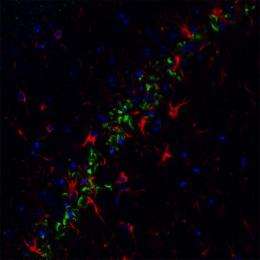
Pyroglutanylated beta-amyloid (green) accumulates in the brains of mice genetically engineered to overproduce it. The red cells are astrocytes, which invade brain regions where the amyloid is deposited and neurons die. The blue structures are nuclei of neurons and astrocytes. Credit: University of Virginia
A highly toxic beta-amyloid a protein that exists in the brains of Alzheimer's disease victims has been found to greatly increase the toxicity of other more common and less toxic beta-amyloids, serving as a possible "trigger" for the advent and development of Alzheimer's, researchers at the University of Virginia and German biotech company Probiodrug have discovered.
The finding, reported in the May 2 online edition of the journal Nature, could lead to more effective treatments for Alzheimer's. Already, Probiodrug AG, based in Halle, Germany has completed phase 1 clinical trials in Europe with a small molecule that inhibits an enzyme, glutaminyl cyclase, that catalyzes the formation of this hypertoxic version of beta-amyloid.
"This form of beta-amyloid, called pyroglutamylated (or pyroglu) beta-amyloid, is a real bad guy in Alzheimer's disease," said principal investigator George Bloom, a U.Va. professor of biology and cell biology in the College of Arts & Sciences and School of Medicine, who is collaborating on the study with scientists at Probiodrug. "We've confirmed that it converts more abundant beta-amyloids into a form that is up to 100 times more toxic, making this a very dangerous killer of brain cells and an attractive target for drug therapy."
Bloom said the process is similar to various prion diseases, such as mad cow disease or chronic wasting disease, where a toxic protein can "infect" normal proteins that spread through the brain and ultimately destroy it.
In the case of Alzheimer's, severe dementia occurs over the course of years prior to death.
"You might think of this pyroglu beta-amyloid as a seed that can further contaminate something that's already bad into something much worse it's the trigger," Bloom said. Just as importantly, the hypertoxic mixtures that are seeded by pyroglu beta-amyloid exist as small aggregates, called oligomers, rather than as much larger fibers found in the amyloid plaques that are a signature feature of the Alzheimer's brain.
And the trigger fires a "bullet," as Bloom puts it. The bullet is a protein called tau that is stimulated by beta-amyloid to form toxic "tangles" in the brain that play a major role in the onset and development of Alzheimer's. Using mice bred to have no tau genes, the researchers found that without the interaction of toxic beta-amyloids with tau, the Alzheimer's cascade cannot begin. The pathway by which pyroglu beta-amyloid induces the tau-dependent death of neurons is now the target of further investigation to understand this important step in the early development of Alzheimer's disease
"There are two matters of practical importance in our discovery," Bloom said. "One, is the new insights we have as to how Alzheimer's might actually progress the mechanisms which are important to understand if we are to try to prevent it from happening; and second, it provides a lead into how to design drugs that might prevent this kind of beta-amyloid from building up in the first place."
Said study co-author Hans-Ulrich Demuth, a biochemist and chief scientific officer at Probiodrug, "This publication further adds significant evidence to our hypothesis about the critical role pyroglu beta-amyloid plays in the initiation of Alzheimer's Disease. For the first time we have found a clear link in the relationship between pyroglu beta-amyloid, oligomer formation and tau protein in neuronal toxicity."
Bloom and his collaborators are now looking for other proteins that are needed for pyroglu beta-amyloid to become toxic. Any such proteins they discover are potential targets for the early diagnosis and/or treatment of Alzheimer's disease.
Provided by
University of Virginia
-
Scientists identify 'missing link' in process leading to Alzheimer's disease
Feb 08, 2007 |
not rated yet |
0
-
Amyloid beta in the brain of individuals with Alzheimer's disease
Mar 30, 2012 |
not rated yet |
0
-
New findings contradict dominant theory in Alzheimer's disease
Oct 28, 2011 |
not rated yet |
0
-
Researchers find new piece in Alzheimer's puzzle
Feb 25, 2009 |
not rated yet |
0
-
Alzheimer's prevention role discovered for prions
Jul 03, 2007 |
not rated yet |
0
-
Motion perception revisited: High Phi effect challenges established motion perception assumptions
Apr 23, 2013 |
3 / 5 (2) |
2
-
Anything you can do I can do better: Neuromolecular foundations of the superiority illusion (Update)
Apr 02, 2013 |
4.5 / 5 (11) |
5
-
The visual system as economist: Neural resource allocation in visual adaptation
Mar 30, 2013 |
5 / 5 (2) |
9
-
Separate lives: Neuronal and organismal lifespans decoupled
Mar 27, 2013 |
4.9 / 5 (8) |
0
-
Sizing things up: The evolutionary neurobiology of scale invariance
Feb 28, 2013 |
4.8 / 5 (10) |
14
-
Indeterminism in Classical Physics
4 hours ago
-
Current in two wires
4 hours ago
-
understanding the dipole model for Rayleigh scattering
6 hours ago
-
question on coriolis effect with drag force
12 hours ago
-
Question of reflection and transmission of TEM wave in normal incidenc
18 hours ago
-
the rudyak-krasnolutski effective potencial
19 hours ago
- More from Physics Forums - Classical Physics
More news stories
A new strategy required in the search for Alzheimer's drugs?
In the search for medication against Alzheimer's disease, scientists have focused – among other factors – on drugs that can break down Amyloid beta (A-beta). After all, it is the accumulation of A-beta that causes the ...
Alzheimer's disease & dementia
2 hours ago |
not rated yet |
0
Alzheimer's disease, the soft target of the euthanasia debate
(Medical Xpress)—The way Alzheimer's disease is portrayed by advocacy groups and the media is having undue influence on the euthanasia debate, according to a Deakin University nursing ethics professor.
Alzheimer's disease & dementia
2 hours ago |
not rated yet |
0
Scientists discover cinnamon compounds' potential ability to prevent Alzheimer's
Cinnamon: Can the red-brown spice with the unmistakable fragrance and variety of uses offer an important benefit? The common baking spice might hold the key to delaying the onset of –– or warding off ...
Alzheimer's disease & dementia
19 hours ago |
5 / 5 (5) |
0
|
Drug reverses Alzheimer's disease deficits in mice, research confirms
An anti-cancer drug reverses memory deficits in an Alzheimer's disease mouse model, University of Pittsburgh Graduate School of Public Health researchers confirm in the journal Science.
Alzheimer's disease & dementia
20 hours ago |
not rated yet |
0
|
Multiple research teams unable to confirm high-profile Alzheimer's study
Teams of highly respected Alzheimer's researchers failed to replicate what appeared to be breakthrough results for the treatment of this brain disease when they were published last year in the journal Science.
Alzheimer's disease & dementia
20 hours ago |
3 / 5 (2) |
3
|
Saudi to send animal samples to US in coronavirus probe
Saudi Arabia said Friday it would send samples taken from animals possibly infected with a deadly SARS-like virus to the United States for testing in a bid to find the source of disease.
Engineered cytomegalovirus protects monkeys from HIV equivalent
(Medical Xpress)—A new study by researchers in the US has shown that an ancient virus can be modified to help in the fight against the simian immunodeficiency virus SIV, which is the equivalent in monkeys ...
New neuron formation could increase capacity for new learning, at the expense of old memories
New research presented today shows that formation of new neurons in the hippocampus - a brain region known for its importance in learning and remembering - could cause forgetting of old memories by causing a reorganization ...
Are there atheists in foxholes? Study says they're the minority
Ernie Pyle – an iconic war correspondent in World War II – reportedly said "There are no atheists in foxholes." A new joint study between two brothers at Cornell and Virginia Wesleyan found that only ...
Controlling mood through the motions of mitochondria
(Medical Xpress)—Regulating the distribution of power in neurons is done by a system that makes the national electric grid look simple by comparison. Each neuron has several thousand mitochondria confined ...
Scientists put bowel cancer under the microscope
Researchers from London's Kingston University have begun a two-year study which could help prolong the lives of people with colorectal tumours.