What you need to know about sunburns and tanning
May 10, 2012 in Health

What you need to know about sunburns and tanning (AP)

Enlarge

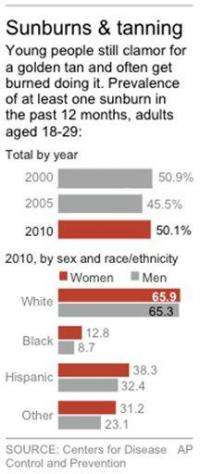
Graphic shows sunburn prevalence for young adults

(AP) -- Roughly half of young adults under 30 say they've had a sunburn in the past year. Not a big deal?

It raises the risk for , including melanoma, a rare but often lethal cancer. Experts say that even one blistering burn can double the risk of developing melanoma.

THINK ARE SAFER?

You'd be wrong. The classifies tanning devices as carcinogens, meaning their use can lead to cancer.

THINK YOU NEED TO BE BRONZE TO LOOK GOOD?

Well, the pale look hasn't been a problem for celebs like Kristen Stewart, Gwyneth Paltrow or Taylor Swift.

WHAT ABOUT PEOPLE WITH DARK SKIN? DO THEY HAVE TO WORRY ABOUT THE SUN?

Melanoma risk for blacks and other dark-skinned people is much lower, but even they can develop it.

WHAT'S THE ADVICE?

To be safe, avoid direct sun between 10 a.m. and 4 p.m. or cover yourself. And when you must be in the sun, use sunscreen often.

©2012 The Associated Press. All rights reserved. This material may not be published, broadcast, rewritten or redistributed.

5 /5 (1 vote)  

Rank 5 /5 (1 vote)
Related Stories
Relevant PhysicsForums posts

More news stories

Obesity weighs down on top soda guzzler Mexico

Artemio Martinez balanced his corpulent frame on a stool in a Mexico City street taco stand, downing a sweet soda and eating a final pork-filled corn tortilla.

Health created 46 minutes ago | popularity not rated yet | comments 0

Consumers largely underestimating calorie content of fast food

People eating at fast food restaurants largely underestimate the calorie content of meals, especially large ones, according to a paper published today in BMJ.

Health created 12 hours ago | popularity not rated yet | comments 0

It's not your imagination: Memory gets muddled at menopause

Don't doubt it when a woman harried by hot flashes says she's having a hard time remembering things. A new study published online in Menopause, the journal of The North American Menopause Society (NAMS), helps confirm with o ...

Health created 13 hours ago | popularity not rated yet | comments 0

Farm bill: Senate rejects GMO labeling amendment

The Senate has overwhelmingly rejected an amendment allowing states to require labeling of genetically modified foods.

Health created 14 hours ago | popularity not rated yet | comments 1

McDonald's can't shake criticism about nutrition

(AP)—McDonald's once again faced criticism that it's a purveyor of junk food that markets to children at its annual shareholder meeting Thursday.

Health created 14 hours ago | popularity not rated yet | comments 0


WHO voices deep concern over spread of SARS-like virus

The World Health Organization voiced deep concern Thursday over the SARS-like virus that has killed 22 people in less than a year, saying it might potentially spread more widely between humans.

Study: No higher cancer rate at Conn. Pratt plant

(AP)—Researchers examining the incidence of brain cancer at jet engine manufacturer Pratt & Whitney in Connecticut say they have found no statistically significant elevations in the rate of cancer among workers.

Controlling mood through the motions of mitochondria

(Medical Xpress)—Regulating the distribution of power in neurons is done by a system that makes the national electric grid look simple by comparison. Each neuron has several thousand mitochondria confined ...

Hormone replacement therapy—clarity at last

The British Menopause Society and Women's Health Concern have today released updated guidelines on Hormone Replacement Therapy (HRT) to provide clarity around the role of HRT, the benefits and the risks. The new guidelines ...

Motion quotient: IQ predicted by ability to filter motion (w/ video)

A brief visual task can predict IQ, according to a new study. This surprisingly simple exercise measures the brain's unconscious ability to filter out visual movement. The study shows that individuals whose ...

Multiple research teams unable to confirm high-profile Alzheimer's study

Teams of highly respected Alzheimer's researchers failed to replicate what appeared to be breakthrough results for the treatment of this brain disease when they were published last year in the journal Science.