Viewing the lungs in 4D
May 2, 2012 in Medical research
(Medical Xpress) -- A new lung imaging method has the potential to revolutionise the study of lungs in both normal and diseased states.
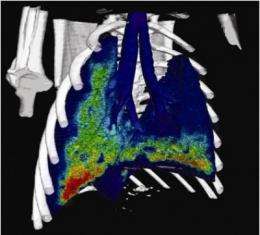
Researchers from Monash University have developed a 4D dynamic functional lung imaging method, which allows them to study breathing lungs in unprecedented detail.
The method, developed by Faculty of Engineering PhD student Stephen Dubsky, provides measurements of motion, expansion and flow at every point within the lung, during the entire breathing cycle.
The technique utilises a synchrotron; essentially a very bright, high quality X-ray, to gather high-speed video of the breathing lung. Further research could allow translation to clinical X-ray imaging hardware, which may provide new a new clinical capability for diagnosis and management of lung disease.
Lead researcher, Dr Andreas Fouras from the Faculty of Engineering said the work, recently published in Journal of the Royal Society Interface, could allow for better understanding into the regional consequences of lung disease.
The lung is a highly dynamic organ, and functional imaging can provide the next step in our understanding of the structure-function relationship within the lungs, Dr Fouras said.
Currently, a clinician treating a patient with a respiratory condition only has the options of spirometry and CT scans available to them. Typically, a CT provides regional information on the structure of the lung, while spirometry provides functional information averaged over the whole lung.
The 4D functional imaging capability we have developed provides the best of both worlds, resulting in a detailed map of lung function.
The technique lends itself to evaluation of respiratory conditions in which there may be alteration in the compliance of lung, chest wall and diaphragmatic function, or airway flow patterns. In particular, it may provide new insights into the regional consequences of restrictive lung disease, chronic obstructive airway diseases, and asthma.
We are working with clinicians, funding bodies and industry partners to provide further impact for this work, Dr Fouras said.
The use of this technology will aid in the development and testing of new drugs and delivery methods, while further development towards clinical application may lead to new pathways for the diagnosis and monitoring of treatments for a variety of lung diseases.
The project is a collaboration between the researchers from the Faculty of Engineering, Professor Stuart Hooper from the Monash Institute of Medical Research and Dr Karen Siu from Monash Biomedical Imaging and the Australian Synchrotron.
The team is the first in Australia, and only the third outside of North America, to win a prestigious and highly competitive American Asthma Foundation Award for their work.
More information: doi: 10.1098/rsif.2012.0116
Journal reference:
Journal of the Royal Society Interface
Provided by
Monash University
-
Researchers light up lungs to help diagnose disease
Apr 28, 2008 |
not rated yet |
0
-
New drug may be the breath of life in intensive care
Jun 07, 2011 |
not rated yet |
0
-
Lung scintigraphy more reliable than CTA in excluding pulmonary embolism in pregnant patients
Oct 20, 2009 |
not rated yet |
0
-
Potential new approach to treatment of chronic lung diseases
Mar 26, 2012 |
not rated yet |
0
-
Early COPD detection could help lung cancer diagnosis
Nov 16, 2011 |
not rated yet |
0
-
Motion perception revisited: High Phi effect challenges established motion perception assumptions
Apr 23, 2013 |
3 / 5 (2) |
2
-
Anything you can do I can do better: Neuromolecular foundations of the superiority illusion (Update)
Apr 02, 2013 |
4.5 / 5 (11) |
5
-
The visual system as economist: Neural resource allocation in visual adaptation
Mar 30, 2013 |
5 / 5 (2) |
9
-
Separate lives: Neuronal and organismal lifespans decoupled
Mar 27, 2013 |
4.9 / 5 (8) |
0
-
Sizing things up: The evolutionary neurobiology of scale invariance
Feb 28, 2013 |
4.8 / 5 (10) |
14
-
Why is zone 1 in liver more prone to ischemic injury?
4 hours ago
-
How can there be villous adenoma in colon, if there are no villi there
May 22, 2013
-
How can there be a term called "intestinal metaplasia" of stomach
May 21, 2013
-
Pressure-volume curve: Elastic Recoil Pressure don't make sense
May 18, 2013
-
If you became brain-dead, would you want them to pull the plug?
May 17, 2013
-
MRI bill question
May 15, 2013
- More from Physics Forums - Medical Sciences
More news stories
Baby's life saved with groundbreaking 3-D printed device that restored his breathing
Every day, their baby stopped breathing, his collapsed bronchus blocking the crucial flow of air to his lungs. April and Bryan Gionfriddo watched helplessly, just praying that somehow the dire predictions ...
Medical research
14 hours ago |
5 / 5 (2) |
0
Research shows how immune system peacefully co-exists with 'good' bacteria
The human gut is loaded with commensal bacteria – "good" microbes that, among other functions, help the body digest food. The gastrointestinal tract contains literally trillions of such cells, and yet the ...
Medical research
18 hours ago |
5 / 5 (3) |
0
|
Slowing the aging process—only with antibiotics
Swiss scientists reveal the mechanism responsible for aging hidden deep within mitochondria—and dramatically slow it down in worms by administering antibiotics to the young.
Medical research
18 hours ago |
4.9 / 5 (10) |
1
|
How healthy are you for your age?
On May 22, JoVE will publish details of a technique to measure the health of human genetic material in relation to a patient's age. The method is demonstrated by the laboratory of Dr. Gil Atzmon at New York's Albert Einste ...
Medical research
22 hours ago |
not rated yet |
0
A molecular explanation for age-related fertility decline in women
(Medical Xpress)—Scientists supported by the National Institutes of Health have a new theory as to why a woman's fertility declines after her mid-30s. They also suggest an approach that might help slow ...
Medical research
23 hours ago |
not rated yet |
0
|
Researchers find possible 'master switch' in deadly brain cancer
(Medical Xpress)—Researchers at the University of Virginia School of Medicine have identified a promising target for treating glioblastoma, one that appears to avoid many of the obstacles that typically frustrate efforts ...
Depression linked to telomere enzyme, aging, chronic disease
(Medical Xpress)—The first symptoms of major depression may be behavioral, but the common mental illness is based in biology—and not limited to the brain.
Vaccine blackjack: IL-21 critical to fight against viral infections
(Medical Xpress)—Scientists at Emory Vaccine Center have shown that an immune regulatory molecule called IL-21 is needed for long-lasting antibody responses in mice against viral infections.
Fast-acting mothers' milk for healthier babies
Human breastmilk responds quickly to protect the child when there is an infection in mothers or babies, according to new international research led by The University of Western Australia.
50 percent of Australians who oppose vaccination get their information from the Internet
To coincide with the broadcast of Jabbed: Love, Fear and Vaccines (SBS ONE, Sunday 26 May at 8.30pm) the first ever national survey on Australian attitudes to vaccination reveals surprising statistics including half of Australians ...
US teen birth rate drops to record low
US teen births have dropped to a record low, but the country still has one of the highest rates among developed nations, the US Centers for Disease Control and Prevention said Thursday.
May 02, 2012
Rank: not rated yet