S. Africa cloned skin recipient to leave hospital
June 26, 2012 by KIM CHAKANETSA in Medical research
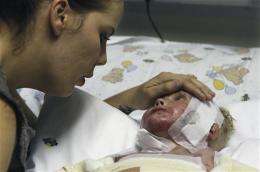
Burn survivor, Isabella "Pippie" Kruger is comforted by her mother Anice, as she recovers from surgery after undergoing a skin transplant operation two weeks ago in Johannesburg, Tuesday June 26, 2012. Kruger became the recipient of pioneering surgery when her burnt skin was layered with cloned skin grown from her own cells in a US laboratory. It was the first operation of it's kind in South Africa. Kruger suffered 3rd degree burns to 80 per cent of her body on New Year's eve when a gel firelighter exploded while her father was preparing a barbecue. (AP Photo/Denis Farrell)
(AP) Bedtime for 3-year-old Isabella Kruger now includes a bottle and a massage. This ritual has become possible again as the toddler recovers from surgery that transplanted cloned skin onto her body after 80 percent of it suffered burns in a backyard accident.
On Tuesday, Isabella, better known as Pippie, was fed her bottle by her mother Anice Kruger. Pippie is now fully awake and no longer reliant on feeding tubes after being kept under complete sedation for more than a week to ensure she kept still and did not tear her fragile new skin.
Doctors allowed an Associated Press team into Pippie's room in a Johannesburg hospital on Tuesday, another sign that the toddler is getting better.
"She is doing really, really well," her mother said.
Earlier this month, Pippie received 30 to 40 grafts of skin which had been cloned in a laboratory in Boston using a sample of her own skin and mouse cells as a scaffold.
Since the operation, Pippie has started to eat baby and mashed food and even some chicken.
The surgeon who attached her skin, Dr. Ridwan Mia, says it is crucial that she is well-nourished in the weeks to come.
"Her body is building muscle, recovering, healing wounds, healing the grafts. We want her to be nice and strong," Mia said.
For her mother, Pippie's recovery is nothing short of a miracle.
She remembers with clarity the moments after a bottle of fire-accelerating gel exploded during a family barbecue, leaving her little girl with severe burns.
"It literally looked like she was boiling. Her skin was just falling off," Kruger said.
Burn victims rarely survive such severe injuries. But Pippie was a fighter.
In the months that followed, Pippie survived multiple cardiac arrests and organ failure before undergoing the skin transplant.
Mia, the surgeon, said that the skin on her legs, head and arms has taken "quite well" while the skin on her chest remains "very fragile".
He said the child is likely to be discharged "towards the end of next week." Still, after that, Pippie will have to undergo daily physiotherapy.
"There is a lot of loss of muscle bulk and strength, which is something she has to work on. It is almost like a baby that needs to gain tone and muscle," Mia said.
Another aspect of her rehabilitation will be psychological counseling.
Pippie's mother is aware that recovery will take a long time, but she is optimistic.
"The thing I'm looking forward most is just to feel her arms around my neck again. Just to get a hug," she said.
Copyright 2012 The Associated Press. All rights reserved. This material may not be published, broadcast, rewritten or redistributed.
-
South Africa burn survivor gets cloned skin grafts
Jun 12, 2012 |
not rated yet |
0
-
Australia hopes for living skin for burns victims
Apr 04, 2010 |
not rated yet |
0
-
Study uses bone marrow stem cells to regenerate skin
Jan 14, 2009 |
not rated yet |
0
-
Biomarker MIA shows presence of neurofibromas
Jul 04, 2011 |
not rated yet |
0
-
Printed cells to treat burn victims
Apr 12, 2010 |
not rated yet |
0
-
Motion perception revisited: High Phi effect challenges established motion perception assumptions
Apr 23, 2013 |
3 / 5 (2) |
2
-
Anything you can do I can do better: Neuromolecular foundations of the superiority illusion (Update)
Apr 02, 2013 |
4.5 / 5 (11) |
5
-
The visual system as economist: Neural resource allocation in visual adaptation
Mar 30, 2013 |
5 / 5 (2) |
9
-
Separate lives: Neuronal and organismal lifespans decoupled
Mar 27, 2013 |
4.9 / 5 (8) |
0
-
Sizing things up: The evolutionary neurobiology of scale invariance
Feb 28, 2013 |
4.8 / 5 (10) |
14
-
Pressure-volume curve: Elastic Recoil Pressure don't make sense
May 18, 2013
-
If you became brain-dead, would you want them to pull the plug?
May 17, 2013
-
MRI bill question
May 15, 2013
-
Ratio of Hydrogen of Oxygen in Dessicated Animal Protein
May 13, 2013
-
Alcohol and acetaminophen
May 13, 2013
-
Marie Curie's leukemia
May 13, 2013
- More from Physics Forums - Medical Sciences
More news stories
Do salamanders hold the solution to regeneration?
Salamanders' immune systems are key to their remarkable ability to regrow limbs, and could also underpin their ability to regenerate spinal cords, brain tissue and even parts of their hearts, scientists have ...
Medical research
39 minutes ago |
not rated yet |
0
|
New study finds blind people have the potential to use their 'inner bat' to locate objects
New research from the University of Southampton has shown that blind and visually impaired people have the potential to use echolocation, similar to that used by bats and dolphins, to determine the location of an object.
Medical research
3 hours ago |
not rated yet |
1
|
Germ-fighting vaccine system makes great strides in delivery
A novel vaccine study from South Dakota State University (SDSU) will headline the groundbreaking research that will be unveiled at the American Association of Pharmaceutical Scientists' (AAPS) National Biotechnology Conference ...
Medical research
3 hours ago |
not rated yet |
0
Discovery of novel medicine for treatment of chronic wounds
Every 20 seconds, a limb is lost as a consequence of diabetic foot ulcer that does not heal. To date, medical solutions that can change this situation are very limited. In his doctoral thesis Yue Shen from the Industrial ...
Medical research
8 hours ago |
5 / 5 (1) |
0
Lymphatic fluid takes detour
When tumours metastasise, they can block lymphatic vessels, as researchers from ETH Zurich have discovered using a new method. The lymphatic fluid subsequently has to find a new path through the tissue. Such ...
Medical research
8 hours ago |
not rated yet |
0
|
Scientists identify molecular trigger for Alzheimer's disease
Researchers have pinpointed a catalytic trigger for the onset of Alzheimer's disease – when the fundamental structure of a protein molecule changes to cause a chain reaction that leads to the death of neurons ...
Study shows premature birth interrupts vital brain development processes leading to reduced cognitive abilities
Researchers from King's College London have for the first time used a novel form of MRI to identify crucial developmental processes in the brain that are vulnerable to the effects of premature birth. This new study, published ...
Leading explanations for whooping cough's resurgence don't stand up to scrutiny
Whooping cough has exploded in the United States and some other developed countries in recent decades, and many experts suspect ineffective childhood vaccines for the alarming resurgence.
72 percent of pregnant women experience constipation and other bowel problems
Nearly three out of four pregnant women experience constipation, diarrhea or other bowel disorders during their pregnancies, a Loyola University Medical Center study has found.
Neurons that can multitask greatly enhance the brain's computational power, study finds
Over the past few decades, neuroscientists have made much progress in mapping the brain by deciphering the functions of individual neurons that perform very specific tasks, such as recognizing the location ...
Music therapy reduces anxiety, use of sedatives for patients receiving ventilator support
New research suggests that for some hospitalized ICU patients on mechanical ventilators, using headphones to listen to their favorite types of music could lower anxiety and reduce their need for sedative medications.