Early surgery ups outcomes in infective endocarditis
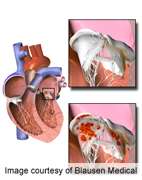
For patients with infective endocarditis and large vegetations, early surgery reduces death from any cause and embolic events, compared with conventional treatment, according to a study published in the June 28 issue of the New England Journal of Medicine.
(HealthDay) -- For patients with infective endocarditis and large vegetations, early surgery reduces death from any cause and embolic events, compared with conventional treatment, according to a study published in the June 28 issue of the New England Journal of Medicine.
Duk-Hyun Kang, M.D., Ph.D., from the University of Ulsan in Seoul, South Korea, and colleagues compared the clinical outcomes for patients with left-sided infective endocarditis, severe valve disease, and large vegetations, randomly assigned to early surgery (37 participants) or conventional treatment (39 participants).
The researchers found that all patients in the early-surgery group underwent valve surgery within 48 hours of randomization, whereas in the conventional-treatment group, 27 patients had surgery during initial hospitalization and three during follow-up. One patient in the early-surgery group experienced the primary end point (in-hospital death or embolic events within six weeks of randomization), compared to nine (23 percent) in the conventional-treatment group (hazard ratio, 0.10). At six months of follow-up there was no significant difference in all-cause mortality between the groups. At six months, the rate of a composite end point of death from any cause, embolic events, or recurrence of infective endocarditis occurred in 3 and 28 percent of the early-surgery and conventional-treatment groups, respectively (hazard ratio, 0.08).
"As compared with conventional treatment, early surgery in patients with infective endocarditis and large vegetations significantly reduced the composite end point of death from any cause and embolic events by effectively decreasing the risk of systemic embolism," the authors write.
More information: Full Text (subscription or payment may be required)
Editorial (subscription or payment may be required)
Journal reference:
New England Journal of Medicine
Copyright © 2012 HealthDay. All rights reserved.
-
Surgery improves endocarditis-induced heart failure survival rates
Nov 22, 2011 |
not rated yet |
0
-
Pre-op chemoradiotherapy ups survival in esophageal cancer
May 31, 2012 |
not rated yet |
0
-
Dental plaque bacteria may trigger blood clots
Mar 26, 2012 |
not rated yet |
0
-
Surgery for severe obesity saves lives
Aug 23, 2007 |
not rated yet |
0
-
Heart infection involving ICD associated with high rate of complications, risk of death
Apr 24, 2012 |
not rated yet |
0
-
Motion perception revisited: High Phi effect challenges established motion perception assumptions
Apr 23, 2013 |
3 / 5 (2) |
2
-
Anything you can do I can do better: Neuromolecular foundations of the superiority illusion (Update)
Apr 02, 2013 |
4.5 / 5 (11) |
5
-
The visual system as economist: Neural resource allocation in visual adaptation
Mar 30, 2013 |
5 / 5 (2) |
9
-
Separate lives: Neuronal and organismal lifespans decoupled
Mar 27, 2013 |
4.9 / 5 (8) |
0
-
Sizing things up: The evolutionary neurobiology of scale invariance
Feb 28, 2013 |
4.8 / 5 (10) |
14
-
Relating physics forces and entropy
5 hours ago
-
Force Between Two Concentric Solenoids
8 hours ago
-
Synchrotron, question about insertion devices and electron velocity
9 hours ago
-
Equating differentials => equating coefficients
10 hours ago
-
The idea behind a reverse shock
16 hours ago
-
Guass's Law for a charge distribution
16 hours ago
- More from Physics Forums - Classical Physics
More news stories
Researchers rewrite obsolete blood-ordering rules
Johns Hopkins researchers have developed new guidelines—the first in more than 35 years—to govern the amount of blood ordered for surgical patients. The recommendations, based on a lengthy study of blood use at The Johns ...
Surgery
May 22, 2013 |
4 / 5 (1) |
0
Indian medics reconstruct baby's swollen head
Indian doctors said Wednesday they have successfully carried out a first round of reconstructive surgery on the skull of a baby suffering from a rare disorder that caused her head to nearly double in size.
Surgery
May 22, 2013 |
not rated yet |
0
Polish man gets quick face transplant after injury (Update)
A 33-year-old Polish man received a face transplant just three weeks after being disfigured in a workplace accident, in what his doctors said Wednesday is the fastest time frame to date for such an operation. ...
Surgery
May 22, 2013 |
not rated yet |
0
Sexual function in older adults with thoracolumbar-pelvic instrumentation
Surgeons investigated sexual function in 62 patients, 50 years and older, who had received extensive spinal–pelvic instrumentation for spinal deformity at the University of Virginia Health Center. Based on their results, ...
Surgery
May 21, 2013 |
not rated yet |
0
Challenges encountered in surgical management of spine trauma in morbidly obese patients
Physicians at Monash University and The Alfred Hospital in Melbourne, Australia describe the logistic, medical, and societal challenges faced in treating spine trauma in morbidly obese patients. Based on a case series of ...
Surgery
May 21, 2013 |
not rated yet |
0
First drug to improve heart failure mortality in over a decade
Coenzyme Q10 decreases all cause mortality by half, according to the results of a multicentre randomised double blind trial presented today at Heart Failure 2013 congress. It is the first drug to improve heart failure mortality ...
Heart failure accelerates male 'menopause'
Heart failure accelerates the aging process and brings on early andropausal syndrome (AS), according to research presented today at the Heart Failure Congress 2013. AS, also referred to as male 'menopause', was four times ...
Seniors more likely to crash when driving with pet, study finds
(HealthDay)—Animals make great companions for senior citizens, but elderly people who always drive with a pet in the car are far more likely to crash than those who never drive with a pet, researchers have ...
New immune system discovered
(Medical Xpress)—A research team, led by Jeremy Barr, a biology post-doctoral fellow, unveils a new immune system that protects humans and animals from infection.
Brain can be trained in compassion, study shows
Until now, little was scientifically known about the human potential to cultivate compassion—the emotional state of caring for people who are suffering in a way that motivates altruistic behavior.
Do salamanders hold the solution to regeneration?
Salamanders' immune systems are key to their remarkable ability to regrow limbs, and could also underpin their ability to regenerate spinal cords, brain tissue and even parts of their hearts, scientists have ...