Freezer damages brain samples used to study autism
June 11, 2012 by STEVE LeBLANC in Autism spectrum disorders

Freezer damages brain samples used to study autism

Enlarge

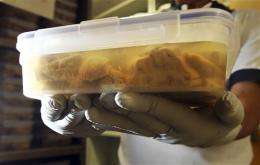
In this Friday, June 8, 2012 photo, George Tejada, assistant director for tissue processing, holds a container with brain slices at the Harvard Brain Tissue Resource Center at McLean Hospital in Belmont, Mass. An official at the hospital said a freezer malfunction discovered in late May damaged other brain samples, including one-third of the world's largest collection of autism brain samples. (AP Photo/The Boston Globe/ Essdras M Suarez)

(AP) — A freezer malfunctioned at a Harvard-affiliated hospital that oversees the world's largest collection of autistic brain samples, damaging a third of the scientifically precious specimens and casting doubt on whether they can be used in research.

The director of the Harvard Brain Tissue Resource Center said the loss was "devastating," particularly in light of the increasing demand for brain samples among scientists searching for the cause of autism and potential treatments.

"Over the last 10 years, the autism tissue program has been working very hard to get the autism community to understand the importance of brain donation," Dr. Francine Benes said. Now many of those samples have been compromised.

The freezer failed sometime late last month at the center, which is housed at McLean Hospital in the Boston suburb of Belmont. At least 54 samples earmarked for autism research were harmed. Many of them turned dark with decay.

However, an initial review indicates that the DNA in the samples is intact and can still be used for genetic research. It's unclear, however, whether the samples could be used for the full range of neuroscience needs.

An important chemical cousin of DNA called RNA was destroyed, she said.

Thirty-two of the brains had been cut in half, with one side placed in a formaldehyde solution and the other placed in the freezer. The samples in the solution remain available for all research projects, the hospital said.

Center officials say they've already completed an inspection of the equipment to ensure the safety of the collection.

Dr. Fred Volkmar, an autism researcher and director of the Child Study Center at Yale University, said the damage is even more disheartening given recent advances in autism research.

Some of that research, including autism studies involving stem cells, wasn't even possible at the time when some of the brains were donated.

"We can't always know where the science is going to take us," Volkmar said. "In that respect, it's a horrible loss. The hope is that at least it's not a total disaster."

The hospital launched an investigation to determine why the freezer malfunctioned and why two alarm systems failed to go off as the temperature rose.

Benes said her biggest fear is that the loss of samples could make it harder in the future to encourage brain donation from autistic children and young adults.

"There has been a lot of resistance of brain donations for religious and cultural reasons," she said.

The collection is owned by the advocacy and research organization Autism Speaks.

The Harvard Brain Tissue Resource Center is the largest and oldest federally funded "brain bank" in the United States. It provides thousands of postmortem brain tissue samples annually to researchers across the nation.

Copyright 2012 The Associated Press. All rights reserved. This material may not be published, broadcast, rewritten or redistributed.

not rated yet  

Rank not rated yet
Relevant PhysicsForums posts

More news stories

Researcher helps give children with autism the chance to communicate

Research by Victoria University PhD education graduand Larah van der Meer highlights the importance of understanding the communication preferences of children with developmental disabilities such as autism.

Autism spectrum disorders created May 14, 2013 | popularity 3.3 / 5 (3) | comments 1

Developers dive in to create a wealth of autism apps

At times, Andy Shih still finds himself overwhelmed by the groundswell of interest in autism applications he's seen in the three years since Apple Inc. released the first iPad.

Autism spectrum disorders created May 09, 2013 | popularity 2 / 5 (1) | comments 0

Enhanced motion perception in autism may point to an underlying cause of the disorder

Children with autism see simple movement twice as quickly as other children their age, and this hypersensitivity to motion may provide clues to a fundamental cause of the developmental disorder, according ...

Autism spectrum disorders created May 08, 2013 | popularity not rated yet | comments 0 | with audio podcast

Autism scientists seek more brains to aid research

(AP)—Autism scientists are seeking more brain samples for research.

Autism spectrum disorders created May 02, 2013 | popularity 5 / 5 (1) | comments 0

Drug shows some benefit for kids with autism

(HealthDay)—An experimental drug for autism did not improve levels of lethargy and social withdrawal in children who took it, but it did show some other benefits, a new study finds.

Autism spectrum disorders created May 02, 2013 | popularity 4 / 5 (1) | comments 0


New theory on genesis of osteoarthritis comes with successful therapy in mice

Scientists at Johns Hopkins have turned their view of osteoarthritis (OA) inside out. Literally. Instead of seeing the painful degenerative disease as a problem primarily of the cartilage that cushions joints, ...

Computational tool translates complex data into simplified 2-dimensional images

In their quest to learn more about the variability of cells between and within tissues, biomedical scientists have devised tools capable of simultaneously measuring dozens of characteristics of individual ...

Researchers identify a potential new risk for sleep apnea: Asthma

Researchers at the University of Wisconsin have identified a potential new risk factor for obstructive sleep apnea: asthma. Using data from the National Institutes of Health (Heart, Lung, and Blood Institute)-funded Wisconsin ...

Study finds that sleep apnea and Alzheimer's are linked

A new study looking at sleep-disordered breathing (SDB) and markers for Alzheimer's disease (AD) risk in cerebrospinal fluid (CSF) and neuroimaging adds to the growing body of research linking the two.

'Gap' for HIV vaccine efforts after latest setback

The hunt for an HIV vaccine has gobbled up $8 billion in the past decade, and the failure of the most recent efficacy trial has delivered yet another setback to 26 years of efforts.

Ginger compounds may be effective in treating asthma symptoms

Gourmands and foodies everywhere have long recognized ginger as a great way to add a little peppery zing to both sweet and savory dishes; now, a study from researchers at Columbia University shows purified components of the ...