Immune system molecule HD6 weaves cobweb-like nanonets to snag Salmonella, other intestinal microbes
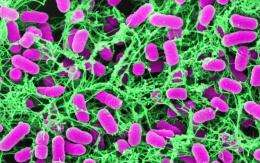
A team of researchers led by UC Davis Health System has found that human alpha-defensin 6 (HD6) – a key component of the body's innate defense system – binds to microbial surfaces and forms "nanonets" that surround, entangle and disable microbes, preventing bacteria from attaching to or invading intestinal cells.
The research describes an entirely new mechanism of action for defensins, an important group of molecules known to bolster the defenses of circulating white blood cells, protect cellular borders from invasive pathogens and regulate which "friendly" microbes can colonize body surfaces. The discovery provides important clues to inflammatory bowel diseases, especially Crohn's disease, which may be caused, in part, by deficiencies in HD6 levels or function.
A paper describing the work appears in the June 22 issue of the journal Science.
"During the past 25 years, researchers have learned a lot about the biological function of defensins, but the role of HD6, a particular molecule that is highly expressed in the intestines, was a mystery," said Charles L. Bevins, professor of microbiology and immunology at UC Davis. "We now know that HD6 has a very unique role in the body's innate immune system. Its ability to latch onto microbial surfaces and self-assemble to cast a fibrous net around bacteria, including pathogens like Salmonella and Yersinia, as well as fungi and protozoan parasites, gives the intestine, a critical part of the body, a powerful and broad spectrum of defense against potential threats."
Bevins is co-senior author of the paper along with his UC Davis colleague Professor Andreas Bäumler, an expert in bacterial pathogenesis; UCLA Emeritus Professor Robert I. Lehrer, whose laboratory was the first to discover defensins in the early 1980s; and Professor Wuyuan Lu, a synthetic protein chemist from the University of Maryland School of Medicine whose work provided clues to HD6's subtle and unique properties. First author Hiutung Chu, a graduate student in the Bevins lab who is now a fellow at the California Institute of Technology, was a driving force on the nine-year quest to solve the HD6 puzzle.
About the protein HD6
Defensins are a family of structurally related, small peptides with antibiotic activity found throughout nature in plants and animals. Humans make six different alpha-defensins. Two of these, HD5 and HD6, are secreted by Paneth cells, specialized secretory cells located within the folds of the small intestinal lining. HD5 has well-known antibacterial properties while the function of HD6 had been unknown. The defensin-rich secretions of Paneth cells work in conjunction with nearby intestinal stem cells to maintain micro flora balance and renew intestinal cellular surfaces.
Chu's graduate work focused on characterizing the biological activity of HD6 in studies using cultured intestinal epithelial cells and transgenic mouse models. Although Chu and Bevins anticipated HD6 activity would be very similar to other alpha-defensins, which kill pathogens by poking holes in the microbial membrane, their early research studies repeatedly showed that HD6 did not kill bacteria. Puzzled, they then looked for other possible functions, collaborating with UC Davis professors Angela Gelli and Scott Dawson to see if HD6 might kill only certain bacteria, fungi or parasites. It did not.
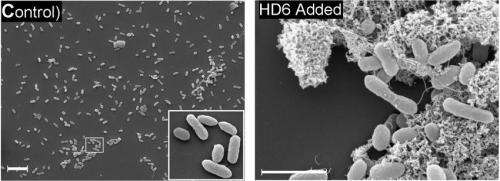
After two years into the project and feeling frustrated about the negative results, Bevins and Chu carefully reviewed the experimental data. That's when they recognized two crucial pieces of information. The first was that whenever HD6 was added to suspensions of either bacteria or fungi, a white haze, or precipitate, formed in the solution (see image below). The second was that early studies conducted in collaboration with Bäumler had shown that while HD6 did not kill the bacterial pathogen Salmonella, it protected transgenic mice from an otherwise lethal infection.
"When we put these two results together, we were able to systematically show that HD6 was inhibiting microbial invasion and uncover HD6's unique structure and function at multiple levels," said Bevins.
On the road to discovery
The UC Davis team then collaborated with Lehrer, whose research focuses on the study of defensins and other antimicrobial peptides that serve as natural antibiotics. In his laboratory, he had a surface plasmon resonance instrument that measured molecular binding in real time. This technique captured the progressive assembly of HD6 molecules, from binding to bacterial proteins at the microbial cell surface to the self-assembly to form fibrils and the sequential addition of fibrils (see images below).
Through the expertise of Lu, a synthetic protein chemist and expert in defensin structure and function relationships, the team obtained sufficient quantities of the highest-grade HD6 peptide and subtle molecular variants of HD6 to test their hypotheses experimentally. Lu was able to identify critical structural components of HD6 that enabled it to self-assemble into fibrils. One feature unique to HD6 is the manner in which four HD6 molecules combine to form a building block whose further assembly creates both fibers and nets. The researchers also found that changing just one of the 32 amino-acid residues of the HD6 molecule -- histidine-27 -- impaired HD6's ability to form a tetramer in the x-ray crystal structure. As a result, HD6 lost the special binding that Lehrer found in his real-time experiments, blocked the ability of HD6 to form nanonets and abrogated its ability to inhibit bacterial invasion.
The Bäumler laboratory created vital bacterial mutants affecting the molecules that HD6 initially binds to on the surface of the microbe. When those molecules were knocked out in the transgenic mouse model, HD6 did not form the fibrils on the bacterial surface.
"This series of experiments provided the vital 'glue' to bind the many facets of the story together, and to convince ourselves and our peers that we had finally solved the mechanism of HD6 action," commented Bevins.
Clues to innate immunity and inflammatory bowel diseases
The UC Davis research describes how HD6 contributes to the body's innate immunity, which protects from microbes that the immune system might not have any experience in managing.
"The innate immune system has to be able to deal with diverse microbes that might have all kinds of tricks that cause infection," said Bevins. "After we've been exposed to a microbe or an infection the first time and survive it, the adaptive immune system can recognize and remember specific pathogens to generate immunity and to mount stronger defenses each time the pathogen is encountered. HD6 is a major player in helping the body prevent potentially dangerous pathogens from coming into close physical contact with intestinal epithelial cells of the intestine, as well as the stem cells that continuously renew the epithelial cell surface."
Previously published studies from the Bevins lab have linked alpha-defensins and Crohn's disease, a chronic inflammatory bowel disease that investigators associated with HD5 and HD6 deficiencies. The secretions of these defensins typically occur at the base of the out pouches (so-called crypts) of the small intestinal surface, where they are ready to fend off bacteria that become dangerously close to the intestinal lining. Individuals with Crohn's disease, however, tend to accumulate invasive bacteria in this same area, developing a chronic inflammation that is self-perpetuating.
"With less of these important defense molecules, microbes that would normally exist in the gut, can irritate the intestinal surface and cause the chronic inflammation that characterizes Crohn's disease," said Bevins. "We know a lot about HD5's antimicrobial activities, so it makes sense why reduced HD5 levels might contribute or allow this condition to progress. Now we have a clue how HD6 levels play a role."
Future studies on Crohn's disease by this team aim to better understand exactly why alpha–defensin-expression is reduced in individuals with Crohn's disease, and perhaps devise strategies to boost the body's production of these vital molecules.
"The multidisciplinary approach that we used to 'crack' the obscure and complex action of HD6 exemplifies the power of team science," Bevins said. "Not to be underestimated, however, is the courage and tenaciousness of graduate student Hiutung Chu in leading the experimental investigations. Many blind alleys were visited as we investigated this molecule, and those frustrating diversions can erode confidence and morale. Hiutung deserves tremendous credit for persevering through those setbacks."
More information: "Human α-defensin 6 Promotes Mucosal Innate Immunity Through Self-Assembled Peptide Nanonets," by H. Chu; S.-P. Nuccio, et al., Science Express, 2012.


