Scientists lead rat race for better PET scan
June 19, 2012 in Medical research

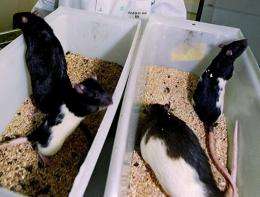
Scientists in Australia have devised a method of scanning lab rats' brains as they scurry about freely

Enlarge

Scientists in Australia have devised a method of scanning lab rats' brains as they scurry about freely, eliminating the need for anaesthesia or forced restraint, a report said Wednesday.

Scientists in Australia have devised a method of scanning lab rats' brains as they scurry about freely, eliminating the need for anaesthesia or forced restraint, a report said Wednesday.

Lab rats currently have to be anaesthetised for most PET (positron emission tomography) scans, as any movement would distort the three-dimensional images used to study the functioning of organs.

But the drugs can change and prevent scientists from measuring what would have been the animals' normal behaviour.

Forcible restraint without anaesthesia, in turn, stresses the animals and may alter the scientists are seeking to measure.

The study of rodent brains has been an important tool in neuroscience development and drug development.

"Many powerful experiments to study brain function and correlate it with animal behaviour would become possible if animals could be imaged whilst awake and unrestrained," study team member Andre Kyme told AFP.

To this end, the team has devised a non-invasive, "harmless and painless" method of tracking the motion of a rat's head and correcting for the movement, according to a report in the Journal of the Royal Society Interface.

All the data collected is adjusted on the basis of the motion measured, so that useful 3D images can be reconstructed, explained Kyme of the University of Sydney School of Physics.

"The present study provides further evidence that rats which are awake and unrestrained, especially those able to behave normally, can have their motion tracked relatively simply and inexpensively," he said.

"The conclusion is that compensating for the motion of awake rats, even those which are free to move and behave normally, is eminently feasible."

Routine of awake, freely-moving rats "could become a reality in the next few years", said Kyme.

Journal reference: Journal of the Royal Society Interface search and more info website

(c) 2012 AFP

not rated yet  

Rank not rated yet
Related Stories
Relevant PhysicsForums posts

More news stories

Study reveals new mechanism for estrogen suppression of liver lipid synthesis

By discovering the new mechanism by which estrogen suppresses lipid synthesis in the liver, UC Irvine endocrinologists have revealed a potential new approach toward treating certain liver diseases.

Medical research created May 23, 2013 | popularity 5 / 5 (1) | comments 0 | with audio podcast

MRI-based measurement helps predict vascular disease in the brain

Aortic arch pulse wave velocity, a measure of arterial stiffness, is a strong independent predictor of disease of the vessels that supply blood to the brain, according to a new study published in the June issue the journal ...

Medical research created May 23, 2013 | popularity not rated yet | comments 0

Antibiotics: A new understanding of sulfonamide nervous system side effects

Since the discovery of Prontosil in 1932, sulfonamide antibiotics have been used to combat a wide spectrum of bacterial infections, from acne to chlamydia and pneumonia. However, their side effects can include serious neurological ...

Medical research created May 23, 2013 | popularity 3 / 5 (1) | comments 0 | with audio podcast

Scientists discover molecule triggers sensation of itch

Scientists at the National Institutes of Health report they have discovered in mouse studies that a small molecule released in the spinal cord triggers a process that is later experienced in the brain as ...

Medical research created May 23, 2013 | popularity 5 / 5 (3) | comments 0 | with audio podcast

Discarded immune cells induce the relocation of stem cells

Spanish researchers have discovered that the daily clearance of neutrophils from the body stimulates the release of hematopoietic stem cells from the bone marrow into the bloodstream, according to a report published today ...

Medical research created May 23, 2013 | popularity 5 / 5 (2) | comments 0


First drug to improve heart failure mortality in over a decade

Coenzyme Q10 decreases all cause mortality by half, according to the results of a multicentre randomised double blind trial presented today at Heart Failure 2013 congress. It is the first drug to improve heart failure mortality ...

Heart failure accelerates male 'menopause'

Heart failure accelerates the aging process and brings on early andropausal syndrome (AS), according to research presented today at the Heart Failure Congress 2013. AS, also referred to as male 'menopause', was four times ...

Death highest in heart failure patients admitted in January, on Friday, and overnight

Mortality and length of stay are highest in heart failure patients admitted in January, on Friday, and overnight, according to research presented today at the Heart Failure Congress 2013. The analysis of nearly 1 million ...

Feds fight morning-after pill age ruling in NY

(AP)—Department of Justice lawyers have again asked a federal appeals court in New York to delay lifting age restrictions and prescription requirements on an emergency contraceptive popularly known as the morning-after ...

Researchers identify first drug targets in childhood genetic tumor disorder

Two mutations central to the development of infantile myofibromatosis (IM)—a disorder characterized by multiple tumors involving the skin, bone, and soft tissue—may provide new therapeutic targets, according to researchers ...

Driving and hands-free talking lead to spike in errors, study shows

Talking on a hands-free device while behind the wheel can lead to a sharp increase in errors that could imperil other drivers on the road, according to new research from the University of Alberta.