Adults with learning disabilities at greater risk of sight problems
July 2, 2012 in Ophthalmology

Adults with learning disabilities at greater risk of sight problems

Enlarge

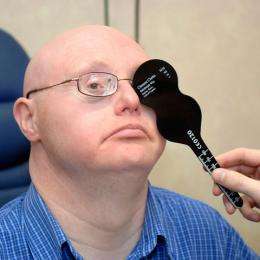
Adults with learning disabilities are ten times more likely to be blind or have impaired vision according to researchers from Lancaster University.

Professor Eric Emerson and Dr Janet Robertson of the Centre for Disability Research at Lancaster University have carried out the first ever overall estimate of the numbers of people with learning disabilities and sight difficulties in the UK on behalf of the RNIB and the SeeAbility.

They found that there are over a million adults in the UK with and six out of ten of these need glasses.

They also found that:

An estimated 96,500 adults with learning disabilities are blind or partially sighted. This means that nearly one in 10 adults with learning disabilities is blind or partially sighted.

An estimated 23,000 children and young people with learning disabilities in the UK are blind or partially sighted.

An estimated 579,000 with learning disabilities have refractive errors including long and short-sightedness.

The report added that people with severe or profound learning disabilities are most likely to have sight problems.

The authors commented that: “People with learning disabilities may not know they have a sight problem and may not be able to tell people. Many people think the person with a they know can see perfectly well. People with learning disabilities need to have a sight test every two years, sometimes more often. Regular sight tests and wearing glasses helps people stay healthy and get the most from life. “

The Centre for Disability Research is run jointly by the Faculty of Arts and Social Sciences and the Faculty of Health and Medicine.

Provided by Lancaster University search and more info website

not rated yet  

Rank not rated yet
Relevant PhysicsForums posts

More news stories

New study pinpoints biochemical mechanism underlying fibrosis following glaucoma surgery

The most common cause of failure after glaucoma surgery is scarring at the surgical site, so researchers are actively looking for ways to minimize or prevent scar formation. Previous work had suggested that vascular endothelial ...

Ophthalmology created May 17, 2013 | popularity not rated yet | comments 0 | with audio podcast

Early screenings key to diagnosing glaucoma

New research is emphasizing the importance of regular screenings for glaucoma, a disease that deteriorates the optic nerve over time and is a leading cause of irreversible blindness worldwide. The onset of glaucoma is associated ...

Ophthalmology created May 17, 2013 | popularity not rated yet | comments 0 | with audio podcast

University partners with Sony to find cure for 'lazy eye'

The University of Nottingham and Nottingham University Hospitals NHS Trust, have been working with Sony Computer Entertainment Europe (SCEE) to develop special 3-D glasses and games to help treat children ...

Ophthalmology created May 08, 2013 | popularity not rated yet | comments 0

First corneal transplant with pre-loaded donor tissue performed at Mass. Eye and Ear

The first successful cornea transplant with donor endothelial tissue preloaded by an eye bank has been performed at Massachusetts Eye and Ear in Boston, Mass. Roberto Pineda II, M.D., Director of the Refractive Surgery Service ...

Ophthalmology created May 07, 2013 | popularity 5 / 5 (1) | comments 0

Study provides clarity on supplements for protection against blinding eye disease

Adding omega-3 fatty acids did not improve a combination of nutritional supplements commonly recommended for treating age-related macular degeneration (AMD), a major cause of vision loss among older Americans, ...

Ophthalmology created May 06, 2013 | popularity 3 / 5 (2) | comments 0 | with audio podcast


Researchers identify a potential new risk for sleep apnea: Asthma

Researchers at the University of Wisconsin have identified a potential new risk factor for obstructive sleep apnea: asthma. Using data from the National Institutes of Health (Heart, Lung, and Blood Institute)-funded Wisconsin ...

Study finds that sleep apnea and Alzheimer's are linked

A new study looking at sleep-disordered breathing (SDB) and markers for Alzheimer's disease (AD) risk in cerebrospinal fluid (CSF) and neuroimaging adds to the growing body of research linking the two.

Computational tool translates complex data into simplified 2-dimensional images

In their quest to learn more about the variability of cells between and within tissues, biomedical scientists have devised tools capable of simultaneously measuring dozens of characteristics of individual ...

New theory on genesis of osteoarthritis comes with successful therapy in mice

Scientists at Johns Hopkins have turned their view of osteoarthritis (OA) inside out. Literally. Instead of seeing the painful degenerative disease as a problem primarily of the cartilage that cushions joints, ...

Ginger compounds may be effective in treating asthma symptoms

Gourmands and foodies everywhere have long recognized ginger as a great way to add a little peppery zing to both sweet and savory dishes; now, a study from researchers at Columbia University shows purified components of the ...

'Gap' for HIV vaccine efforts after latest setback

The hunt for an HIV vaccine has gobbled up $8 billion in the past decade, and the failure of the most recent efficacy trial has delivered yet another setback to 26 years of efforts.