Basal cell carcinoma risk can be chronic
July 25, 2012 in Cancer

Basal cell carcinoma risk can be chronic

Enlarge

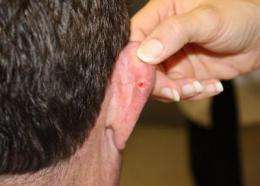
A six-year study of patients with a history of basal cell carcinoma suggests that who have had multiple instances will continue to have new instances. There is neither preventive medication nor a cure. Treatment involves removal. Credit: Kelly Nelson/National Cancer Institute

In the powerful sunlight of July, newly published results from a large study of people at high risk for basal cell carcinoma support the emerging view of the nation's most common cancer as a chronic ailment that often repeatedly afflicts older people but for which the seeds may be planted in youth. The research also found a new association with eczema.

" is a chronic disease once people have had multiple instances of it, because they are always at risk of getting more," said Dr. Martin Weinstock, professor of dermatology in the Warren Alpert Medical School of Brown University, who practices at the Providence Veterans Affairs Medical Center. "It's not something at the moment we can cure. It's something that we need to monitor continually so that when these cancers crop up we can minimize the damage."

Dermatologists hold out hope for a medication that will help prevent recurrences of BCC. To test one such medicine, Weinstock chaired the six-site, six-year VA Topical Tretinoin Chemoprevential Trial, which last year found that the skin medication failed to prevent further instances of BCC in high-.

Weinstock is the corresponding author of the new study, published online July 19 in the , which presents an analysis of the risk predictors of BCC recurrence found among the trial's population of 1,131 people, all of whom were veterans, 97 percent of whom were men, and whose median age was 72. On average, a participant had more than three episodes of BCC or before entering the study.

History, eczema, and early exposure

Overall, 44 percent of developed new BCCs during the study period. The biggest predictor of another bout with BCC after three to four years of follow-up was a prior history of them. The 129 participants who had more than five BCCs in the five years before the study had a hazard rate ratio that was nearly four times as high as that of the 204 people who had none or one and more than twice as high that of the 200 people who had three.

Eczema was another predictor of BCC recurrence in the study's high-risk group. Participants who acknowledged a family history of the skin condition had a hazard rate ratio 1.54 times higher than people who did not, after statistical adjustments.

"We don't know why this is," Weinstock said. "The connection with eczema is something that's new, that needs to be further explored."

Age was another predictor, and not just in providing further confirmation that the risk people face increases with age. The study also showed that particularly intense sun exposure before the age of 30 was a strong a predictor of BCC occurrence among the high-risk study population, even though for most of them their 30s were decades ago.

"We talk about sun protection, which is important, but that's something for basal cell that's most important in your youth," Weinstock said. "While we don't exonerate UV exposure in one's 40s, 50s, and 60s, it was particularly UV exposure before the age of 30 that was most closely related to BCC in our study."

Awaiting a new trial

If limiting UV exposure is most crucial before the age of 30, what can doctors do for older people who may be headed for multiple bouts with BCC?

"Right now we have this wait and cut approach," he said. "We know these people are at and we know that most of them are going to get more."

A better solution comes back to finding and testing preventive medication. Tretinoin didn't work, but Weinstock said he and his colleagues are testing another called 5-Fluorouracil. He said he is optimistic but has not yet seen the data from a trial that began about three years ago.

Journal reference: Journal of Investigative Dermatology search and more info website

Provided by Brown University search and more info website

5 /5 (1 vote)  

Rank 5 /5 (1 vote)
Relevant PhysicsForums posts

More news stories

American cancer society celebrates 100 years of progress

(HealthDay)—The American Cancer Society, which is celebrating on Wednesday a century of fighting a disease once viewed as a death sentence, is making a pledge to put itself out of business.

Cancer created 13 hours ago | popularity not rated yet | comments 0

CT detects twice as many lung cancers as X-ray at initial screening exam

National Lung Screening Trial (NLST) investigators also conclude that the 20 percent reduction in lung cancer mortality with low-dose computed tomography (LDCT) versus chest X-ray (CXR) screening previously reported in the ...

Cancer created 13 hours ago | popularity not rated yet | comments 0

Research offers promising new approach to treatment of lung cancer

Researchers have developed a new drug delivery system that allows inhalation of chemotherapeutic drugs to help treat lung cancer, and in laboratory and animal tests it appears to reduce the systemic damage ...

Cancer created 17 hours ago | popularity not rated yet | comments 0 | with audio podcast

Study details genes that control whether tumors adapt or die when faced with p53 activating drugs

When turned on, the gene p53 turns off cancer. However, when existing drugs boost p53, only a few tumors die – the rest resist the challenge. A study published in the journal Cell Reports shows how: tumors that live even i ...

Cancer created 17 hours ago | popularity not rated yet | comments 0 | with audio podcast

Small increase in cancer risk following CT scans in childhood and adolescence

Study leader, Professor John Mathews from the University of Melbourne said this small increase in cancer risk must be weighed against the undoubted benefits from CT scans in diagnosing and monitoring disease.

Cancer created 21 hours ago | popularity not rated yet | comments 0


US teen birth rate drops to record low

US teen births have dropped to a record low, but the country still has one of the highest rates among developed nations, the US Centers for Disease Control and Prevention said Thursday.

Slowing the aging process—only with antibiotics

Swiss scientists reveal the mechanism responsible for aging hidden deep within mitochondria—and dramatically slow it down in worms by administering antibiotics to the young.

Researchers complete largest genetic sequencing study of human disease

Researchers from Queen Mary, University of London have led the largest sequencing study of human disease to date, investigating the genetic basis of six autoimmune diseases.

Brain can be trained in compassion, study shows

Until now, little was scientifically known about the human potential to cultivate compassion—the emotional state of caring for people who are suffering in a way that motivates altruistic behavior.

Rate of bicycle-related fatalities significantly lower in states with helmet laws

Existing research shows that bicyclists who wear helmets have an 88 percent lower risk of brain injury, but researchers at Boston Children's Hospital found that simply having bicycle helmet laws in place showed a 20 percent ...

Having both migraines, depression may mean smaller brain

(HealthDay)—Migraines and depression can each cause a great deal of suffering, but new research indicates the combination of the two may be linked to something else entirely—a smaller brain.