New recruits in the fight against disease
July 23, 2012 in Medical research
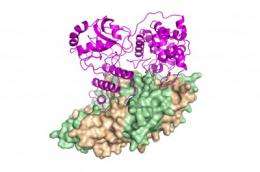
An illustration of the bacteriophage lysin Ply C
(Medical Xpress) -- Scientists have discovered the structure and operating procedures of a powerful anti-bacterial killing machine that could become an alternative to antibiotics.
In research published in the Proceedings of the National Academy of Science USA, scientists from Monash University, The Rockefeller University and the University of Maryland detail how the bacteriophage lysin, PlyC, kills bacteria that cause infections from sore throats to pneumonia and streptococcal toxic shock syndrome.
Bacteriophages, viruses that specifically infect and kill bacteria using special proteins called lysins, have been investigated as possible treatments since 1919. However, with the discovery of antibiotics in the 1940s, 'phage therapy' was generally abandoned.
In collaboration with Professor Vince Fischetti at Rockefeller and Dr. Dan Nelson at Maryland, Monash researchers Professor James Whisstock, Associate Professor Ashley Buckle and Dr. Sheena McGowan from the School of Biomedical Sciences, have spent the last six years deciphering the atomic structure of PlyC, to better understand its remarkable anti-bacterial properties.
Dr. McGowan said PlyC looked a little like a spaceship.
"PlyC is actually made from nine separate protein parts that assemble to form a very effective bacterial killing machine. It actually resembles a flying saucer carrying two warheads," Dr. McGowan said.
"It operates by locking onto the bacterial surface using eight separate docking sites located on one face of the saucer. The two warheads can then chew through the surface of the cell, rapidly killing the bacteria."
Associate Professor Buckle said the PlyC, which attacks the streptococci bacteria, was a very promising target for the future development of new drugs.
"PlyC, in its purified form, has been shown to be 100 times more efficient at killing certain bacteria than any other lysin to date even faster than household bleach," Associate Professor Buckle said.
First identified in 1925, PlyC was purified in the 1960s by Professor Fischetti, but its atomic structure proved elusive until now.
"Scientists have been trying to decipher the structure of PlyC for more than 40 years. Finally knowing what it looks like, and how it attacks bacteria, is a huge step forward," Dr. McGowan said.
Provided by
Monash University
-
Newly engineered enzyme is a powerful staph antibiotic
Feb 08, 2010 |
not rated yet |
0
-
Newly identified enzyme treats deadly bacterial infections in mice
Jul 02, 2008 |
not rated yet |
0
-
Using viruses to beat superbugs
Mar 26, 2012 |
not rated yet |
0
-
Disarming disease-causing bacteria
Apr 04, 2012 |
not rated yet |
0
-
Outsmarting killer bacteria: Next generation of antibiotics to combat drug-resistant 'superbugs'
Sep 14, 2010 |
not rated yet |
0
-
Motion perception revisited: High Phi effect challenges established motion perception assumptions
Apr 23, 2013 |
3 / 5 (2) |
2
-
Anything you can do I can do better: Neuromolecular foundations of the superiority illusion (Update)
Apr 02, 2013 |
4.5 / 5 (11) |
5
-
The visual system as economist: Neural resource allocation in visual adaptation
Mar 30, 2013 |
5 / 5 (2) |
9
-
Separate lives: Neuronal and organismal lifespans decoupled
Mar 27, 2013 |
4.9 / 5 (8) |
0
-
Sizing things up: The evolutionary neurobiology of scale invariance
Feb 28, 2013 |
4.8 / 5 (10) |
14
-
Pressure-volume curve: Elastic Recoil Pressure don't make sense
21 hours ago
-
If you became brain-dead, would you want them to pull the plug?
May 17, 2013
-
MRI bill question
May 15, 2013
-
Ratio of Hydrogen of Oxygen in Dessicated Animal Protein
May 13, 2013
-
Alcohol and acetaminophen
May 13, 2013
-
Marie Curie's leukemia
May 13, 2013
- More from Physics Forums - Medical Sciences
More news stories
Now we know why old scizophrenia medicine works on antibiotics-resistant bacteria
In 2008 researchers from the University of Southern Denmark showed that the drug thioridazine, which has previously been used to treat schizophrenia, is also a powerful weapon against antibiotic-resistant bacteria such as ...
Medical research
May 17, 2013 |
3.7 / 5 (3) |
0
|
SUMO wrestling cells reveal new protective mechanism target for stroke
Scientists investigating the interaction of a group of proteins in the brain responsible for protecting nerve cells from damage have identified a new target that could increase cell survival.
Medical research
May 17, 2013 |
5 / 5 (1) |
0
How serotonin receptors can shape drug effects, from LSD to migraine medication
New findings by researchers carrying out experiments at the U.S. Department of Energy Office of Science's Advanced Photon Source (APS) help explain why some drugs that interact with two kinds of human serotonin ...
Medical research
May 17, 2013 |
not rated yet |
0
|
Preventing blood poisoning
Peptide molecules derived from the body's natural immune system can help boost the body's defence against life-threatening blood poisoning, joint University research has uncovered.
Medical research
May 17, 2013 |
4 / 5 (1) |
0
|
New mechanism to prevent type 2 diabetes in obese individuals
A new Montréal study conducted by Dr. May Faraj, associate research professor at the Université de Montréal and invited scientist at the IRCM, along with her research team and medical collaborators, shows ...
Medical research
May 17, 2013 |
not rated yet |
0
|
Consuming coffee linked to lower risk of detrimental liver disease, study finds
Regular consumption of coffee is associated with a reduced risk of primary sclerosing cholangitis (PSC), an autoimmune liver disease, Mayo Clinic research shows. The findings were being presented at the Digestive Disease ...
Ketamine shows significant therapeutic benefit in people with treatment-resistant depression
Patients with treatment-resistant major depression saw dramatic improvement in their illness after treatment with ketamine, an anesthetic, according to the largest ketamine clinical trial to-date led by researchers from the ...
New research identifies risks, interventions for children's GI health
An increasing number of U.S. children are experiencing gastrointestinal issues that require interventions to resolve, according to research presented at Digestive Disease Week (DDW).
US psychiatry gets makeover in new manual
The latest makeover to a massive psychiatric tome honored by some, reviled by others and even called the "Bible" of mental disorders is being released Saturday with a host of new changes.
New case of SARS-like virus in Saudi: ministry
A new case of the deadly coronavirus has been detected in Saudi Arabia where 15 people have already died after contracting it, the health ministry announced on Saturday on its Internet website.
AIDS science at 30: 'Cure' now part of lexicon
Big names in medicine are set to give an upbeat assessment of the war on AIDS on Tuesday, 30 years after French researchers identified the virus that causes the disease.