New drug candidate shows promise against cancer
Drugs containing platinum are among the most powerful and widely used cancer drugs. However, such drugs have toxic side effects, and cancer cells can eventually become resistant to them.
MIT chemistry professor Stephen J. Lippard, who has spent much of his career studying platinum drugs, has now identified a compound that kills cancer cells better than cisplatin, the most commonly used platinum anticancer drug. The new compound may be able to evade cancer-cell resistance to conventional platinum compounds.
“I’ve long believed that there’s something special about platinum and its ability to treat cancer,” Lippard says. Using new variants, “we might have a chance of applying platinum to a broader range of cancer types, more successfully,” he says.
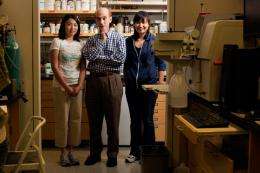
Lippard is senior author of a paper describing the new drug candidate, known as phenanthriplatin, in the Proceedings of the National Academy of Sciences (PNAS). Lead author is postdoc Ga Young Park; other authors are graduate student Justin Wilson and postdoc Ying Song.
Cisplatin, first approved to treat cancer in 1978, is particularly effective against testicular cancer, and is also used to treat ovarian and some lung tumors, as well as lymphoma and other cancers. At its center is a platinum atom bound to two ammonia molecules and two chloride ions. When the compound enters a cancerous cell, it becomes positively charged because water molecules replace its chloride ions. The resulting positive ion can attack negatively charged DNA, forming cross-links with the DNA strands and making it difficult, if not impossible, for the cell to read that section of DNA. Too much of this damage, if not repaired, kills the cell.
For many years, Lippard has studied the mechanism of cisplatin’s action and has pursued similar drugs that could be more powerful, work against more types of cancer, have fewer side effects and evade cancer-cell resistance.
One way to do that is to vary the structure of the platinum compound, altering its activity. In this case, the researchers studied compounds that are similar to cisplatin, but have only one replaceable chlorine atom. Such a compound can bind to DNA at only one site instead of two.
From early research on platinum compounds done in the 1970s, researchers thought that platinum compounds needed two DNA binding sites to have an effect on cancer cells. However, in the 1980s, it was discovered that certain positively charged platinum compounds that can only bind to DNA at one site have anti-cancer activity, rekindling interest in them.
In 2008, Lippard’s group investigated a compound called pyriplatin, in which one of the chlorine atoms of cisplatin is replaced by a six-membered pyridine ring that includes five carbon atoms and one nitrogen atom. This compound had some anti-cancer activity, but was not as powerful as cisplatin or oxaliplatin, another FDA-approved platinum-based cancer drug.
Lippard then set out to create similar compounds with larger rings, which he theorized might be more effective at blocking DNA transcription. One of those was phenanthriplatin, the compound described in the new PNAS paper.
Phenanthriplatin was tested against 60 types of cancer cells as part of the National Cancer Institute’s cancer-drug screening program, and it was found to be four to 40 times more potent than cisplatin, depending on the cancer type. It also showed a different pattern of activity than that of cisplatin, suggesting that it could be used to treat types of cancer against which cisplatin is ineffective.
One reason for the efficacy of phenanthriplatin is that it can get into cancer cells more easily than cisplatin, Lippard says. Previous studies have shown that platinum compounds containing carbon can pass through specific channels, found in abundance on cancer cells, that allow positively charged organic compounds to enter. Another reason is the ability of phenanthriplatin to inhibit transcription, the process by which cells convert DNA to RNA in the first step of gene expression.
Another advantage of phenanthriplatin is that it seems to be able to evade some of cancer cells’ defenses against cisplatin. Sulfur-containing compounds found in cells, such as glutathione, can attack platinum and destroy it before it can reach and bind to DNA. However, phenanthriplatin contains a bulky three-ring attachment that appears to prevent sulfur from inactivating the platinum compounds as effectively.
Luigi Marzilli, a professor of chemistry at Louisiana State University, says the new compound appears to be very promising. “It expands the utility of platinum drugs and avoids some of the problems that existing drugs have,” says Marzilli, who was not part of the research team.
The researchers are now conducting animal tests to determine how the drug is distributed throughout the body, and how well it kills tumors. Depending on the results, they may be able to modify the compound to improve those properties, Lippard says.
More information: www.pnas.org/content/early/201 … /1207670109.abstract
This story is republished courtesy of MIT News (web.mit.edu/newsoffice/), a popular site that covers news about MIT research, innovation and teaching.


