Drug shows promise for triple-negative breast cancer
July 3, 2012 in Cancer

Drug shows promise for triple-negative breast cancer

Enlarge

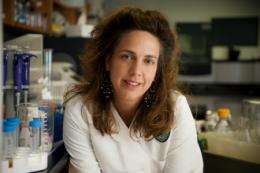
Tulane scientists, led by Dr. Bridgette Collins-Burow, have reported research results of a promising new therapy for triple-negative breast cancer. (Photo by Paula Burch-Celentano)

(Medical Xpress) -- A promising new therapy for hard-to-treat triple-negative breast cancer has been reported in the journal Breast Cancer Research by a team at the Tulane University School of Medicine, led by Dr. Bridgette Collins-Burow.

More than one million cases of are diagnosed worldwide every year, of which approximately 15 percent are triple-negative cancers, according to the team that reported on the study.

“Lack of effective therapies, young age at the onset of the disease and early metastatic spread have contributed to the poor prognoses and outcomes associated with these malignancies,” says Collins-Burow, an assistant professor of medicine.

Some kinds of breast cancer can be treated with drugs that target hormone receptors, which are protein structures on and inside cells. In healthy cells and most kinds of cancer cells, hormones attach to such receptors and provide signals to the cells for growth and functioning.

These cancers can be treated by hormonal therapies — drugs that bind to the receptors in place of hormones, thus cutting off hormonal signaling and eventually killing the cells.

But triple-negative breast cancers lack these hormone receptors, so the cancer cells continue to flourish. Triple-negative cancers also lack the growth factor receptor HER2 and cannot be treated with monoclonal therapy such as Herceptin. 


The Tulane team explored the effect of using a histone deacetylase (HDAC) inhibitor called panobinostat on triple-negative breast cancer tumors in mice. This drug inhibits the actions of rogue enzymes that are responsible for allowing the uncontrolled growth of cancer cells. 


“Panobinostat selectively targeted triple-negative breast and decreased tumor growth in mice,” says Collins-Burow. “It was also able to partially reverse the morphological changes in cells to a more epithelial type. These results show a potential therapeutic role for HDAC inhibitors, especially panobinostat, in targeting the aggressive triple-negative breast cancer.”

More information: breast-cancer-rese… ent/14/3/R79

Journal reference: Breast Cancer Research search and more info website

Provided by Tulane University search and more info website

5 /5 (1 vote)  

Rank 5 /5 (1 vote)
Relevant PhysicsForums posts

More news stories

ASCO: combo antibody therapy effective for melanoma

(HealthDay)—Concurrent use of two immune checkpoint antibodies—ipilimumab and nivolumab—may be effective for the treatment of advanced melanoma, according to a proof-of-principal study presented in ...

Cancer created 17 hours ago | popularity not rated yet | comments 0

Risk factors ID'd for poor cutaneous cell CA outcomes

(HealthDay)—The risks of metastasis and death associated with cutaneous squamous cell carcinoma (CSCC) are low, but significant, and risk factors for poor outcome include tumor diameter, invasion beyond ...

Cancer created 17 hours ago | popularity not rated yet | comments 0 | with audio podcast

Physical & emotional impairments common, often untreated in people with cancer

A new review finds cancer survivors suffer a diverse and complex set of impairments, affecting virtually every organ system. Writing in CA: A Cancer Journal for Clinicians, Julie Silver, M.D., associate professor at Harvar ...

Cancer created 22 hours ago | popularity not rated yet | comments 0

Calif. doc with 'cancer cure' gets 14 years prison (Update)

(AP)—A California doctor has been sentenced to 14 years in federal prison for bilking her patients out of more than $1 million by promising that an herbal supplement could cure late-stage cancer and other diseases.

Cancer created 22 hours ago | popularity not rated yet | comments 0

New protein-targeting drug shows promise in early trial for patients with high-risk CLL

A new oral targeted drug, idelalisib (GS-1101), has the potential to stave off the need for additional treatments for relapsed or treatment-resistant chronic lymphocytic leukemia (CLL), according to a study led in part by ...

Cancer created May 17, 2013 | popularity not rated yet | comments 0 | with audio podcast


AIDS science at 30: 'Cure' now part of lexicon

Big names in medicine are set to give an upbeat assessment of the war on AIDS on Tuesday, 30 years after French researchers identified the virus that causes the disease.

For combat veterans suffering from post-traumatic stress disorder, 'fear circuitry' in the brain never rests

Chronic trauma can inflict lasting damage to brain regions associated with fear and anxiety. Previous imaging studies of people with post-traumatic stress disorder, or PTSD, have shown that these brain regions can over-or ...

Melon focus headband turns to Kickstarter for rollout plans

(Medical Xpress)—What if the quality of your work depends more on your focus on the piano keys or canvas or laptop than your musical or painting or computing skills? If target users can be convinced, they ...

Temporal processing in the olfactory system

The neural machinery underlying our olfactory sense continues to be an enigma for neuroscience. A recent review in Neuron seeks to expand traditional ideas about how neurons in the olfactory bulb might encode information about ...

Now we know why old scizophrenia medicine works on antibiotics-resistant bacteria

In 2008 researchers from the University of Southern Denmark showed that the drug thioridazine, which has previously been used to treat schizophrenia, is also a powerful weapon against antibiotic-resistant bacteria such as ...

23 dead in initiation rites in South Africa

(AP)—Twenty-three youths have died in the past nine days at initiation ceremonies that include circumcisions and survival tests, South African police said Friday.