New research confirms efficacy of transcranial magnetic stimulation for depression
July 26, 2012 in Psychology & Psychiatry
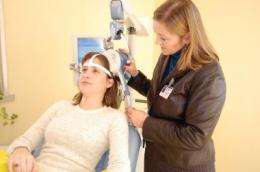
In one of the first studies to look at transcranial magnetic stimulation (TMS) in real-world clinical practice settings, researchers at Butler Hospital, along with colleagues across the US, confirmed that TMS is an effective treatment for patients with depression who are unable to find symptom relief through antidepressant medications. Credit: Butler Hospital
In one of the first studies to look at transcranial magnetic stimulation (TMS) in real-world clinical practice settings, researchers at Butler Hospital, along with colleagues across the U.S., confirmed that TMS is an effective treatment for patients with depression who are unable to find symptom relief through antidepressant medications. The study findings are published online in the June 11, 2012 edition of Depression and Anxiety in the Wiley Online Library.
Previous analysis of the efficacy of TMS has been provided through more than 30 published trials, yielding generally consistent results supporting the use of TMS to treat depression when medications aren't sufficient. "Those previous studies were key in laying the groundwork for the FDA to approve the first device for delivery of TMS as a treatment for depression in 2008," said Linda Carpenter, MD, lead author of the report and chief of the Mood Disorders Program and the Neuromodulation Clinic at Butler Hospital. "Naturalistic studies like ours, which provide scrutiny of real-life patient outcomes when TMS therapy is given in actual clinical practice settings, are the next step in further understanding the effectiveness of TMS. They are also important for informing healthcare policy, particularly in an era when difficult decisions must be made about allocation of scarce resources."
Carpenter explains that naturalistic studies differ from controlled clinical trials because they permit the inclusion of subjects with a wider range of symptomatology and comorbidity, whereas controlled clinical trials typically have more rigid criteria for inclusion. "As a multisite study collecting naturalistic outcomes from patients in clinics in various regions in the U.S., we were also able to capture effects that might arise from introducing a novel psychiatric treatment modality like TMS in non-research settings," said Carpenter. In all, the study confirms how well TMS works in diverse settings where TMS is administered to a real-life population of patients with depression that have not found relief through many other available treatments.
The published report summarized data collected from 42 clinical TMS practice sites in the US, and included outcomes from 307 patients with Major Depressive Disorder (MDD) who had persistent symptoms despite the use of antidepressant medication. Change during TMS was assessed using both clinicians' ratings of overall depression severity and scores on patient self-report depression scales, which require the patient to rate the severity of each symptom on the same standardized scale at the end of each 2-week period. Rates for "response" and "remission" to TMS were calculated based on the same cut-off scores and conventions used for other clinical trials of antidepressant treatments. Fifty-eight percent positive response rate to TMS and 37 percent remission rate were observed.
"The patient outcomes we found in this study demonstrated a response rate similar to controlled clinical trial populations," said Dr. Carpenter, explaining that this new data validates TMS efficacy in treating depression for those who have failed to benefit from antidepressant medications. "Continued research and confirmation of the effectiveness of TMS is important for understanding its place in everyday psychiatric care and to support advocacy for insurance coverage of the treatment." Thanks in part to the advocacy efforts of Dr. Carpenter, TMS was recently approved for coverage by Medicare in New England, and it is also now covered by BCBSRI. "Next steps for TMS research involve enhancing our understanding of how to maintain positive response to TMS over time after the course of therapy ends and learning how to customize the treatment for patients using newer technologies, so TMS can help even more patients."
Provided by
Women & Infants Hospital
-
Transcranial magnetic stimulation effective in treating major depression
Nov 22, 2007 |
not rated yet |
0
-
Magnetic therapy becoming more popular for treating depression
Feb 06, 2012 |
not rated yet |
0
-
New TMS clinic offers noninvasive treatment for major depression
Nov 05, 2009 |
not rated yet |
0
-
Follow-up study supports the long-term benefits of transcranial magnetic stimulation for depression
Oct 12, 2010 |
not rated yet |
0
-
Magnetic fields prevent editor from talking (w/ video)
Apr 12, 2011 |
not rated yet |
0
-
Motion perception revisited: High Phi effect challenges established motion perception assumptions
Apr 23, 2013 |
3 / 5 (2) |
2
-
Anything you can do I can do better: Neuromolecular foundations of the superiority illusion (Update)
Apr 02, 2013 |
4.5 / 5 (11) |
5
-
The visual system as economist: Neural resource allocation in visual adaptation
Mar 30, 2013 |
5 / 5 (2) |
9
-
Separate lives: Neuronal and organismal lifespans decoupled
Mar 27, 2013 |
4.9 / 5 (8) |
0
-
Sizing things up: The evolutionary neurobiology of scale invariance
Feb 28, 2013 |
4.8 / 5 (10) |
14
-
How can there be villous adenoma in colon, if there are no villi there
11 hours ago
-
How can there be a term called "intestinal metaplasia" of stomach
May 21, 2013
-
Pressure-volume curve: Elastic Recoil Pressure don't make sense
May 18, 2013
-
If you became brain-dead, would you want them to pull the plug?
May 17, 2013
-
MRI bill question
May 15, 2013
-
Ratio of Hydrogen of Oxygen in Dessicated Animal Protein
May 13, 2013
- More from Physics Forums - Medical Sciences
More news stories
'Boys will be boys' in US, but not in Asia
A new study shows there is a gender gap when it comes to behavior and self-control in American young children – one that does not appear to exist in children in Asia.
Psychology & Psychiatry
1 hour ago |
not rated yet |
0
Brain can be trained in compassion, study shows
Until now, little was scientifically known about the human potential to cultivate compassion—the emotional state of caring for people who are suffering in a way that motivates altruistic behavior.
Psychology & Psychiatry
2 hours ago |
not rated yet |
1
|
Good marriage can buffer effects of dad's depression on young children
What effect does a father's depression have on his young son or daughter? When fathers report a high level of emotional intimacy in their marriage, their children benefit, said a University of Illinois study.
Psychology & Psychiatry
3 hours ago |
not rated yet |
0
American, Nepalese kids a world apart on social duties
(Medical Xpress)—Preschoolers universally recognize that one's choices are not always free – that our decisions may be constrained by social obligations to be nice to others or follow rules set by parents ...
Psychology & Psychiatry
10 hours ago |
not rated yet |
0
Ethicists' behavior not more moral, study finds
(Medical Xpress)—Do ethicists engage in better moral behavior than other professors? The answer is no. Nor are they more likely than nonethicists to act according to values they espouse, according to researchers from the ...
Psychology & Psychiatry
10 hours ago |
5 / 5 (1) |
0
Fecal microbiota tx feasible for recurrent C. difficile in HIV
(HealthDay)—For HIV-infected individuals with recurrent Clostridium difficile infection, fecal microbiota therapy is feasible, according to a letter published in the May 21 issue of the Annals of Intern ...
FDA panel backs experimental Merck insomnia drug
(AP)—A federal panel of medical experts says that an experimental insomnia drug from Merck & Co Inc. appears safe and effective, despite evidence from company trials that the pill can cause daytime sleepiness and difficulty ...
Systematic screening of med adherence will ID barriers
(HealthDay)—Implementation of systematic monitoring for medication adherence will allow for identification of barriers to adherence and tailoring of interventions, according to a viewpoint piece published ...
Having both migraines, depression may mean smaller brain
(HealthDay)—Migraines and depression can each cause a great deal of suffering, but new research indicates the combination of the two may be linked to something else entirely—a smaller brain.
Swine flu pandemic of 2009 more deadly for younger adults, study finds
As the world prepares for what may be the next pandemic strain of influenza virus, in the H7N9 bird flu, a new UC Irvine study reveals that the 2009 H1N1 swine flu pandemic was deadliest for people under the age of 65, while ...
Slowing the aging process—only with antibiotics
Swiss scientists reveal the mechanism responsible for aging hidden deep within mitochondria—and dramatically slow it down in worms by administering antibiotics to the young.