Fruit flies light the way to pinpoint genetic changes that spell cancer
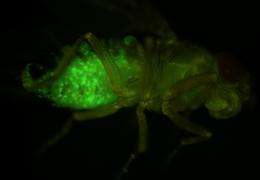
Researchers at IMCB are using fruit fly as a genetic model to accelerate the discovery of novel cancer genes. The picture shows metastatic tumours spreading throughout the fly body (visualised by the green fluorescent proteins) when one of the newly found “cooperating” cancer genes are removed in combination with an activated EFGR “driver” mutation.
By studying fruit flies, scientists at A*STARs Institute of Molecular and Cell Biology (IMCB) have successfully devised a fast and cost-saving way to uncover genetic changes that have a higher potential to cause cancer. With this new approach, researchers will now be able to rapidly distinguish the range of genetic changes that are causally linked to cancer (i.e. driver mutations) versus those with limited impact on cancer progression. This research paves the way for doctors to design more targeted treatment against the different cancer types, based on the specific cancer-linked mutations present in the patient. This study published in the prestigious journal Genes & Development could help advance the development of personalized medicine in cancer care and treatment.
The era of genomic sequencing has generated an unparalleled wealth of information on the complexity of genetic changes that occur as cancer develops and progresses. Many genetic changes arise in cancer cells and changes continue to accumulate during the progression of disease to metastatic cancer. The current challenge is to understand which of the many genetic changes are important drivers of disease progression said Dr. Stephen Cohen, Principal Investigator at IMCB and team leader of this paper.
Though very different in many ways, fruit flies and humans share similarities in a remarkable two-thirds of their genomes. That is to say, many of the genes found in humans are also present in the flies. Similarly, various signalling pathways involved in tumour formation are also well conserved from fruit flies to humans. In fact, previous studies have shown that about 75 percent of known human disease genes have a recognisable match in the genome of fruit flies.
Leveraging on their genetic similarities, Dr. Héctor Herranz, a post-doctorate from the Dr. Cohens team developed an innovative strategy to genetically screen the whole fly genome for cooperating cancer genes. On their own, these are the genes that appear to be harmless and have little or no impact on cancer. But in fact, they cooperate with other cancer genes, so that the combination causes aggressive cancer, which neither would cause alone.
In this study, the team was specifically looking for genes that could cooperate with EGFR driver mutation, a genetic change commonly associated with breast and lung cancers in humans. SOCS5, reported in this paper, is one of the several new cooperating cancer genes to be identified through this innovative approach. Most of these new-found genes have yet to be identified as cancer genes in human or mouse models.
Said Mr. Xin Hong, a PhD student and the co-first author of this paper, We were very surprised by our finding because this it the first time that the SOCS gene family is found to be linked to cancer. Previously it has only been associated with immunological disorders.
Dr. Cohen added, Though these studies are in the early stages, they are very promising. Already, there are indications that levels of SOCS5 expression are reduced in breast cancer, and patients with low levels of SOCS5 have poor prognosis.
The IMCB team is preparing to explore the use of SOCS5 as a biomarker in diagnosis for cancer.
Said Professor Wanjin Hong, Executive Director of IMCB, This study sheds light on the complexities of cancer genetics and paves the way to accelerate development of personalized medicine in cancer care. It is a fine examples of how powerful genetic approach using the fly model can reveal molecular mechanisms underlying human cancer. More importantly, it shows how fundamental research can have far-reaching applications for potential clinical benefits.
More information: "Oncogenic cooperation between SOCS family proteins and EGFR identified using a Drosophila epithelial transformation model" genesdev.cshlp.org… ull.pdf+html
Journal reference:
Genes & Development
Provided by
Agency for Science, Technology and Research (A*STAR), Singapore
-
New lung cancer gene found
Jul 19, 2011 |
not rated yet |
0
-
New genome profiling technique identifies weak points in breast cancer cells
Aug 03, 2011 |
not rated yet |
0
-
New bowel cancer gene discovery
Nov 10, 2010 |
not rated yet |
0
-
Landscape of cancer genes and mutational processes in breast cancer
May 16, 2012 |
not rated yet |
0
-
'Post-it note' on breast cancer gene signals risk of disease spreading
Jul 12, 2012 |
not rated yet |
0
-
Motion perception revisited: High Phi effect challenges established motion perception assumptions
Apr 23, 2013 |
3 / 5 (2) |
2
-
Anything you can do I can do better: Neuromolecular foundations of the superiority illusion (Update)
Apr 02, 2013 |
4.5 / 5 (11) |
5
-
The visual system as economist: Neural resource allocation in visual adaptation
Mar 30, 2013 |
5 / 5 (2) |
9
-
Separate lives: Neuronal and organismal lifespans decoupled
Mar 27, 2013 |
4.9 / 5 (8) |
0
-
Sizing things up: The evolutionary neurobiology of scale invariance
Feb 28, 2013 |
4.8 / 5 (10) |
14
-
Classical and Quantum Mechanics via Lie algebras
Apr 15, 2011
- More from Physics Forums - Independent Research
More news stories
Researchers identify new circadian clock component
Northwestern University scientists have shown a gene involved in neurodegenerative disease also plays a critical role in the proper function of the circadian clock.
Genetics
May 16, 2013 |
3 / 5 (1) |
0
|
Returning genetic incidental findings without patient consent violates basic rights, experts say
Informed consent is the backbone of patient care. Genetic testing has long required patient consent and patients have had a "right not to know" the results. However, as 21st century medicine now begins to use the tools of ...
Genetics
May 16, 2013 |
5 / 5 (1) |
3
|
Ethicists provide framework supporting new recommendations on reporting incidental findings in gene sequencing
In a paper published in Science Express, a group of experts led by bioethicists in the Center for Medical Ethics and Health Policy at Baylor College of Medicine provide a framework for the new American College of Medical Geneti ...
Genetics
May 16, 2013 |
not rated yet |
0
Experts urge caution over use of new genetic sequencing techniques
The use of genome-wide analysis (GWA), where the entirety of an individual's DNA is examined to look for the genomic mutations or variants which can cause health problems is a massively useful technology for diagnosing disease. ...
Genetics
May 16, 2013 |
not rated yet |
0
Collecting DNA for human rights: How to help while safeguarding privacy
DNA databases might help identify victims of crime and human trafficking, but how do we safeguard the personal privacy of innocent victims and family members? A new report online May 15 in the Cell Press journal Trends in ...
Genetics
May 15, 2013 |
not rated yet |
0
'Gap' for HIV vaccine efforts after latest setback
The hunt for an HIV vaccine has gobbled up $8 billion in the past decade, and the failure of the most recent efficacy trial has delivered yet another setback to 26 years of efforts.
Consuming coffee linked to lower risk of detrimental liver disease, study finds
Regular consumption of coffee is associated with a reduced risk of primary sclerosing cholangitis (PSC), an autoimmune liver disease, Mayo Clinic research shows. The findings were being presented at the Digestive Disease ...
Ketamine shows significant therapeutic benefit in people with treatment-resistant depression
Patients with treatment-resistant major depression saw dramatic improvement in their illness after treatment with ketamine, an anesthetic, according to the largest ketamine clinical trial to-date led by researchers from the ...
Research examines new methods for managing digestive health
Research presented at Digestive Disease Week (DDW) explores new methods for managing digestive health through diet and lifestyle.
New smartphone application improves colonoscopy preparation
The use of a smartphone application significantly improves patients' preparation for a colonoscopy, according to new research presented today at Digestive Disease Week (DDW). The preparation process, which begins days in ...
New research identifies risks, interventions for children's GI health
An increasing number of U.S. children are experiencing gastrointestinal issues that require interventions to resolve, according to research presented at Digestive Disease Week (DDW).