Microfibers help virus fool the body's immune system
July 31, 2012 in Medical research
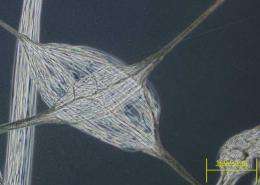
Bio-macromolecule fibers formed by the electrostatic interaction between plasmid DNA and positively charged peptides.
A key challenge in virus-based gene therapy is avoiding detection by the human immune system so that the virus would not be deactivated before it reaches its intended target. Now, researchers at the Institute of Bioengineering and Nanotechnology (IBN) have succeeded in circumventing the bodys own defense mechanism by combining two IBN innovations.
In a recent study published in Advanced Materials, IBN researchers demonstrated that cancer cells could be more effectively eliminated when therapeutic viruses were encased in microfibers or synthetic tissue fibers.
Using a novel method developed at IBN, the researchers were able to encapsulate an insect virus with fibers produced from peptides and DNA for gene delivery. As the structure of the microfibers closely resembles human tissue fibers, they were able to disguise the virus by reducing the bodys ability to recognize the virus and prevent its premature deactivation. Tests conducted on mice with brain tumor show that the microfiber-coated viruses could significantly slow down tumor growth and prolong survival, in comparison to treatment with uncoated viruses.
Gene therapy is a technique for correcting defective genes responsible for disease development. It involves using DNA encoded with a functional gene to replace a mutated gene, and viruses that are stripped of its disease-causing ability are used as a tool to deliver the therapeutic gene into the target cells.
IBN has been investigating the use of engineered insect virus to treat cancer and neurological disorders since 2003, and the first successful gene delivery to human embryonic stem cells using a baculoviral vector was achieved at IBN in 2006. That same year, IBN researchers published a paper in Cancer Research demonstrating the delivery of therapeutic genes by baculoviral vectors for cancer treatment in an animal tumor model.
In trying to prevent the body from disabling the virus before it reaches the diseased cells, the research team led by IBN Group Leader Dr. Shu Wang turned to a unique microfiber fabrication technique developed by Dr. Andrew C. A. Wan at IBN. In the human body, tissue fibers are naturally formed by the assembly of two different types of macromolecules, such as proteins and DNA. Currently, synthetic tissue fibers are fabricated with only one type of biomolecular material because fibers composed of more than one type of biomolecule are difficult to produce.
Using a water-based chemical process, IBN scientists were able to construct tissue fibers from two biomolecular materials peptides and DNA. The researchers flanked two droplets of the oppositely charged peptide and DNA molecules after it has been dissolved in water. Upon contact, the droplets zipped together to form a two-component fiber. Fiber formation presumably occurs from the electrostatic interaction between the positively charged peptide molecule and the negatively charged DNA molecule. Through the same procedure, baculoviral vectors were added to the DNA solution to coat the virus with the fibers.
Dr. Shu Wang shared, For the very first time, we have shown that two biomolecules, namely peptides and DNA, can interact with each other to form structured fibers in a test tube. Since these biomolecules are readily metabolized in the human body to naturally occurring molecules and have no adverse toxicity, they hold strong biomedical potential for the delivery of therapeutic drugs, genes, proteins and viruses to combat cancer.
This innovative application of microfibers with viral vectors is an exciting development for gene therapy that was made possible through multidisciplinary collaboration between biologists, chemists and materials scientists at IBN. Our fibrous materials are also of great interest as biocompatible tissue engineering scaffolds for applications in regenerative medicine, said Professor Jackie Y. Ying, IBN Executive Director.
More information: 1. J. Yang, et al. Microfibers Fabricated by Non-Covalent Assembly of Peptide and DNA for Viral Vector Encapsulation and Cancer Therapy, Advanced Materials, (2012) DOI: 10.1002/adma.201201145.
2. J. Zeng, J. Du, N. Palanisamy and S. Wang, Baculoviral Vector-Mediated Transient and Stable Transgene Expression in Human Embryonic Stem Cells, Stem Cells, 25 (2007) 1055-1061.
3. C. Y. Wang, et al., Recombinant Baculovirus Containing the Diphtheria Toxin A Gene for Malignant Glioma Therapy, Cancer Research, 66 (2006) 5798-5806.
4. A. C. A. Wan, et al., Silica-Incorporated Polyelectrolyte-Complex Fibers as Tissue Engineering Scaffolds, Advanced Materials, 18 (2006) 641-644.
Journal reference:
Advanced Materials
Cancer Research
Stem Cells
Provided by
Agency for Science, Technology and Research (A*STAR), Singapore
-
Insect virus holds the key to safer stem cell therapy
Jul 29, 2011 |
not rated yet |
0
-
A promising discovery for breast cancer therapy
Apr 20, 2012 |
not rated yet |
0
-
Singapore nanotechnology combats fatal brain infections
Jun 28, 2009 |
not rated yet |
0
-
Polymers hold promise for safer gene delivery
Sep 07, 2007 |
not rated yet |
0
-
Fused polymer-based multi-component fibers provide well-defined domains for cell co-culture in tissue engineering
Jul 04, 2012 |
not rated yet |
0
-
Motion perception revisited: High Phi effect challenges established motion perception assumptions
Apr 23, 2013 |
3 / 5 (2) |
2
-
Anything you can do I can do better: Neuromolecular foundations of the superiority illusion (Update)
Apr 02, 2013 |
4.5 / 5 (11) |
5
-
The visual system as economist: Neural resource allocation in visual adaptation
Mar 30, 2013 |
5 / 5 (2) |
9
-
Separate lives: Neuronal and organismal lifespans decoupled
Mar 27, 2013 |
4.9 / 5 (8) |
0
-
Sizing things up: The evolutionary neurobiology of scale invariance
Feb 28, 2013 |
4.8 / 5 (10) |
14
-
How can there be a term called "intestinal metaplasia" of stomach
May 21, 2013
-
Pressure-volume curve: Elastic Recoil Pressure don't make sense
May 18, 2013
-
If you became brain-dead, would you want them to pull the plug?
May 17, 2013
-
MRI bill question
May 15, 2013
-
Ratio of Hydrogen of Oxygen in Dessicated Animal Protein
May 13, 2013
-
Alcohol and acetaminophen
May 13, 2013
- More from Physics Forums - Medical Sciences
More news stories
Targeting the X-factor to tackle cardiovascular disease
New research at The University of Nottingham aimed at preventing harmful blood clots associated with heart disease and stroke has recently received a major funding boost from the British Heart Foundation.
Medical research
10 minutes ago |
not rated yet |
0
Italy approves law on controversial stem cell therapy
Italian lawmakers on Wednesday gave their final approval to a law that allows limited use of a controversial type of stem cell therapy which has been condemned by many scientists but has given hope to families of terminally-ill ...
Medical research
25 minutes ago |
not rated yet |
0
H. pylori, smoking trends, and gastric cancer in US men
Trends in Helicobacter pylori (H. pylori) and smoking explain a significant proportion of the decline of intestinal-type noncardia gastric adenocarcinoma (NCGA) incidence in US men between 1978 and 2008, and are estimated ...
Medical research
14 hours ago |
not rated yet |
0
Common food supplement fights degenerative brain disorders
Widely available in pharmacies and health stores, phosphatidylserine is a natural food supplement produced from beef, oysters, and soy. Proven to improve cognition and slow memory loss, it's a popular treatment for older ...
Medical research
19 hours ago |
5 / 5 (3) |
0
|
Finding a family for a pair of orphan receptors in the brain
Researchers at Emory University have identified a protein that stimulates a pair of "orphan receptors" found in the brain, solving a long-standing biological puzzle and possibly leading to future treatments for neurological ...
Medical research
19 hours ago |
5 / 5 (1) |
0
|
Japan hospital tests powerful breast cancer therapy
A Japanese cancer specialist said Wednesday she has started the world's first clinical trial of a powerful, non-surgical, short-term radiation therapy for breast cancer.
Portland, Ore., rejecting water fluoridation
(AP)—The mayor of Portland, Ore., has conceded defeat in an effort to add fluoride to the city's drinking water.
Mysterious illness kills two in southeast Alabama
(AP)—Alabama health officials say a mysterious respiratory illness has left five people hospitalized and two dead in the southeastern part of the state.
Study focuses on new mums' sleepiness and injury risk on the road
New mothers throughout Australia are needed to help QUT sleep researchers investigate whether the disrupted sleep experienced by mothers when caring for their new baby raises the risk of injury while driving.
Study says empathy plays a key role in moral judgments
Is it permissible to harm one to save many? Those who tend to say "yes" when faced with this classic dilemma are likely to be deficient in a specific kind of empathy, according to a report published in the scientific journal ...
Phthalates: Study links chemicals widely found in plastics, processed food to elevated blood pressure in children, teens
Plastic additives known as phthalates (pronounced THAL-ates) are odorless, colorless and just about everywhere: They turn up in flooring, plastic cups, beach balls, plastic wrap, intravenous tubing and—according to the ...
Jul 31, 2012
Rank: not rated yet