Musical glove improves sensation, mobility for people with spinal cord injury
July 17, 2012 in Neuroscience

Musical glove improves sensation, mobility for people with spinal cord injury

Enlarge

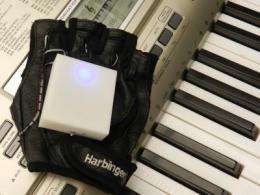
Mobile Music Touch is used with a piano keyboard and vibrates a person's fingers to indicate which keys to play. While learning to play the instrument, several people with paralyzing spinal cord injury experienced improved sensation in their fingers. Credit: Georgia Institute of Technology

Georgia Tech researchers have created a wireless, musical glove that may improve sensation and motor skills for people with paralyzing spinal cord injury (SCI).

The gadget was successfully used by individuals with limited feeling or movement in their hands due to tetraplegia. These individuals had sustained their injury more than a year before the study, a time frame when most rehab patients see very little improvement for the remainder of their lives. Remarkably, the device was primarily used while the participants were going about their daily routines.

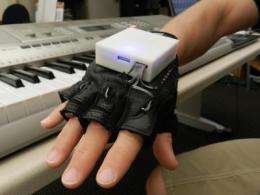
The device is called Mobile Music Touch (MMT). The glove, which looks like a glove with a small box on the back, is used with a piano keyboard and vibrates a person's fingers to indicate which keys to play. While learning to play the instrument, several people with SCI experienced improved sensation in their fingers.

This video is not supported by your browser at this time.

Researchers at Georgia Tech and Atlanta's Shepherd Center have created a wireless, musical glove that may improve sensation and motor skills for people with spinal cord injuries. The gadget, Mobile Music Touch, was successfully used by individuals with tetraplegia who suffered their injury more than year before the study, a time frame when most rehab patients see very little improvement for the remainder of their lives. Credit: Georgia Institute of Technology

Researchers at Georgia Tech and Atlanta's Shepherd Center recently completed a study focusing on people with weakness and sensory loss due to SCI.

"After our preliminary work in 2011, we suspected that the glove would have positive results for people with SCI," said Ph.D. graduate Tanya Markow, the project's leader. "But we were surprised by how much improvement they made in our study. For example, after using the glove, some participants were able to feel the texture of their bed sheets and clothes for the first time since their injury."

Markow worked with individuals with SCI who had limited feeling or movement in their hands. Each suffered a spinal injury more than a year prior to the study. The eight-week project required to practice playing the piano for 30 minutes, three times a week. Half used the MMT glove to practice; half did not.

The MMT system works with a computer, MP3 player or smart phone. A song, such as Ode to Joy, is programmed into a device, which is wirelessly linked to the glove. As the musical notes are illuminated on the correct keys on the piano keyboard, the gadget sends vibrations to "tap" the corresponding fingers. The participants play along, gradually memorizing the keys and learning additional songs.

However, these active learning sessions with MMT were not the primary focus of the study. The participants also wore the glove at home for two hours a day, five days a week, feeling only the vibration (and not playing the piano). Previous studies showed that wearing the MMT system passively in this manner helped participants learn songs faster and retain them better. The researchers hoped that the passive wearing of the device would also have rehabilitative effects.

At the end of the study, participants performed a variety of common grasping and tests to measure their improvement. Those who used the MMT system performed significantly better than those who just learned the piano normally.

"Some people were able to pick up objects more easily," said Markow. "Another said he could immediately feel the heat from a cup of coffee, rather than after a delay."
Musical glove improves sensation, mobility for people with spinal cord injury
Enlarge

Georgia Tech researchers, together with Shepherd Center, have created a wireless, musical glove that may improve sensation and motor skills for people with paralyzing spinal cord injury. Mobile Music Touch was successfully used by individuals with limited feeling or movement in their hands due to tetraplegia. Credit: Georgia Institute of Technology

Markow believes the increased motor abilities could be caused by renewed brain activity that sometimes becomes dormant in persons with SCI. The vibration might be triggering activity in the hand's sensory cortex, which leads to firing in the brain's motor cortex. Markow would like to expand the study to include functional MRI results.

The glove has evolved in recent years under the leadership of Georgia Tech's Thad Starner and Ellen Yi-Luen Do, as well as Deborah Backus, director of multiple sclerosis research at Shepherd Center. The initial concept, Piano Touch, developed with the team by then master's student Kevin Huang, demonstrated that people could easily learn to play the piano by wearing the glove and feeling its vibrations. It didn't take long for Starner to see the larger health benefits.

"Equipment used for hand rehabilitation may seem monotonous and boring to some, and doesn't provide any feedback or incentive," said Starner, who oversees the Contextual Computing Group. "Mobile Music Touch overcomes each of those challenges and provides surprising benefits for people with weakness and due to SCI. It's a great example of how wearable computing can change people's lives."

Provided by Georgia Institute of Technology search and more info website

5 /5 (1 vote)  

Rank 5 /5 (1 vote)
Relevant PhysicsForums posts

More news stories

For combat veterans suffering from post-traumatic stress disorder, 'fear circuitry' in the brain never rests

Chronic trauma can inflict lasting damage to brain regions associated with fear and anxiety. Previous imaging studies of people with post-traumatic stress disorder, or PTSD, have shown that these brain regions can over-or ...

Neuroscience created May 18, 2013 | popularity 5 / 5 (1) | comments 0 | with audio podcast

Temporal processing in the olfactory system

The neural machinery underlying our olfactory sense continues to be an enigma for neuroscience. A recent review in Neuron seeks to expand traditional ideas about how neurons in the olfactory bulb might encode information about ...

Neuroscience created May 17, 2013 | popularity 4 / 5 (1) | comments 0 | with audio podcast report

Melon focus headband turns to Kickstarter for rollout plans

(Medical Xpress)—What if the quality of your work depends more on your focus on the piano keys or canvas or laptop than your musical or painting or computing skills? If target users can be convinced, they ...

Neuroscience created May 17, 2013 | popularity 3.7 / 5 (3) | comments 0 | with audio podcast weblog

Deep brain stimulation: A fix when the drugs don't work

Neurological disorders can have a devastating impact on the lives of sufferers and their families.

Neuroscience created May 17, 2013 | popularity 5 / 5 (1) | comments 0 | with audio podcast

Brain makes call on which ear is used for cell phone

If you're a left-brain thinker, chances are you use your right hand to hold your cell phone up to your right ear, according to a newly published study from Henry Ford Hospital in Detroit.

Neuroscience created May 16, 2013 | popularity 2 / 5 (2) | comments 0 | with audio podcast


Researchers identify a potential new risk for sleep apnea: Asthma

Researchers at the University of Wisconsin have identified a potential new risk factor for obstructive sleep apnea: asthma. Using data from the National Institutes of Health (Heart, Lung, and Blood Institute)-funded Wisconsin ...

Study finds that sleep apnea and Alzheimer's are linked

A new study looking at sleep-disordered breathing (SDB) and markers for Alzheimer's disease (AD) risk in cerebrospinal fluid (CSF) and neuroimaging adds to the growing body of research linking the two.

Ginger compounds may be effective in treating asthma symptoms

Gourmands and foodies everywhere have long recognized ginger as a great way to add a little peppery zing to both sweet and savory dishes; now, a study from researchers at Columbia University shows purified components of the ...

Computational tool translates complex data into simplified 2-dimensional images

In their quest to learn more about the variability of cells between and within tissues, biomedical scientists have devised tools capable of simultaneously measuring dozens of characteristics of individual ...

New theory on genesis of osteoarthritis comes with successful therapy in mice

Scientists at Johns Hopkins have turned their view of osteoarthritis (OA) inside out. Literally. Instead of seeing the painful degenerative disease as a problem primarily of the cartilage that cushions joints, ...

'Gap' for HIV vaccine efforts after latest setback

The hunt for an HIV vaccine has gobbled up $8 billion in the past decade, and the failure of the most recent efficacy trial has delivered yet another setback to 26 years of efforts.