Scientists pinpoint key ingredient in fighting pneumonia
July 19, 2012 By Helen Dodson in Medical research

Yale scientists pinpoint key ingredient in fighting pneumonia

Enlarge

Credit: Illustration by Michael Helfenbein

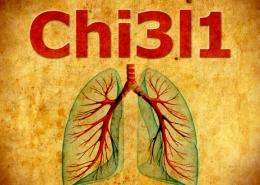
(Medical Xpress) -- A mysterious protein produced by a wide spectrum of living things is crucial in regulating the immune response to the most common form of pneumonia, a new Yale School of Medicine study shows. The study appears online in Cell Host & Microbe and in the July 19 print issue.

The — present in the blood of every human being – is crucial to a successful response to the bacteria and also seems to prevent that response from damaging the host, according to the researchers.

“We believe this may be a major cornerstone in our understanding how we respond to many different kinds of pathogens,” said Dr. Jack A. Elias, chair of the Department of Internal Medicine and senior author of the paper.

The Yale team investigated the protein, which has a number of names including chitinase 3-like-1 (Chi3l1), because it is a member of an ancient family of proteins found in species as diverse as plants, insects, and humans. This evolutionary conservation led researchers to believe that Chi3l1 plays an essential role in these organisms. However little was known about the functions of this protein in health or disease.  

The Yale team found that when mice lacking this key protein were exposed to Streptococcus pneumoniae, they experienced exaggerated levels of inflammation, suffered much greater damage from inflammation and hemorrhage, and had a higher rate of mortality and sepsis (blood poisoning) than those with the protein. They found that the protein helped immune system cells called macrophages to clear the pathogens from the body.

They also found that Chi311 inhibited the innate and decreased its ability to damage tissue in the host. The latter is particularly important, note the researchers, because an overwhelming innate immune system response contributes to the adverse consequences of infections, such as respiratory failure and sepsis, which are among the highest causes of death in hospitals.

“In recent years there has been a much greater appreciation that the perfect immune system response is one that eliminates bacteria but does not kill the host,” said Dr. Charles Dela Cruz, assistant professor of medicine and lead author of the paper. “This molecule seems to help the organism achieve that balance.”

Journal reference: Cell Host & Microbe search and more info website

Provided by Yale University search and more info website

5 /5 (2 votes)  

Rank 5 /5 (2 votes)
Relevant PhysicsForums posts

More news stories

Discovery of novel medicine for treatment of chronic wounds

Every 20 seconds, a limb is lost as a consequence of diabetic foot ulcer that does not heal. To date, medical solutions that can change this situation are very limited. In his doctoral thesis Yue Shen from the Industrial ...

Medical research created 1 hour ago | popularity not rated yet | comments 0

Lymphatic fluid takes detour

When tumours metastasise, they can block lymphatic vessels, as researchers from ETH Zurich have discovered using a new method. The lymphatic fluid subsequently has to find a new path through the tissue. Such ...

Medical research created 1 hour ago | popularity not rated yet | comments 0 | with audio podcast

Computational tool translates complex data into simplified 2-dimensional images

In their quest to learn more about the variability of cells between and within tissues, biomedical scientists have devised tools capable of simultaneously measuring dozens of characteristics of individual ...

Medical research created 19 hours ago | popularity 5 / 5 (3) | comments 0 | with audio podcast

Now we know why old scizophrenia medicine works on antibiotics-resistant bacteria

In 2008 researchers from the University of Southern Denmark showed that the drug thioridazine, which has previously been used to treat schizophrenia, is also a powerful weapon against antibiotic-resistant bacteria such as ...

Medical research created May 17, 2013 | popularity 4 / 5 (4) | comments 0 | with audio podcast

SUMO wrestling cells reveal new protective mechanism target for stroke

Scientists investigating the interaction of a group of proteins in the brain responsible for protecting nerve cells from damage have identified a new target that could increase cell survival.

Medical research created May 17, 2013 | popularity 5 / 5 (1) | comments 0


Rise in type 2 diabetes amongst young

The number of young people diagnosed with type 2 diabetes has seen the sharpest rise over the last twenty years compared to a background of a general increase across the board, new University research has ...

Vitamin D could provide new and effective treatments for asthma

(Medical Xpress)—Scientists at King's College London have discovered that Vitamin D has the potential to significantly reduce the symptoms of asthma. The study, led by Professor Catherine Hawrylowicz from ...

Research uncovers a potential role of two proteins in diabetes

(Medical Xpress)—Flinders University researchers are breaking new ground in a decade-long journey to pinpoint the function of two closely related proteins.

Immune protein could stop diabetes in its tracks

Melbourne researchers have identified an immune protein that has the potential to stop or reverse the development of type 1 diabetes in its early stages, before insulin-producing cells have been destroyed.

Measles surges in UK years after vaccine scare

More than a decade ago, British parents refused to give measles shots to at least a million children because of a vaccine scare that raised the specter of autism. Now, health officials are scrambling to catch ...

Rethinking treatment goals improves results for 'untreatable' anorexics

(Medical Xpress)—Patients with the most severe and dangerous form of chronic anorexia are more likely to make a significant improvement towards recovery and stay in therapy if traditional psychological treatments are re-focused ...