Strobe eyewear training improves visual memory
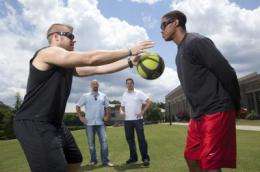
Stroboscopic training, performing a physical activity while using eyewear that simulates a strobe-like experience, has been found to increase visual short-term memory retention, and the effects last for 24 hours.
Participants in a Duke University study engaged in physical activities, such as playing catch, while using either specialized eyewear that limits vision to only brief snapshots or while using eyewear with clear lenses that provides uninterrupted vision. Participants from the Duke community, including varsity athletes, completed a computer-based visual memory test before and after the physical activities. The study found that participants who trained with the strobe eyewear gained a boost in visual memory abilities.
Participants completed a memory test that required them to note the identity of eight letters of the alphabet that were briefly displayed on a computer screen. After a variable delay, participants were asked to recall one of the eight letters. On easy-level trials, the recall prompt came immediately after the letters disappeared, but on more difficult trials, the prompt came as late as 2.5 seconds following the display. Because participants did not know which letter they would be asked to recall, they had to retain all of the items in memory.
"Humans have a memory buffer in their brain that keeps information alive for a certain short-lived period," said Greg Appelbaum, assistant professor of psychiatry at Duke and first author of the study. "Wearing the strobe eyewear during the physical training seemed to boost the ability to retain information in this buffer."
The strobe eyewear disrupts vision by only allowing the user to see glimpses of the world. Users must adjust their visual processing in order to perform normally, and this adjustment produces a lingering benefit: once participants removed the strobe eyewear, there was an observed boost in their visual memory retention that was found to still be active 24 hours later.
Earlier work by Appelbaum and the project's senior researcher, Stephen Mitroff, had shown that stroboscopic training improves visual perception, including the ability to detect subtle motion cues and the processing of briefly presented visual information. Yet the earlier study had not determined how long the benefits might last.
"Our earlier work on stroboscopic training showed that it can improve perceptual abilities, but we don't know exactly how," said Mitroff, associate professor of psychology and neuroscience and member of the Duke Institute for Brain Sciences. "This project takes a big step by showing that these improved perceptual abilities are driven, at least in part, by improvements in visual memory."
"Improving human cognition is an important goal with so many benefits," said Appelbaum, also a member of the Duke Institute for Brain Sciences. "Interestingly, our findings demonstrate one way in which visual experience has the capacity to improve cognition."
Participants for the study came from the 2010-2011 Duke University men's and women's varsity soccer teams, Duke's 2010-2011 men's basketball team and members of the general university community. Mitroff reported that participants had little or no trouble with the stroboscopic training, and several participants later returned to inquire about how they could be involved as research assistants.
The research was supported by Nike SPARQ Sensory Performance, which designed the eyewear and is marketing it as Nike SPARQ Vapor Strobe. The study appeared online July 19 in Attention, Perception, & Psychophysics.
More information: "Stroboscopic visual training improves information encoding in short-term memory," L. Gregory Appelbaum, Matthew S. Cain, Julia E. Schroeder, Elise F. Darling, and Stephen R. Mitroff, Attention, Perception, & Psychophysics, July 2012. DOI 10.3758/s13414-012-0344-6


