Analyzing tumor cells in blood using nanomagnets
July 16, 2012 in Medical research
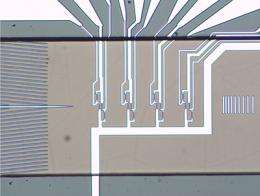
Siemens' researchers have been able to analyze blood cells by employing the same magnetic reading technology as is used for computer hard drives. They have developed a prototype for the magnetic flow cytometry of blood. Blood is the most important source of diagnostic information for doctors tracking the success of therapy for a tumor or HIV. For their new process, the researchers are taking advantage of the GMR (giant magnetoresistance) effect. The picture shows a chip which analyzes blood and provides four bit information per cell. With this information the researchers can determine the cell's diameter and the speed at which it is moving — information which allows them to make accurate conclusions about whether it is a tumor cell or not.
Siemens' researchers have been able to analyze blood cells by employing the same magnetic reading technology as is used for computer hard drives. They have developed a prototype for the magnetic flow cytometry of blood. Blood is the most important source of diagnostic information for doctors tracking the success of therapy for a tumor or HIV. For their new process, the researchers are taking advantage of the GMR (giant magnetoresistance) effect, the discovery of which was the subject of the 2007 Nobel Prize in Physics.
In the field of medical diagnostics, an optical method of measurement for examining the characteristics of individual cells has existed for decades, remaining largely unchanged from the time it was developed. This method is known as flow cytometry, and can be used to identify specific cells, such as circulating tumor cells. Extracting cell data from whole blood, however, requires a time-consuming process. So the costs for traditional flow cytometry are too high for general clinical use or decentralized implementation, and growth in the market for this equipment has mostly been confined to the area of research.
But in the future, the new magnetic flow cytometry could offer a way of carrying out blood testing nearer to the patient (point-of-care), offering a method for specific cell detection in addition to a complete blood count. The scientists at Siemens Corporate Technology are employing GMR reading processes in combination with superparamagnetically marked cells. Their demonstration model, which is not yet ready for the market, can quantitatively detect specifically marked analytes in whole blood, without requiring pre-conditioning of the sample, such as the lysis (destruction) of red blood cells. Specifically, the marking of these analyte blood cells is accomplished using antibodies, which have superparamagnetic nanoparticles (beads) hanging on them. A magnet then attracts the marked cells, so that they are separated out and, like pearls on a string, they are counted by the GMR sensor.
This process enables the quantitative identification of tumor cells, for example. Through this special experimental design the researchers get four bits of information for each individual cell that is measured. With this information they can determine the cell's diameter and the speed at which it is moving - information which allows them to make accurate conclusions about whether it is a tumor cell or not. Recently, the researchers showed that miniaturization of this kind of measuring system would be possible. For demonstrating this possibility in his bachelor's thesis, a researcher won the Innovation Prize for Applied Research from Regensburg University of Applied Sciences
Provided by Siemens
-
Finding cancer cells in blood: Chip-based method for the rapid, sensitive isolation of rare cells in blood
Mar 02, 2012 |
not rated yet |
0
-
New detector for rare cancer cells
Jul 07, 2012 |
not rated yet |
0
-
New chemistry technology promises more effective prescription drug therapies
May 09, 2011 |
not rated yet |
0
-
Molecules on branched-polymer surfaces can capture rare tumor cells in blood
Nov 17, 2011 |
not rated yet |
0
-
Using magnets to help prevent heart attacks
Jun 07, 2011 |
not rated yet |
0
-
Motion perception revisited: High Phi effect challenges established motion perception assumptions
Apr 23, 2013 |
3 / 5 (2) |
2
-
Anything you can do I can do better: Neuromolecular foundations of the superiority illusion (Update)
Apr 02, 2013 |
4.5 / 5 (11) |
5
-
The visual system as economist: Neural resource allocation in visual adaptation
Mar 30, 2013 |
5 / 5 (2) |
9
-
Separate lives: Neuronal and organismal lifespans decoupled
Mar 27, 2013 |
4.9 / 5 (8) |
0
-
Sizing things up: The evolutionary neurobiology of scale invariance
Feb 28, 2013 |
4.8 / 5 (10) |
14
-
Pressure-volume curve: Elastic Recoil Pressure don't make sense
May 18, 2013
-
If you became brain-dead, would you want them to pull the plug?
May 17, 2013
-
MRI bill question
May 15, 2013
-
Ratio of Hydrogen of Oxygen in Dessicated Animal Protein
May 13, 2013
-
Alcohol and acetaminophen
May 13, 2013
-
Marie Curie's leukemia
May 13, 2013
- More from Physics Forums - Medical Sciences
More news stories
Now we know why old scizophrenia medicine works on antibiotics-resistant bacteria
In 2008 researchers from the University of Southern Denmark showed that the drug thioridazine, which has previously been used to treat schizophrenia, is also a powerful weapon against antibiotic-resistant bacteria such as ...
Medical research
May 17, 2013 |
3.7 / 5 (3) |
0
|
SUMO wrestling cells reveal new protective mechanism target for stroke
Scientists investigating the interaction of a group of proteins in the brain responsible for protecting nerve cells from damage have identified a new target that could increase cell survival.
Medical research
May 17, 2013 |
5 / 5 (1) |
0
How serotonin receptors can shape drug effects, from LSD to migraine medication
New findings by researchers carrying out experiments at the U.S. Department of Energy Office of Science's Advanced Photon Source (APS) help explain why some drugs that interact with two kinds of human serotonin ...
Medical research
May 17, 2013 |
not rated yet |
0
|
Preventing blood poisoning
Peptide molecules derived from the body's natural immune system can help boost the body's defence against life-threatening blood poisoning, joint University research has uncovered.
Medical research
May 17, 2013 |
4 / 5 (1) |
0
|
New mechanism to prevent type 2 diabetes in obese individuals
A new Montréal study conducted by Dr. May Faraj, associate research professor at the Université de Montréal and invited scientist at the IRCM, along with her research team and medical collaborators, shows ...
Medical research
May 17, 2013 |
not rated yet |
0
|
Ketamine shows significant therapeutic benefit in people with treatment-resistant depression
Patients with treatment-resistant major depression saw dramatic improvement in their illness after treatment with ketamine, an anesthetic, according to the largest ketamine clinical trial to-date led by researchers from the ...
Consuming coffee linked to lower risk of detrimental liver disease, study finds
Regular consumption of coffee is associated with a reduced risk of primary sclerosing cholangitis (PSC), an autoimmune liver disease, Mayo Clinic research shows. The findings were being presented at the Digestive Disease ...
Research examines new methods for managing digestive health
Research presented at Digestive Disease Week (DDW) explores new methods for managing digestive health through diet and lifestyle.
New research identifies risks, interventions for children's GI health
An increasing number of U.S. children are experiencing gastrointestinal issues that require interventions to resolve, according to research presented at Digestive Disease Week (DDW).
New smartphone application improves colonoscopy preparation
The use of a smartphone application significantly improves patients' preparation for a colonoscopy, according to new research presented today at Digestive Disease Week (DDW). The preparation process, which begins days in ...
New research identifies practice changes to improve value and quality of GI procedures
There are significant cost and risk factors associated with two procedures commonly used to diagnose or treat gastrointestinal problems, according to research presented at Digestive Disease Week (DDW).