Utah researchers developing prosthetic implant
July 27, 2012 in Medical research
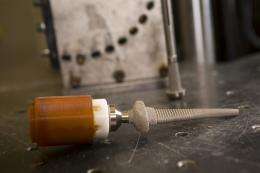
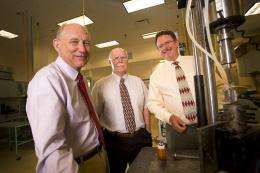
A new implantable prosthetic device is being developed by researchers at the University of Utah and George E. Wahlen Department of Veterans Affairs Medical Center. Nothing like it has been used on a human in the United States. Photo Credit: Kent Bachus, Roy Bloebaum and Peter Beck (left to right) are researchers at the University of Utah and George E. Wahlen Department of Veterans Affairs Medical Center. They are developing an implantable prosthetic device that was recently approved for a FDA feasibility study.
Thousands of veterans and warfighters returning to the U.S. suffer with limb amputations, and for many, standard prosthetics are not an option. Skin issues or short remaining-limb length can cause amputees to forgo the typical socket-type attachment systems.
A team of researchers and surgeons from the University of Utah and the George E. Wahlen Department of Veterans Affairs (VA) Medical Center in Salt Lake City hope to provide an alternative solution via osseointegrated direct skeletal attachment of prosthetic limbs for these veterans and the many others with a similar condition. For the last six years, this team has been developing a device that can be implanted directly into a persons residual bone, passing through the skin, so they can securely attach a prosthetic limb without the need for a socket.
We are trying desperately to provide relief to the many veterans who have lost a limb, says Roy Bloebaum, professor of orthopaedics at the University of Utah and the director of the VA Bone and Joint Research Lab. Most of these people are very young and have many years to live. Our goal is to give them back all of the abilities they had before they were injured.
Nothing like it has been done at a U.S. hospital, and the procedure has only been attempted an estimated 250 times worldwide in Europe and Australia, with mixed results.
A new implantable prosthetic device is being developed by researchers at the University of Utah and George E. Wahlen Department of Veterans Affairs Medical Center. Nothing like it has been used on a human in the United States. Photo Credit: Courtesy of Technology Venture Development
Bloebaum is working with two other University of Utah professors Kent Bachus, an engineer and a professor of orthopaedics and director of the Orthopaedic Research Lab at the university, and Peter Beck, an orthopaedic surgeon and adjunct professor of orthopaedics.Their research recently hit two milestones. One was a partnership with DJO Surgical, a global developer, manufacturer and distributor of medical devices, which has licensed the implant technology and is assisting with the remaining research and development. The other milestone was being accepted into a new Food and Drug Administration program that allows them to design a human early feasibility study. DJO Surgical applied for the FDA study and is responsible for managing its implementation.
The early feasibility study will last up to three years. During that time, the clinical research team will implant their device into 10 patients. A unique element will be the ability to develop and refine their device between operations, which should accelerate the overall refinement process by compressing the development cycle.
We have already addressed some of the major research challenges with osseointegrated implant devices Bachus says.
Researchers studying these implants have faced three fundamental problems getting the bone to grow into the device, preventing infection and determining how to address the skin interface.
Researchers believe they have already addressed most of these problems, as the solutions lie in the design of their device and the materials used. Specifically, the titanium device is integral to its success because it is coated with a porous titanium material called P2 (P squared), which is a proprietary coating that is owned by DJO. Skin and bone grows into the material, forming a secure bond.
Bloebaum, Bachus and Beck still have a long way to go before U.S. hospitals will be offering their implant prosthesis. They are currently working to secure $5 million in grants and partnerships like the one with DJO.
We are excited to sign this partnership agreement with the University of Utah and Dr. Bloebaum, says Bryan Monroe, DJOs senior vice president and general manager of DJO Surgical. With the combination of our proprietary titanium P2 porous coating and Dr. Bloebaums unique approach for percutaneous osseointegrated prosthesis, we believe that we have developed a winning solution that will have a monumental impact on the lives of amputees.
Provided by
University of Utah
-
Mathematicians design bone implants for the future
Feb 03, 2011 |
not rated yet |
0
-
Of life and limb
Jan 05, 2012 |
not rated yet |
0
-
Nanostructures improve bone response to titanium implants
Jul 03, 2008 |
not rated yet |
0
-
Crowning glory: Bonelike coating for dental implants makes everyone smile
Apr 04, 2008 |
not rated yet |
0
-
New 'bionic' leg gives amputees a natural gait
Aug 17, 2011 |
not rated yet |
0
-
Motion perception revisited: High Phi effect challenges established motion perception assumptions
Apr 23, 2013 |
3 / 5 (2) |
2
-
Anything you can do I can do better: Neuromolecular foundations of the superiority illusion (Update)
Apr 02, 2013 |
4.5 / 5 (11) |
5
-
The visual system as economist: Neural resource allocation in visual adaptation
Mar 30, 2013 |
5 / 5 (2) |
9
-
Separate lives: Neuronal and organismal lifespans decoupled
Mar 27, 2013 |
4.9 / 5 (8) |
0
-
Sizing things up: The evolutionary neurobiology of scale invariance
Feb 28, 2013 |
4.8 / 5 (10) |
14
-
How can there be villous adenoma in colon, if there are no villi there
16 hours ago
-
How can there be a term called "intestinal metaplasia" of stomach
May 21, 2013
-
Pressure-volume curve: Elastic Recoil Pressure don't make sense
May 18, 2013
-
If you became brain-dead, would you want them to pull the plug?
May 17, 2013
-
MRI bill question
May 15, 2013
-
Ratio of Hydrogen of Oxygen in Dessicated Animal Protein
May 13, 2013
- More from Physics Forums - Medical Sciences
More news stories
Baby's life saved with groundbreaking 3-D printed device that restored his breathing
Every day, their baby stopped breathing, his collapsed bronchus blocking the crucial flow of air to his lungs. April and Bryan Gionfriddo watched helplessly, just praying that somehow the dire predictions ...
Medical research
6 hours ago |
5 / 5 (1) |
0
Research shows how immune system peacefully co-exists with 'good' bacteria
The human gut is loaded with commensal bacteria – "good" microbes that, among other functions, help the body digest food. The gastrointestinal tract contains literally trillions of such cells, and yet the ...
Medical research
10 hours ago |
5 / 5 (3) |
0
|
Slowing the aging process—only with antibiotics
Swiss scientists reveal the mechanism responsible for aging hidden deep within mitochondria—and dramatically slow it down in worms by administering antibiotics to the young.
Medical research
10 hours ago |
4.8 / 5 (6) |
0
|
How healthy are you for your age?
On May 22, JoVE will publish details of a technique to measure the health of human genetic material in relation to a patient's age. The method is demonstrated by the laboratory of Dr. Gil Atzmon at New York's Albert Einste ...
Medical research
13 hours ago |
not rated yet |
0
A molecular explanation for age-related fertility decline in women
(Medical Xpress)—Scientists supported by the National Institutes of Health have a new theory as to why a woman's fertility declines after her mid-30s. They also suggest an approach that might help slow ...
Medical research
15 hours ago |
not rated yet |
0
|
Researchers complete largest genetic sequencing study of human disease
Researchers from Queen Mary, University of London have led the largest sequencing study of human disease to date, investigating the genetic basis of six autoimmune diseases.
Brain can be trained in compassion, study shows
Until now, little was scientifically known about the human potential to cultivate compassion—the emotional state of caring for people who are suffering in a way that motivates altruistic behavior.
Having both migraines, depression may mean smaller brain
(HealthDay)—Migraines and depression can each cause a great deal of suffering, but new research indicates the combination of the two may be linked to something else entirely—a smaller brain.
Novel approach for influenza vaccination shows promise in early animal testing
A new approach for immunizing against influenza elicited a more potent immune response and broader protection than the currently licensed seasonal influenza vaccines when tested in mice and ferrets. The vaccine ...
Enzyme-activating antibodies revealed as marker for most severe form of rheumatoid arthritis
In a series of lab experiments designed to unravel the workings of a key enzyme widely considered a possible trigger of rheumatoid arthritis, researchers at Johns Hopkins have found that in the most severe ...
Research offers promising new approach to treatment of lung cancer
Researchers have developed a new drug delivery system that allows inhalation of chemotherapeutic drugs to help treat lung cancer, and in laboratory and animal tests it appears to reduce the systemic damage ...
