Australian court OKs logo ban on cigarette packs
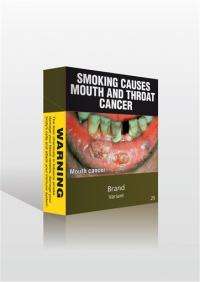
(AP) — Australia's highest court on Wednesday upheld the world's toughest law on cigarette promotion, meaning tobacco companies will be prohibited from displaying their logos on cigarette packs that will instead feature images of cancer-riddled mouths, blinded eyeballs and sickly children.
The High Court rejected a challenge by tobacco companies who argued the value of their trademarks will be destroyed if they are no longer able to display their distinctive colors, brand designs and logos on packs of cigarettes.
Starting in December, packs will instead come in a uniformly drab shade of olive and feature dire health warnings and graphic photographs of smoking's health effects. The government, which has urged other countries to adopt similar rules, hopes the new packs will make smoking as unglamorous as possible.
"Many other countries around the world ... will take heart from the success of this decision today," Attorney General Nicola Roxon told reporters after the court ruling.
"Governments can take on big tobacco and win and it's worth countries looking again at what the next appropriate step is for them," she added.
British American Tobacco, Philip Morris International, Imperial Tobacco and Japan Tobacco International are worried that the law will set a global precedent that could slash billions of dollars from the values of their brands. They challenged the new rules on the grounds that they violate intellectual property rights and devalue their trademarks.
The cigarette makers argued that the government would unfairly benefit from the law by using cigarette packs as a platform to promote its own message, without compensating the tobacco companies. Australia's constitution says the government can only acquire the property of others on "just terms."
The court, which ordered the tobacco companies to pay the government's legal fees, withheld its reasons for the judgment on Wednesday. They'll be released later this year.
Philip Morris said it would continue to pursue compensation through the terms of a bilateral investment treaty between Australia and Hong Kong.
"There is still a long way to go before all the legal questions about plain packaging are fully explored and answered," company spokesman Chris Argent said in a statement.
British American Tobacco spokesman Scott McIntyre said the company was disappointed in the court's decision but would comply with the law.
"Although the (law) passed the constitutional test, it's still a bad law that will only benefit organized crime groups which sell illegal tobacco on our streets. ... The illegal cigarette black market will grow further when all packs look the same and are easier to copy," McIntyre said in a statement.
Imperial Tobacco echoed that argument.
"Plain packaging will simply provide counterfeiters with a road map," spokeswoman Sonia Stewart said in a statement. "The legislation will make the counterfeiters' job both cheaper and easier by mandating exactly how a pack must look."
Australia's Health Minister Tanya Plibersek dismissed those claims, saying there are still measures to prevent counterfeiting, such as the use of alphanumeric codes on legitimate cigarette packs.
Australia faces a potential challenge to its laws through the World Trade Organization, with three tobacco growing countries — Ukraine, Honduras and the Dominican Republic — making official requests for consultation on plain packaging. Consultations are the first stage of the WTO's dispute resolution process.
These countries argue that the laws contravene Australia's international obligations in respect to trade-related aspects of intellectual property.
Roxon said while countries had raised with Australia the trade implications of the laws, her government would fight to maintain them.
"It's never been asserted successfully around the world in any trade dispute that governments are not allowed to take public health measures to protect their community," she said.
Ross McKenzie, a Macquarie University lecturer on health studies, said it was likely that the tobacco industry was behind the WTO challenge.
"From everything I've read, the challenges won't be particularly strong," McKenzie said.
"The trademarks aren't being expropriated; they're being restricted in their use, which is quite different. There're lots of trademarks that are restricted by lots of governments," he added.
Tobacco advertising was banned from Australian television and radio in 1976. Restrictions on advertising have tightened over the years to include print ads, the Internet and retail outlets.
Smokers account for 17 percent of Australia's population, compared with around 20 percent of American adults.
With high taxes aimed at dissuading smokers, a pack of 25 cigarettes retails in Australia for about 16 Australian dollars ($17).
Copyright 2012 The Associated Press. All rights reserved. This material may not be published, broadcast, rewritten or redistributed.


