New cancer therapy using ultra-violet C (UVC) pulse flash irradiation
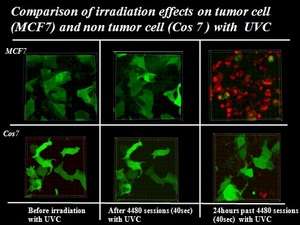
MCF7: neoplastic cell, COS7:non-neoplastic cell. The Ultra Violet C (UVC) pulse flash irradiation only selectivity caused death of neoplastic cells, and not non-neoplastic cells. © Tokai University
Johbu Itoh at the Tokai University School of Medicine in Japan has developed a new and highly effective cancer therapy method where cancer cells are irradiated with ultraviolet C (UVC) light. The new method employs high intensity-UVC pulse flash rays (UVCPFR) of a broad UVC spectrum (230 to 280 nm) produced by a modified UV-flash sterilization system (BHX200). The experiments showed the pulsed nature of the spectrum to enhance the efficiency of destruction of neoplastic cells.
Importantly, the research demonstrates that under the appropriate UVC irradiation conditions, only neoplastic cell were destroyed, while non-neoplastic cells did not.
The well-known "germicidal light" of low pressure mercury lamps (UV lamp) is widely used for sterilizing medical instruments. However, it takes several hours for the weak light from UV lamps to have their germicidal effects.
In contrast, the sterilization effects of UV pulsed flash rays (wavelengths of 230-280nm and peak wavelength of 248 nm) show promise as a more efficient and rapid means of destroying a wider range of bacteria because this type of irradiation produces light whose energy is tens of thousands of times greater for a given area of irradiation, compared with conventional UV lamps (65W equivalency).
UVC pulse flash rays (UVCPFR), with 1-10 continuous flashes per second, can be produced by a powerful discharge of xenon gas. Johbu Itoh and colleagues at the Tokai University School of Medicine has developed and established UVCPFR therapy system for cancer therapy.
The researchers irradiated cells with pulsed light UVCPFR and caused functional disorder to produce cell injury and/or a functional obstruction only to neoplastic cells. Higher ultraviolet radiation sensitivity in the UVC range was observed in neoplastic cells compared to non-neoplastic cells. That is, a short burst of ultraviolet radiation was sufficient to selectively induce injury and death to neoplastic cells.
Furthermore, experiments showed UVCPFR to cause cell death within a few seconds. One of the major features of this method is that below a certain range of irradiation conditions, damage to intact or non-neoplastic cells can be largely ignored, and only neoplastic cells die. This method offers a simple means of reducing the burden on patients undergoing cancer therapy. Itoh and colleagues plan to adapt this system for cancer treatment using endoscopy, laser microscopy, and other such light irradiation equipment.
More information: www.acplan.jp/ichc2012/
Provided by Tokai University School of Medicine
-
UVC light kills wound bacteria
Jul 23, 2012 |
not rated yet |
0
-
What happens when we sunburn: Researchers describe inflammatory mechanism for first time
Jul 08, 2012 |
not rated yet |
0
-
Light dynamics for cancer treatment
May 03, 2012 |
not rated yet |
0
-
Study reveals harmful effects of compact fluorescent light bulbs to skin
Jul 19, 2012 |
not rated yet |
0
-
Researchers explain cell response to skin-damaging UV rays
Oct 01, 2007 |
not rated yet |
0
-
Motion perception revisited: High Phi effect challenges established motion perception assumptions
Apr 23, 2013 |
3 / 5 (2) |
2
-
Anything you can do I can do better: Neuromolecular foundations of the superiority illusion (Update)
Apr 02, 2013 |
4.5 / 5 (11) |
5
-
The visual system as economist: Neural resource allocation in visual adaptation
Mar 30, 2013 |
5 / 5 (2) |
9
-
Separate lives: Neuronal and organismal lifespans decoupled
Mar 27, 2013 |
4.9 / 5 (8) |
0
-
Sizing things up: The evolutionary neurobiology of scale invariance
Feb 28, 2013 |
4.8 / 5 (10) |
14
-
Pressure-volume curve: Elastic Recoil Pressure don't make sense
May 18, 2013
-
If you became brain-dead, would you want them to pull the plug?
May 17, 2013
-
MRI bill question
May 15, 2013
-
Ratio of Hydrogen of Oxygen in Dessicated Animal Protein
May 13, 2013
-
Alcohol and acetaminophen
May 13, 2013
-
Marie Curie's leukemia
May 13, 2013
- More from Physics Forums - Medical Sciences
More news stories
New smartphone application improves colonoscopy preparation
The use of a smartphone application significantly improves patients' preparation for a colonoscopy, according to new research presented today at Digestive Disease Week (DDW). The preparation process, which begins days in ...
Cancer
23 hours ago |
not rated yet |
0
Research examines new methods for managing digestive health
Research presented at Digestive Disease Week (DDW) explores new methods for managing digestive health through diet and lifestyle.
Cancer
May 19, 2013 |
not rated yet |
1
New colonoscope provides ground-breaking view of colon
A ground-breaking advance in colonoscopy technology signals the future of colorectal care, according to research presented today at Digestive Disease Week(DDW). Additional research focuses on optimizing the minimal withdrawal ...
Cancer
May 18, 2013 |
5 / 5 (2) |
0
ASCO: combo antibody therapy effective for melanoma
(HealthDay)—Concurrent use of two immune checkpoint antibodies—ipilimumab and nivolumab—may be effective for the treatment of advanced melanoma, according to a proof-of-principal study presented in ...
Cancer
May 17, 2013 |
not rated yet |
0
Risk factors ID'd for poor cutaneous cell CA outcomes
(HealthDay)—The risks of metastasis and death associated with cutaneous squamous cell carcinoma (CSCC) are low, but significant, and risk factors for poor outcome include tumor diameter, invasion beyond ...
Cancer
May 17, 2013 |
not rated yet |
0
|
New theory on genesis of osteoarthritis comes with successful therapy in mice
Scientists at Johns Hopkins have turned their view of osteoarthritis (OA) inside out. Literally. Instead of seeing the painful degenerative disease as a problem primarily of the cartilage that cushions joints, ...
Computational tool translates complex data into simplified 2-dimensional images
In their quest to learn more about the variability of cells between and within tissues, biomedical scientists have devised tools capable of simultaneously measuring dozens of characteristics of individual ...
Researchers identify a potential new risk for sleep apnea: Asthma
Researchers at the University of Wisconsin have identified a potential new risk factor for obstructive sleep apnea: asthma. Using data from the National Institutes of Health (Heart, Lung, and Blood Institute)-funded Wisconsin ...
Study finds that sleep apnea and Alzheimer's are linked
A new study looking at sleep-disordered breathing (SDB) and markers for Alzheimer's disease (AD) risk in cerebrospinal fluid (CSF) and neuroimaging adds to the growing body of research linking the two.
'Gap' for HIV vaccine efforts after latest setback
The hunt for an HIV vaccine has gobbled up $8 billion in the past decade, and the failure of the most recent efficacy trial has delivered yet another setback to 26 years of efforts.
Ginger compounds may be effective in treating asthma symptoms
Gourmands and foodies everywhere have long recognized ginger as a great way to add a little peppery zing to both sweet and savory dishes; now, a study from researchers at Columbia University shows purified components of the ...