Color-coded labels improve healthy food choices in employees from all backgrounds

In the Massachusetts General Hospital cafeteria, color-coded labels indicate the healthiest sandwich choices (green), along with those designated less (yellow) and least (red) healthy. Credit: Massachusetts General Hospital Nutrition and Food Service
A program designed to encourage more healthful food choices through simple color-coded labels and the positioning of items in display cases was equally successful across all categories of employees at a large hospital cafeteria. In an article appearing in American Journal of Preventive Medicine, a team of Massachusetts General Hospital (MGH) researchers report that the interventions worked equally well across all racial and ethnic groups and educational levels.
"These findings are important because obesity is much more common among Americans who are black or Latino and among those of low socioeconomic status," says Douglas Levy, PhD, of the Mongan Institute for Health Policy at MGH, lead author of the AJPM report. "Improving food choices in these groups may help reduce their obesity levels and improve population health."
The authors note that current efforts to encourage healthful food choices by labeling or posting the calorie content of foods have had uncertain results. Even individuals with relatively high educational levels may have difficulty reading and understanding nutritional labels, and the problem is probably greater among low-income or minority individuals with limited literacy. As reported earlier this year, the MGH research team which includes leaders of the MGH Nutrition and Food Service devised a two-phase plan to encourage more healthful food purchases without the need for complex food labels.
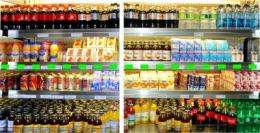
The before (left) image shows sugar-sweetened soft drinks and juices were mixed together with diet beverages and low-fat dairy items. The after (right) image shows water, diet beverages and other healthy choices are placed at or above eye level (dotted green line), while less healthy items are below. Credit: Massachusetts General Hospital Nutrition and Food Service
In the first phase, which began in March 2010, color-coded labels were attached to all items in the main hospital cafeteria green signifying the healthiest items, such as fruits, vegetables and lean meats; yellow indicating less healthy items, and red for those with little or no nutritional value. The second "choice architecture" phase, which began in June 2010, focused on popular items cold beverages, pre-made sandwiches and chips likely to be purchased by customers with little time to spend who may be more influenced by location and convenience. Cafeteria beverage refrigerators were arranged to place water, diet beverages and low-fat dairy products at eye level, while beverages with a red or yellow label were placed below eye level. Refrigerators and racks containing sandwiches or chips were similarly arranged, and additional baskets of bottled water were placed near stations where hot food was served.
The study was designed to measure changes in employee purchases of green-, yellow- and red-labeled items by racial/ethnic categories and by job type during both phases of the program. Data reflecting purchases by more than 4,600 employees, each of whom was enrolled in a program allowing them to pay for meals through payroll deduction, was recorded by cafeteria cash registers and matched to human resources information. While it was possible to track how an individual employee's food choices changed during the study period, no information that could identify an employee was available to the research team. Participants were categorized by self-reported race or ethnicity white, black, Latino or Asian. Educational level was reflected by job type service workers; administrative/support staff; technicians, including radiology technicians and respiratory therapists; health professionals, such as pharmacists and occupational therapists; or management/clinicians, which included physicians and nurses.
At the outset of the study, black and Latino employees and those in job categories associated with lower education purchased more red items and fewer green items than did white employees or those in higher-education job types. But at the end of both phases of the intervention, employees in all groups purchased fewer red items and more green items. A specific analysis of beverage purchases chosen because the consumption of sugar-sweetened beverage is highest among black and low-income individuals and strongly linked to obesity, diabetes and heart disease found that the purchase of healthful beverages increased for all groups. In addition, black and low-education employees, who paid the highest cost per beverage at the study's outset, were paying significantly less per beverage purchased at the end of the study period.
All elements of the overall program remain in place at the MGH, and the color-coded labeling has been extended to all food service sites. "Further study is needed to determine the long-term effect of these interventions and whether additional steps could improve their effectiveness in particularly vulnerable populations," says Levy, an assistant professor of Medicine at Harvard Medical School. "But because these measures are both simple and inexpensive to implement, they could easily be tried in a variety of food sales environments such as cafeterias, convenience stories and even vending machines."
Journal reference:
American Journal of Preventive Medicine
Provided by
Massachusetts General Hospital
-
Color-coding, rearranging food products improves healthy choices in hospital cafeteria
Jan 19, 2012 |
not rated yet |
0
-
Are you a healthy grocery shopper?
May 03, 2012 |
not rated yet |
0
-
Seeing certain foods prompts kids to eat healthier
Jul 25, 2012 |
not rated yet |
0
-
Children who eat vended snack foods face chronic health problems, poor diet
Sep 02, 2010 |
not rated yet |
0
-
Study: Middle school students prefer soda
Oct 05, 2006 |
not rated yet |
0
-
Motion perception revisited: High Phi effect challenges established motion perception assumptions
Apr 23, 2013 |
3 / 5 (2) |
2
-
Anything you can do I can do better: Neuromolecular foundations of the superiority illusion (Update)
Apr 02, 2013 |
4.5 / 5 (11) |
5
-
The visual system as economist: Neural resource allocation in visual adaptation
Mar 30, 2013 |
5 / 5 (2) |
9
-
Separate lives: Neuronal and organismal lifespans decoupled
Mar 27, 2013 |
4.9 / 5 (8) |
0
-
Sizing things up: The evolutionary neurobiology of scale invariance
Feb 28, 2013 |
4.8 / 5 (10) |
14
-
Classical and Quantum Mechanics via Lie algebras
Apr 15, 2011
- More from Physics Forums - Independent Research
More news stories
New research identifies risks, interventions for children's GI health
An increasing number of U.S. children are experiencing gastrointestinal issues that require interventions to resolve, according to research presented at Digestive Disease Week (DDW).
Health
May 18, 2013 |
not rated yet |
0
|
Youth who have their first drink during puberty have higher levels of later drinking
Research shows that the earlier the age at which youth take their first alcoholic drink, the greater the risk of developing alcohol problems. Thus, age at first drink (AFD) is generally considered a powerful predictor of ...
Health
May 17, 2013 |
not rated yet |
0
British MPs concerned about parliamentary boozing
One quarter of British lawmakers believe there is an "unhealthy" drinking culture in the Houses of Parliament, according to a survey published on Friday.
Health
May 17, 2013 |
not rated yet |
0
Patient openness to research can depend on race and sex of study personnel
Researchers at the University of Cincinnati (UC) have found that the race and sex of study personnel can influence a patient's decision on whether or not to participate in clinical research.
Health
May 17, 2013 |
not rated yet |
0
Clinical support for patient self-management is rhetoric rather than reality
The processes to allow people to self-manage their own illness are not being used appropriately by health professionals to the benefit of their patients, new research suggests.
Health
May 17, 2013 |
not rated yet |
0
Researchers identify a potential new risk for sleep apnea: Asthma
Researchers at the University of Wisconsin have identified a potential new risk factor for obstructive sleep apnea: asthma. Using data from the National Institutes of Health (Heart, Lung, and Blood Institute)-funded Wisconsin ...
'Gap' for HIV vaccine efforts after latest setback
The hunt for an HIV vaccine has gobbled up $8 billion in the past decade, and the failure of the most recent efficacy trial has delivered yet another setback to 26 years of efforts.
Study finds that sleep apnea and Alzheimer's are linked
A new study looking at sleep-disordered breathing (SDB) and markers for Alzheimer's disease (AD) risk in cerebrospinal fluid (CSF) and neuroimaging adds to the growing body of research linking the two.
Computational tool translates complex data into simplified 2-dimensional images
In their quest to learn more about the variability of cells between and within tissues, biomedical scientists have devised tools capable of simultaneously measuring dozens of characteristics of individual ...
New theory on genesis of osteoarthritis comes with successful therapy in mice
Scientists at Johns Hopkins have turned their view of osteoarthritis (OA) inside out. Literally. Instead of seeing the painful degenerative disease as a problem primarily of the cartilage that cushions joints, ...
Alzheimer's leaves bilingual victims stranded in Canada
The devastating effect of Alzheimer's disease on bilingual people has been thrown into focus in Canada, where the sudden loss of a second language can leave sufferers feeling like strangers in their own country.
