Could compact fluorescent bulbs pose skin cancer risk?
August 3, 2012 By Alan Mozes, HealthDay Reporter in Cancer

Could compact fluorescent bulbs pose skin cancer risk?

Tiny flaws in all brands tested allowed emission of harmful UV rays, study found.

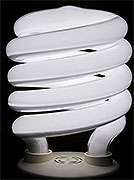
(HealthDay) -- As the United States bakes under the summer sun, dermatologists often warn of cancer risks posed by ultraviolet (UV) sunlight. But research now points to a new and ubiquitous indoor source of these harmful rays: eco-friendly compact fluorescent light bulbs.

Scientists say they found widespread chipping or cracking in the phosphor surface coating of nearly all the compact fluorescent bulbs they examined, allowing UV rays to escape.

Most of the bulbs "have cracks in the phosphor coating, probably due to the fact that the coating is brittle and has trouble making the tight bends required to make these bulbs compact," explained study lead author Miriam Rafailovich, a professor of materials science and engineering and director of the Garcia Center for Polymers at Engineered Interfaces at Stony Brook University in Stony Brook, N.Y. "As a result, we observed, by eye, defects in nearly all the bulbs that we studied."

And, Rafailovich added that, "skin cells exposed to [compact fluorescent light] emissions showed the same damage as those exposed to UV light" when placed in close range (meaning less than one foot) to a CFL bulb.

The study is funded by the U.S. National Science Foundation and is published in a recent issue of the journal .

As Americans grow more concerned about environmental and energy issues, millions have made the switch from the old to compact fluorescents. The U.S. National Institutes of Health notes that the newer technology uses roughly 75 percent less energy than standard incandescent bulbs.

Each compact fluorescent bulb has a phosphor coating applied to its narrow glass tubing. The coating is designed to both enhance the bulb's luminescence capacity while at the same time absorbing that would otherwise be emitted.

But the authors warn that if the bulb's surface area is riddled with "bald" spots, UV protection is lost.

To see how widespread the problem might be, the Stony Brook team set out to purchase a wide array of commercially available in stores across the Suffolk and Nassau county regions of Long Island, N.Y.

They measured each bulb for levels of UV emissions, while at the same time examining each for signs of cracking in its phosphor coating.

The result: All the bulbs, regardless of manufacturer or brand, were found to emit "significant" levels of both UVC and UVA rays as a result of cracks in their respective applied coatings.

Further laboratory testing revealed that when healthy human were exposed to the UV emitted from the bulbs, damage ensued that was "consistent" with the damage typically caused by UV radiation from the sun.

By contrast, exposure to incandescent bulbs of similar strength prompted no skin cell damage.

According to Rafailovich, "these bulbs are fragile, the phosphor is easily damaged, and possibly dangerous amounts of UV are emitted. Therefore, it's best not to use these bulbs at close range -- less than a couple of feet -- or look directly at them. To be safe, they should be used behind a glass cover, or kept at a distance of several feet or more."

Rafailovich said it's incredible that this situation has arisen at all. "You should not need suntan lotion to protect you from indoor lighting," she said.

In any case, one dermatologist believes using sunscreen each day is a good way to keep the UV away, whatever the source.

Dr. William Ting is a private practice dermatologist and medical director of California Dermatology Care in San Ramon, Calif. He said that doctors "have always had some suspicion about these bulbs in terms of exactly how much UV is getting through to patients. However, I don't think we're going to slow down the adoption of this technology, which means that people will increasingly find themselves in environments where they have no control over the use of these light bulbs."

His advice: "Everyone should be wearing sunscreen every single day no matter what, because even a short commute from home to work can lead to sun damage over time. And if everyone adheres to that there's no reason to be concerned about this issue."

Another expert agreed.

"Recommending that people apply sunscreen every day is always good advice," said Dr. Darrell Rigel, a clinical professor of dermatology at NYU Langone Medical Center in New York City. "That said, I'm not sure what the risk is here. Is it a risk of some kind? Yes. It is a big risk? Probably not. And I would not alarm people that they're going to get skin cancer because they're exposed to a compact fluorescent [bulb]."

"For example," Rigel said, "most people work in offices within five to six feet of the long, standard that everyone is familiar with. And over the course of a typical work year of 2,000 hours you'd get the equivalent of about 20 minutes of street sun exposure in NYC in September. In other words, not a lot. So while more research is needed, at this point I wouldn't have people panicking about this."

The American Lighting Association, an industry group representing light bulb manufacturers, did not respond to HealthDay requests for comment.

More information: Find out more about compact fluorescent bulbs at the U.S. National Institutes of Health.

Copyright © 2012 HealthDay. All rights reserved.

4.4 /5 (8 votes)  

Filter


Move the slider to adjust rank threshold, so that you can hide some of the comments.


Display comments: newest first

weewee
Aug 03, 2012

Rank: not rated yet
Juist wondering when we could see human trials with this new procedure. Does anyone know when that might be?
alfie_null
Aug 04, 2012

Rank: 5 / 5 (1)
... found to emit "significant" levels ...

Please give numbers, or at least relate to, e.g. solar radiation. Medical practitioners in particular, like using information-free phrases like this. Don't encourage them.
Doug_Huffman
Aug 05, 2012

Rank: not rated yet
Please give numbers, or at least relate to, e.g. solar radiation.
"For example, most people work in offices within five to six feet of the long, standard fluorescent light bulbs that everyone is familiar with, ...over the course of a typical work year of 2,000 hours you'd get the equivalent of about 20 minutes of street sun exposure in NYC in September." This without phosphor coating cracking. With coating cracking and metallic mercury pollution, there is no rationale for supplanting the Edison bulb.
Voleure
Aug 05, 2012

Rank: 3 / 5 (2)
Um Doug back to Edison? Seriously? Go LED pricey still but lasts, switched last year. The compact bulbs are fine for occasional use in the ceiling. Far enough away and places like hallways or where there is a fixture to block the stray UV's.
ultra1bob
Aug 05, 2012

Rank: 5 / 5 (1)
"In any case, one dermatologist believes using sunscreen each day is a good way to keep the UV away, whatever the source."

Actually, a lot of the sunscreens have questionable ingredients that cause their own problems. See the Environmental Work Group's website for further details.
DarkHorse66
Aug 06, 2012

Rank: not rated yet
"In any case, one dermatologist believes using sunscreen each day is a good way to keep the UV away, whatever the source."

Actually, a lot of the sunscreens have questionable ingredients that cause their own problems. See the Environmental Work Group's website for further details.

One neat way to avoid the nanoparticles and an excess of other chemical crap that they tend to put into many lotions these days, is to buy the creams meant for children (also by extension better for sensitive skin). They are just as good and the ingredients list is shorter. The same rules still hold: high spf factor and re-apply according to directions. :) As for LED's; I'm highly looking forward to their prices coming down, but can anyone who is more familiar with their specs tell me what kind of frequency ranges they tend to transmit in? There are some kinds of light (halogen is a prominent culprit, but fluoro too) that a person with light sensitivities will react badly to. Cheers, DH66
DarkHorse66
Aug 06, 2012

Rank: 5 / 5 (1)
... Go LED pricey still but lasts, switched last year. The compact bulbs are fine for occasional use in the ceiling. Far enough away and places like hallways or where there is a fixture to block the stray UV's.

I like LED technology. I haven't tried the bulbs yet but I do know that they use even less energy than the compact ones. The difference is (as far as I know) enough to show up on your electricity bill. This holds as well for TV's. I recently had to replace my newly defunct CRT TV with a digital one. I bought a 32in (80cm) LED-TV. It actually reduced my electricity bill. The other bonus was that, unlike a plasma or LCD-TV, it is almost completely cold to the touch (and VERY slimline). Those others emit so much more heat that it is scary.
Regards, DH66
Rank 4.4 /5 (8 votes)
Related Stories
Relevant PhysicsForums posts

More news stories

New fluorescent tools for cancer diagnosis

In recent years, microRNAs (miRNAs) and other non-coding RNAs are small molecules that help control the expression of specific proteins. In recent years they have emerged as disease biomarkers. miRNA profiles have been used ...

Cancer created 11 hours ago | popularity not rated yet | comments 0

Modulating the immune system to combat metastatic cancer

Cancer cells spread and grow by avoiding detection and destruction by the immune system. Stimulation of the immune system can help to eliminate cancer cells; however, there are many factors that cause the immune system to ...

Cancer created 11 hours ago | popularity not rated yet | comments 0

Scientists put bowel cancer under the microscope

Researchers from London's Kingston University have begun a two-year study which could help prolong the lives of people with colorectal tumours.

Cancer created 15 hours ago | popularity 5 / 5 (1) | comments 0

Researcher identifies breast cancer fighting hormone

Transformative research from Western University has identified new hormones in the body which may suppress breast cancer and stimulate the regression of breast tumors.

Cancer created 15 hours ago | popularity 5 / 5 (1) | comments 0

Ground breaking cancer research finds immune system link

(Medical Xpress)—Curtin University researchers have found evidence that targeting specific cells in the body can reverse the effects of cancer on the immune system.

Cancer created 16 hours ago | popularity 5 / 5 (3) | comments 0


Engineered cytomegalovirus protects monkeys from HIV equivalent

(Medical Xpress)—A new study by researchers in the US has shown that an ancient virus can be modified to help in the fight against the simian immunodeficiency virus SIV, which is the equivalent in monkeys ...

Researchers identify first drug targets in childhood genetic tumor disorder

Two mutations central to the development of infantile myofibromatosis (IM)—a disorder characterized by multiple tumors involving the skin, bone, and soft tissue—may provide new therapeutic targets, according to researchers ...

Hormone levels may provide key to understanding psychological disorders in women

Women at a particular stage in their monthly menstrual cycle may be more vulnerable to some of the psychological side-effects associated with stressful experiences, according to a study from UCL.

Going live: Immune cell activation in multiple sclerosis

Biological processes are generally based on events at the molecular and cellular level. To understand what happens in the course of infections, diseases or normal bodily functions, scientists would need to ...

Driving and hands-free talking lead to spike in errors, study shows

Talking on a hands-free device while behind the wheel can lead to a sharp increase in errors that could imperil other drivers on the road, according to new research from the University of Alberta.

Help at hand for people with schizophrenia

How can healthy people who hear voices help schizophrenics? Finding the answer for this is at the centre of research conducted at the University of Bergen.