Difficult to diagnose cases of infectious endocarditis solved with SPECT/CT imaging agent
August 1, 2012 in Diseases, Conditions, Syndromes
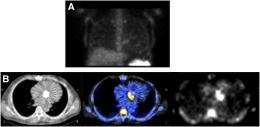
When combined with standard diagnostic tests, functional imaging procedures have been shown to reduce the rate of misdiagnosed cases of infectious endocarditis. According to new research published in the August issue of The Journal of Nuclear Medicine, single photon emission computed tomography (SPECT)/computed tomography (CT) with 99mTc-hexamethylpropleneamine oxime-labeled white blood cells (99mTc-HMPAO-WBC) can improve the diagnosis of infectious endocarditis in hard-to-diagnose cases.
Infectious endocarditis is an infection of the lining of the heart chambers and heart valves that is caused by bacteria, fungi or other infectious substances. It affects 2-4 people per 100,000 each year, with 25-50 percent of the cases occurring in patients older than 60 years. Mortality from infectious endocarditis remains high when this condition is undiagnosed and, therefore, not adequately treated.
The diagnosis of infectious endocarditis is becoming progressively more challenging in the past years because of a variety of factors: the indiscriminate use of antimicrobial agents in some clinical settings, the increased number of individuals with predisposing or underlying conditions (i.e., frail and elderly, immune-suppressed persons), and the increasing number of interventional cardiovascular procedures and placement of valve prostheses, intravascular devices and cardiac devices.
"SPECT/CT with 99mT-HMPAO-WBC is a nuclear medicine technique currently used for the management of patients with infection; its application in infectious endocarditis has been restricted to few reports," said Paola A. Erba, MD, lead author of the study. "With this work we aimed to open new perspective for the application of this technique."
Researchers conducted 99mTc-HMPAO-WBC SPECT/CT scans on 131 consecutive patients with suspected infectious endocarditis. Patients with permanent cardiac devices were excluded from the research as the devices might have introduced the infection. Results from the scans were compared to diagnostic tests for standard infectious endocarditistransthoracic or transesophageal echocardiography, blood cultures and the modified Duke Endocarditis Service criteria, which are recommended for classification.
Of the 131 patients, 97 were found to have uptake indicating infection. The 99mTc-HMPAO-WBC SPECT/CT scan was true-positive in 46 of 51 patients and false negative in 5 of 51 cases (90 percent sensitivity, 94 percent negative predictive value and 100 percent specificity and positive predictor value). In addition, septic embolism was detected in 41 percent of the patients.
"When the results of the 99mTc-HMPAO-WBC SPECT/CT scan were associated with either positive echocardiography or a positive blood culture, no cases of infectious endocarditis went undiagnosed," noted Erba. "This demonstrates the added value that 99mTc-HMPAO-WBC SPECT/CT scans can provide to assist physicians in their diagnosis and treatment decisions. Cardiologists and infectivologists dealing with infectious endocarditis should consider using 99mT-HMPAO-WBC when they are facing difficult situation."
More information: "Added Value of 99mTc-HMPAO-Labeled Leukocyte SPECT/CT in Characterization and Management of Patients with Infectious Endocarditis" Journal of Nuclear Medicine. interactive.snm.or… ileID=217327
Journal reference:
Journal of Nuclear Medicine
Provided by
Society of Nuclear Medicine
-
Surgery improves endocarditis-induced heart failure survival rates
Nov 22, 2011 |
not rated yet |
0
-
Artificial intelligence helps diagnose cardiac infections
Sep 12, 2009 |
not rated yet |
0
-
Fewer amputations in diabetic patients with dual isotope SPECT/CT
Jun 06, 2011 |
not rated yet |
0
-
Molecular imaging may be best for capturing renal transplant complications
Jun 07, 2010 |
not rated yet |
0
-
Novel imaging probe allows noninvasive detection of dangerous heart-valve infection
Aug 21, 2011 |
not rated yet |
0
-
Motion perception revisited: High Phi effect challenges established motion perception assumptions
Apr 23, 2013 |
3 / 5 (2) |
2
-
Anything you can do I can do better: Neuromolecular foundations of the superiority illusion (Update)
Apr 02, 2013 |
4.5 / 5 (11) |
5
-
The visual system as economist: Neural resource allocation in visual adaptation
Mar 30, 2013 |
5 / 5 (2) |
9
-
Separate lives: Neuronal and organismal lifespans decoupled
Mar 27, 2013 |
4.9 / 5 (8) |
0
-
Sizing things up: The evolutionary neurobiology of scale invariance
Feb 28, 2013 |
4.8 / 5 (10) |
14
-
Classical and Quantum Mechanics via Lie algebras
Apr 15, 2011
- More from Physics Forums - Independent Research
More news stories
Researchers find genetic risk factor for pulmonary fibrosis
A paper recently published in the New England Journal of Medicine and co-written by physicians and scientists at the University of Colorado School of Medicine finds that an important genetic risk factor for pulmonary fibros ...
Diseases, Conditions, Syndromes
2 hours ago |
not rated yet |
0
Biomarkers discovered for inflammatory bowel disease
Using the Department of Defense Serum Repository (DoDSR), University of Cincinnati (UC) researchers have identified a number of biomarkers for inflammatory bowel disease (IBD), which could help with earlier diagnosis and ...
Diseases, Conditions, Syndromes
2 hours ago |
not rated yet |
0
CDC says high number of public pools contain microbes
(HealthDay)—Three-quarters of public schools in the metro Atlanta area contain microbes, including bacteria indicating the presence of fecal matter, according to research published in the May 17 issue of ...
Diseases, Conditions, Syndromes
3 hours ago |
not rated yet |
0
Study examines outbreak of spinal infections in Michigan
(HealthDay)—Factors such as increased case finding may explain why Michigan had half of the total spinal infections associated with contaminated methylprednisolone acetate in the recent fungal meningitis ...
Diseases, Conditions, Syndromes
3 hours ago |
not rated yet |
0
World not ready for mass flu outbreak, WHO says
The world is unprepared for a massive virus outbreak, the deputy chief of the World Health Organization warned Tuesday, amid fears that H7N9 bird flu striking China could morph into a form that spreads easily among people.
Diseases, Conditions, Syndromes
4 hours ago |
not rated yet |
0
New sleeping pill poised to hit US markets
An experimental sleeping pill from US drug company Merck is effective at helping people fall and stay asleep, according to reviewers at the US Food and Drug Administration, which could soon approve the new drug.
If you can remember it, you can remember it wrong
(Medical Xpress)—Native peoples in regions where cameras are uncommon sometimes react with caution when their picture is taken. The fear that something must have been stolen from them to create the photo ...
Reducing caloric intake delays nerve cell loss
Activating an enzyme known to play a role in the anti-aging benefits of calorie restriction delays the loss of brain cells and preserves cognitive function in mice, according to a study published in the May ...
B vitamins could delay dementia
(Medical Xpress)—Despite spending billions of dollars on research and development, drug companies have been unable to come up with effective treatments for dementia and Alzheimer's Disease (AD). Now, A. ...
Antidepressant reduces stress-induced heart condition
A drug commonly used to treat depression and anxiety may improve a stress-related heart condition in people with stable coronary heart disease, according to researchers at Duke Medicine.
Insight into the dazzling impact of insulin in cells
Australian scientists have charted the path of insulin action in cells in precise detail like never before. This provides a comprehensive blueprint for understanding what goes wrong in diabetes.