In epileptic seizures, researchers see the neurology of consciousness
August 15, 2012 By Bill Hathaway in Neuroscience
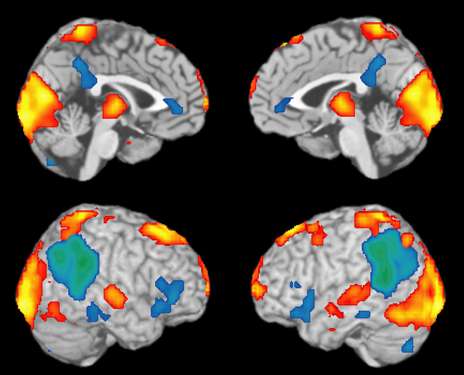
The fMRI images are different viewpoints of the brain of a child experiencing an epileptic seizure. Areas in yellow and orange represent increased brain activity compared to its normal state, while areas in blue show decreased activity. These are the areas of the brain needed for normal consciousness.
(Medical Xpress) -- Yale researchers studying epileptic seizures have shed new light on the neurological origins of consciousness.
When epileptics lose consciousness during a variety of types of seizures, the signals converge on the same brain structures, but through different pathways, says Dr. Hal Blumenfeld, professor of neurology, neurobiology, and neurosurgery.
Understanding of these mechanisms could lead to improved treatment strategies to prevent impairment of consciousness and improve the quality of life of people with epilepsy, he said.
Blumenfelds research is described in the current issue of the journal Lancet Neurology.
Journal reference:
Lancet Neurology
Provided by
Yale University
-
Early treatment stops epilepsy in its tracks
Dec 13, 2007 |
not rated yet |
0
-
Non-epileptic seizures may be misdiagnosed longer in veterans
Sep 05, 2011 |
not rated yet |
0
-
Study highlights success of brain surgery for severe epilepsy
Jul 21, 2011 |
not rated yet |
0
-
Dogs may be responding to psychological seizures, not epilepsy seizures
Jan 22, 2007 |
not rated yet |
0
-
UCL researching light therapy as a potential treatment for epilepsy
Jun 18, 2010 |
not rated yet |
0
-
Motion perception revisited: High Phi effect challenges established motion perception assumptions
Apr 23, 2013 |
3 / 5 (2) |
2
-
Anything you can do I can do better: Neuromolecular foundations of the superiority illusion (Update)
Apr 02, 2013 |
4.5 / 5 (11) |
5
-
The visual system as economist: Neural resource allocation in visual adaptation
Mar 30, 2013 |
5 / 5 (2) |
9
-
Separate lives: Neuronal and organismal lifespans decoupled
Mar 27, 2013 |
4.9 / 5 (8) |
0
-
Sizing things up: The evolutionary neurobiology of scale invariance
Feb 28, 2013 |
4.8 / 5 (10) |
14
-
Why is zone 1 in liver more prone to ischemic injury?
May 23, 2013
-
How can there be villous adenoma in colon, if there are no villi there
May 22, 2013
-
How can there be a term called "intestinal metaplasia" of stomach
May 21, 2013
-
Pressure-volume curve: Elastic Recoil Pressure don't make sense
May 18, 2013
-
If you became brain-dead, would you want them to pull the plug?
May 17, 2013
-
MRI bill question
May 15, 2013
- More from Physics Forums - Medical Sciences
More news stories
New neuron formation could increase capacity for new learning, at the expense of old memories
New research presented today shows that formation of new neurons in the hippocampus - a brain region known for its importance in learning and remembering - could cause forgetting of old memories by causing a reorganization ...
Neuroscience
4 hours ago |
5 / 5 (2) |
0
Help at hand for people with schizophrenia
How can healthy people who hear voices help schizophrenics? Finding the answer for this is at the centre of research conducted at the University of Bergen.
Neuroscience
5 hours ago |
3 / 5 (1) |
2
Japanese research organizations contribute to Human Brain Project
One of the major frontiers of modern science is a comprehensive understanding of the human brain and its functions to guide the development of new technologies in information and communication. In a major announcement for ...
Neuroscience
5 hours ago |
1 / 5 (1) |
0
Controlling mood through the motions of mitochondria
(Medical Xpress)—Regulating the distribution of power in neurons is done by a system that makes the national electric grid look simple by comparison. Each neuron has several thousand mitochondria confined ...
Neuroscience
20 hours ago |
4.9 / 5 (9) |
0
|
Brain uses internal 'average voice' prototype to identify who is talking
(Medical Xpress)—The human brain is able to identify individuals' voices by comparing them against an internal 'average voice' prototype, according to neuroscientists.
Neuroscience
May 23, 2013 |
3 / 5 (2) |
2
|
About one in four uninsured could be excluded from ACA
(HealthDay)—More than one in four of those eligible for new premium assistance tax credits under the Affordable Care Act (ACA) do not have a checking account and will not be able to receive premiums from ...
Comorbidities common with alopecia areata
(HealthDay)—Comorbid conditions often accompany alopecia areata, according to a study published online May 22 in JAMA Dermatology.
Pollen count apps for smartphones are nothing to sneeze at
Kate O'Reilly's spring allergy survival kit includes the usual stuff - nasal sprays, allergy pills and a box of tissues. This season, she's added a new weapon to her line of defense: an app on her smartphone.
Hormone levels may provide key to understanding psychological disorders in women
Women at a particular stage in their monthly menstrual cycle may be more vulnerable to some of the psychological side-effects associated with stressful experiences, according to a study from UCL.
Engineered cytomegalovirus protects monkeys from HIV equivalent
(Medical Xpress)—A new study by researchers in the US has shown that an ancient virus can be modified to help in the fight against the simian immunodeficiency virus SIV, which is the equivalent in monkeys ...
Going live: Immune cell activation in multiple sclerosis
Biological processes are generally based on events at the molecular and cellular level. To understand what happens in the course of infections, diseases or normal bodily functions, scientists would need to ...