Good stability with artificial disc plus cage fusion
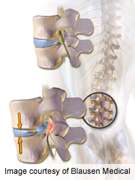
For patients with multi-level cervical disc herniation, artificial cervical disc replacement and adjacent segment cage fusion achieves definite stabilization and satisfactory mobility, according to research published online July 24 in the Journal of Spinal Disorders & Techniques.
(HealthDay) -- For patients with multi-level cervical disc herniation, artificial cervical disc replacement and adjacent segment cage fusion achieves definite stabilization and satisfactory mobility, according to research published online July 24 in the Journal of Spinal Disorders & Techniques.
Xianjun Ren, M.D., of the Xinqiao Hospital in China, and colleagues conducted a prospective, nonrandomized study involving 26 patients (17 male; mean age, 47 years; 12 with myelopathy; 14 with radiculopathy) with multi-level cervical disc herniation who underwent a single-level cervical disc replacement procedure using a Bryan cervical disc prostheses combined with adjacent segment cage fusion.
The researchers found that all patients underwent single-level Bryan disc replacement and cage fusion on adjacent segments, with the segments located next to each other in 23 patients. During 24 to 47 months of follow-up, for all Bryan discs, definite stabilization was achieved. Postoperatively, the average range of motion was 9.5 degrees. In all cages, solid fusion was achieved, with no subsidence or displacement. At the final follow-up, the Japanese Orthopedic Association score increased from 9.2 to 13.5 points and the neck disability index was reduced from 40.8 to 28.5. Based on Odom's criteria, clinical success was 84.6 percent.
"Our early clinical outcome showed that disc replacement combined with cage fusion could produce good stability. It could restore the motion of the cervical spine to a large degree, avoid possible complication of multi-level disc replacement, and reduce the medical cost," the authors write. "However, many issues remain for further study, such as longer-term follow-up, fusion rate of cage, a change of biomechanics of cervical spine, as well as acceleration in device-related wear."
More information: Abstract
Full Text (subscription or payment may be required)
Copyright © 2012 HealthDay. All rights reserved.
-
Artificial disc replacement as good or better than spinal fusion surgery (Audio)
Feb 27, 2009 |
not rated yet |
0
-
Artificial disc a viable alternative to fusion for 2-level disc disease
May 21, 2011 |
not rated yet |
0
-
For back, neck pain, artificial disc replacement has cost, outcome advantages over fusion surgery
Mar 22, 2011 |
not rated yet |
0
-
UCSF analysis shows newer surgery for neck pain may be better
Apr 11, 2011 |
not rated yet |
0
-
FDA approves cervical disk device
Jul 17, 2007 |
not rated yet |
0
-
Motion perception revisited: High Phi effect challenges established motion perception assumptions
Apr 23, 2013 |
3 / 5 (2) |
2
-
Anything you can do I can do better: Neuromolecular foundations of the superiority illusion (Update)
Apr 02, 2013 |
4.5 / 5 (11) |
5
-
The visual system as economist: Neural resource allocation in visual adaptation
Mar 30, 2013 |
5 / 5 (2) |
9
-
Separate lives: Neuronal and organismal lifespans decoupled
Mar 27, 2013 |
4.9 / 5 (8) |
0
-
Sizing things up: The evolutionary neurobiology of scale invariance
Feb 28, 2013 |
4.8 / 5 (10) |
14
-
Classical and Quantum Mechanics via Lie algebras
Apr 15, 2011
- More from Physics Forums - Independent Research
More news stories
Plastic realistic: Medical students to use plastinated human bodies for anatomy learning
Nanyang Technological University's (NTU) new medical school will be pioneering the use of plastinated bodies for medical education in Singapore.
Other
1 hour ago |
not rated yet |
0
Survey points out deficiencies in addictions training for medical residents
A 2012 survey of internal medicine residents at Massachusetts General Hospital (MGH) – one of the nation's leading teaching hospitals – found that more than half rated the training they had received in addiction and other ...
Other
19 hours ago |
not rated yet |
0
Early use of tracheostomy for mechanically ventilated patients not associated with improved survival
For critically ill patients receiving mechanical ventilation, early tracheostomy (within the first 4 days after admission) was not associated with an improvement in the risk of death within 30 days compared to patients who ...
Other
May 21, 2013 |
not rated yet |
0
Decisions to forgo life support may depend heavily on the ICU where patients are treated
The decision to limit life support in patients in the intensive care unit (ICU) appears to be significantly influenced by physician practices and/or the culture of the hospital, suggests new findings from researchers at the ...
Other
May 21, 2013 |
not rated yet |
0
People on higher incomes are happier with new knees
Knee replacement surgery is a very common procedure. However, it does not always resolve function or pain in all the recipients of new knees. A study by Robert Barrack, MD and his colleagues from the Washington University ...
Other
May 21, 2013 |
not rated yet |
0
Major human drug trial underway for Alzheimer's
A potentially ground-breaking human drug trial is currently underway, which aims to discover whether blood pressure medication can slow or halt the progression of Alzheimer's Disease (AD). This is the latest ...
Pay attention: How we focus and concentrate
Scientists at Newcastle University have shed new light on how the brain tunes in to relevant information.
New discovery in fight against deadly meningococcal disease
Professor Michael Jennings, Deputy Director of the Institute for Glycomics at Griffith University, was part of an international team that discovered the previously unknown pathway of how the bacterium colonizes people.
Are kids who take music lessons different from other kids?
(Medical Xpress)—Research by U of T Mississauga psychology professor Glenn Schellenberg reveals that two key personality traits – openness-to-experience and conscientiousness—predict better than IQ ...
Researchers identify networks of neurons in the brain that are disrupted in psychiatric disease
Studying the networks of connections in the brains of people affected by schizophrenia, bipolar disease or depression has allowed Dr. Peter Williamson, from Western University, to gain a better understanding of the biological ...
New imaging techniques used to help patients suffering from epilepsy
New techniques in imaging of brain activity developed by Jean Gotman, from McGill University's Montreal Neurological Institute, and his colleagues lead to improved treatment of patients suffering from epilepsy. The combination ...