Human airways' 'Brush' mechanism gives clues to lung diseases
August 23, 2012 in Medical research

Human airways' 'Brush' mechanism gives clues to lung diseases

Researchers say proper mucus clearance may depend on how tiny hair-like cilia operate.

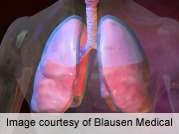
(HealthDay)—A new study that helps explain how human airways rid the lungs of mucus could give insights into asthma, cystic fibrosis and chronic obstructive pulmonary disease (COPD), researchers say.

Human airways rely on mucus to expel foreign matter—including toxic and infectious particles—from the body, the study authors said in a news release from the American Association for the Advancement of Science.

"The air we breathe isn't exactly clean, and we take in many dangerous elements with every breath," study co-author Michael Rubinstein noted in the news release. "We need a mechanism to remove all the junk we breathe in, and the way it's done is with a very sticky gel called mucus that catches these particles and removes them with the help of tiny [hair-like] cilia," he explained.

"The cilia are constantly beating, even while we sleep," Rubinstein said. "In a coordinated fashion, they push mucus containing foreign objects out of the lungs, and we either swallow it or spit it out. These cilia even beat for a few hours after we die. If they stopped, we'd be flooded with mucus that provides a fertile breeding ground for bacteria."

It's long been believed that mucus clearance occurs through a "gel-on-liquid" method, in which a watery layer acts as a lubricant and separates mucus from cells that line the airways. However, this does not explain how mucus remains in its own distinct layer.

In this study, published in the Aug. 24 issue of the journal Science, Rubinstein and colleagues at the University of North Carolina at Chapel Hill suggest a "gel-on-brush" form of mucus clearance, in which mucus moves atop a brush-like layer rather than a watery layer.

"This layer—this brush—seems to be very important for the healthy functioning of human airways," Rubinstein said. "It protects cells from sticky mucus, and it creates a second barrier of defense in case viruses or bacteria penetrate through the mucus. They would not penetrate through the brush layer because the brush is denser," he added.

"We found that there is a specific condition, below which the brush is healthy and cells are happy," Rubinstein said. "But above this ideal condition, in diseases like [cystic fibrosis] or COPD, the brush becomes compressed and actually prevents the normal cilia beating and healthy flow of mucus."

If the mucus layer becomes too dense, it can crash through the brush layer, collapse the cilia and stick to the cells lining the airways, the authors noted in the news release.

"The collapse of this brush is what can lead to immobile mucus and result in infection, inflammation and eventually the destruction of lung tissue and the loss of lung function," Rubinstein explained. Insights like those might someday help researchers develop new treatments for lung diseases, he added, and also provide a way to assess the effectiveness of those treatments.

More information: The American Academy of Family Physicians has more about chronic obstructive pulmonary disease.

Journal reference: Science search and more info website

Copyright © 2012 HealthDay. All rights reserved.

5 /5 (1 vote)  

Rank 5 /5 (1 vote)
Related Stories
Relevant PhysicsForums posts

More news stories

Study reveals new mechanism for estrogen suppression of liver lipid synthesis

By discovering the new mechanism by which estrogen suppresses lipid synthesis in the liver, UC Irvine endocrinologists have revealed a potential new approach toward treating certain liver diseases.

Medical research created 16 hours ago | popularity not rated yet | comments 0 | with audio podcast

MRI-based measurement helps predict vascular disease in the brain

Aortic arch pulse wave velocity, a measure of arterial stiffness, is a strong independent predictor of disease of the vessels that supply blood to the brain, according to a new study published in the June issue the journal ...

Medical research created 16 hours ago | popularity not rated yet | comments 0

Antibiotics: A new understanding of sulfonamide nervous system side effects

Since the discovery of Prontosil in 1932, sulfonamide antibiotics have been used to combat a wide spectrum of bacterial infections, from acne to chlamydia and pneumonia. However, their side effects can include serious neurological ...

Medical research created 18 hours ago | popularity not rated yet | comments 0 | with audio podcast

Scientists discover molecule triggers sensation of itch

Scientists at the National Institutes of Health report they have discovered in mouse studies that a small molecule released in the spinal cord triggers a process that is later experienced in the brain as ...

Medical research created 18 hours ago | popularity 5 / 5 (2) | comments 0 | with audio podcast

Discarded immune cells induce the relocation of stem cells

Spanish researchers have discovered that the daily clearance of neutrophils from the body stimulates the release of hematopoietic stem cells from the bone marrow into the bloodstream, according to a report published today ...

Medical research created 20 hours ago | popularity 5 / 5 (2) | comments 0


Alzheimer's disease, the soft target of the euthanasia debate

(Medical Xpress)—The way Alzheimer's disease is portrayed by advocacy groups and the media is having undue influence on the euthanasia debate, according to a Deakin University nursing ethics professor.

Depression raises diabetics' risk of severe low blood sugar episodes

(Medical Xpress)—Patients with diabetes who are depressed are much more likely to develop episodes of dangerously low blood sugars, or hypoglycemia, than are those who are not depressed, a new study has ...

Patenting the human genome

Can human genes be patented? That was the question posed by Alan J. Snyder, vice president and associate provost for research and graduate studies at Lehigh, and Lee Kaplan, scientific director of cellular and molecular genetics ...

Cardiac study used as source for new guidelines on treating people undergoing coronary artery bypass surgery

Cardiac research from the University of Alberta had serious impact as a source for the American College of Cardiology and the American Heart Association's new guidelines on how to treat patients undergoing coronary artery ...

How the EU could help more children survive cancer

A leading expert in childhood cancer at The University of Nottingham is spearheading a Europe-wide lobby of the European Parliament to try to make it easier for doctors to develop and test new treatments on children and young ...

Controlling mood through the motions of mitochondria

(Medical Xpress)—Regulating the distribution of power in neurons is done by a system that makes the national electric grid look simple by comparison. Each neuron has several thousand mitochondria confined ...