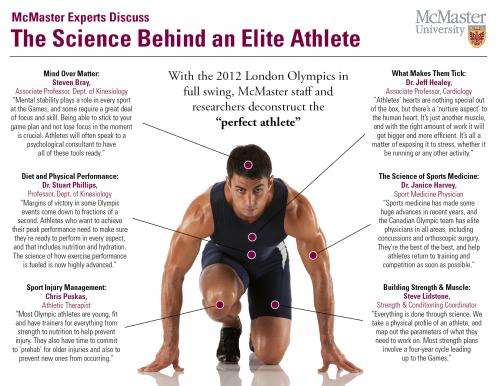
Infographic: McMaster researchers break-down the perfect athlete
August 6, 2012 By Andrew Baulcomb in Other
At the halfway point of the 2012 London Olympics, viewers have already witnessed some of the most awe-inspiring performances in the history of the Games - from 15-year-old Lithuanian Ruta Meilutyte taking gold in the 100-metre breaststroke, to our own Canadian men's eight claiming silver in the dying seconds of Wednesday's race (including Mac grads Jeremiah Brown and Doug Csima).
But what exactly does it take to compete on the biggest stage in the world? Many athletes in London have been training since they were children: sacrificing school, sleep and any semblance of a normal social life to workout and practice six days a week. Everything in the life of an Olympian becomes an exact science, and it isn't easy.
For repeat Olympians such as Laval's Alexandre Despatie, having the discipline and physical ability to rehab a devistating injury can mean the difference between one more shot at a medal, and the end of a dream.
Others, such as two-sport phenomenon Clara Hughes, have devoted their entire adult lives to the pursuit of excellence in sport - a lifestyle that involves superhuman stamina, drive and determination.
Getting as close to perfection as humanly possible is the goal of every Olympic athlete, and in the attached infographic, McMaster staff and researchers break down exactly what it takes to reach for the top.
Provided by
McMaster University
-
Olympic effort adapting to life after elite sport, new study finds
Jul 09, 2012 |
not rated yet |
0
-
Ancient Olympians glorified gods and community
Jul 26, 2012 |
not rated yet |
0
-
Australia's Twitter warning to athletes
Feb 28, 2012 |
not rated yet |
0
-
Researcher uncovers what athletes need to perform well
Dec 09, 2008 |
not rated yet |
0
-
US Olympics fans will turn to tablets for coverage: study
Jul 19, 2012 |
not rated yet |
0
-
Motion perception revisited: High Phi effect challenges established motion perception assumptions
Apr 23, 2013 |
3 / 5 (2) |
2
-
Anything you can do I can do better: Neuromolecular foundations of the superiority illusion (Update)
Apr 02, 2013 |
4.5 / 5 (11) |
5
-
The visual system as economist: Neural resource allocation in visual adaptation
Mar 30, 2013 |
5 / 5 (2) |
9
-
Separate lives: Neuronal and organismal lifespans decoupled
Mar 27, 2013 |
4.9 / 5 (8) |
0
-
Sizing things up: The evolutionary neurobiology of scale invariance
Feb 28, 2013 |
4.8 / 5 (10) |
14
-
Classical and Quantum Mechanics via Lie algebras
Apr 15, 2011
- More from Physics Forums - Independent Research
More news stories
Early use of tracheostomy for mechanically ventilated patients not associated with improved survival
For critically ill patients receiving mechanical ventilation, early tracheostomy (within the first 4 days after admission) was not associated with an improvement in the risk of death within 30 days compared to patients who ...
Other
21 hours ago |
not rated yet |
0
Decisions to forgo life support may depend heavily on the ICU where patients are treated
The decision to limit life support in patients in the intensive care unit (ICU) appears to be significantly influenced by physician practices and/or the culture of the hospital, suggests new findings from researchers at the ...
Other
23 hours ago |
not rated yet |
0
People on higher incomes are happier with new knees
Knee replacement surgery is a very common procedure. However, it does not always resolve function or pain in all the recipients of new knees. A study by Robert Barrack, MD and his colleagues from the Washington University ...
Other
May 21, 2013 |
not rated yet |
0
New search engine finds rare diagnoses
Doctors are trained to think "common disease" when they meet patients in their practices, and as they rarely or never meet a rare disease, it often takes many years to reach the right diagnosis. A new search tool called FindZebra ...
Other
May 21, 2013 |
not rated yet |
0
Delayed transfer to the ICU increases risk of death in hospital patients
Delayed transfer to the intensive care unit (ICU) in hospitalized patients significantly increases the risk of dying in the hospital, according to a new study from researchers in Chicago.
Other
May 21, 2013 |
not rated yet |
0
Researchers complete largest genetic sequencing study of human disease
Researchers from Queen Mary, University of London have led the largest sequencing study of human disease to date, investigating the genetic basis of six autoimmune diseases.
Slowing the aging process—only with antibiotics
Swiss scientists reveal the mechanism responsible for aging hidden deep within mitochondria—and dramatically slow it down in worms by administering antibiotics to the young.
Research offers promising new approach to treatment of lung cancer
Researchers have developed a new drug delivery system that allows inhalation of chemotherapeutic drugs to help treat lung cancer, and in laboratory and animal tests it appears to reduce the systemic damage ...
Researchers analyse hunting behaviour of fish larvae in virtual reality
Moving objects attract greater attention – a fact exploited by video screens in public spaces and animated advertising banners on the Internet. For most animal species, moving objects also play a major ...
Overeating learned in infancy, study suggests
In the long run, encouraging a baby to finish the last ounce in their bottle might be doing more harm than good.
Research shows how immune system peacefully co-exists with 'good' bacteria
The human gut is loaded with commensal bacteria – "good" microbes that, among other functions, help the body digest food. The gastrointestinal tract contains literally trillions of such cells, and yet the ...