Potential drug molecule shows enhanced anti-HIV activity
August 9, 2012 in HIV & AIDS

Potential drug molecule shows enhanced anti-HIV activity

Enlarge

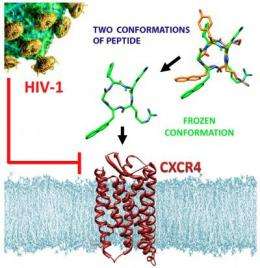
The modified anti-HIV molecule (center) binds with more than two orders of magnitude higher affinity to the CXCR4 receptor on the surface of immune cells and shows greatly enhanced anti-HIV activity. This could be a step toward the design of new, more effective drugs against AIDS, inflammatory diseases, and some forms of cancer. Copyright Wiley-VCH Verlag, reproduced with permission.

Researchers from Munich and Naples have shown that minimal modification of a synthetic peptide with anti-HIV activity results in a new compound with more than two orders of magnitude higher binding affinity to the chemokine receptor CXCR4 and greatly improved anti-HIV activity. This could be a step toward the design of new, more effective drugs against AIDS, inflammatory diseases, and some forms of cancer.

Different strains of -1 use either the chemokine receptor CCR5 or CXCR4 for entry into . While drugs that block usage of CCR5 by the virus are already available for anti-HIV therapy, no drugs have been approved that prevent the virus from using the CXCR4 receptor. Because the new cyclic peptide may be used to block CXCR4, it is a promising new to block HIV-1 infections.

An international, interdisciplinary team including researchers in pharmaceutical radiochemistry and chemistry at the Technische Universität München (TUM), a group of molecular modelers at the University of Naples, and virologists at the Helmholtz Zentrum München reported the results in Angewandte Chemie International Edition. This work was initiated by the radiochemists and organic chemists at TUM, who realized that their approach to modifying peptides as high-affinity CXCR4 ligands for imaging of cancers also has the potential to open a whole new area of drug research.

The researchers used a smart trick to augment both the binding affinity and the anti-HIV activity of an already known lead structure: They shifted one of the important side chains from the carbon to a neighboring nitrogen, thus fixing the skeleton of the molecule to present its binding groups in an improved orientation.

The cyclic structure of the peptide, with one unnatural D-amino acid (the mirror image of the natural amino acid tyrosine) and one so-called "peptoid" structure, makes the compound stable against enzymatic degradation and thus suitable for in vivo applications. Since CXCR4 receptors also play an important role in cancer metastasis, derivatives of this compound are also being tested as new agents for imaging and treatment of cancer. The team's "frozen peptoid" displays a 400 to 1500 times higher binding affinity to the CXCR4 ligand compared to other CXCR4-targeting compounds currently under clinical development, including one already involved in the treatment of non-Hodgkin lymphoma and multiple myeloma.

"We are very happy that the specific modifications designed by our team have led to a drug compound that may be useful for treatment of multiple life-threatening diseases," says Prof. Horst Kessler, a senior fellow of the TUM Institute for Advanced Study and "emeritus of excellence" in the TUM Department of Chemistry. "For anti-," adds Prof. Ruth Brack-Werner, a virologist from the Helmholtz Zentrum, "the new compound may provide a drug against particularly aggressive HIV-1 strains that come up in HIV-infected individuals after many years of infection." "We look forward with great enthusiasm to the next preclinical and clinical tests," says Prof. Hans-Jürgen Wester, TUM Chair of Pharmaceutical Radiochemistry. "These compounds offer exciting possibilities."

More information: A Conformationally Frozen Peptoid Boosts CXCR4 Affinity and Anti-HIV Activity. Oliver Demmer, Andreas O. Frank, Franz Hagn, Margret Schottelius, Luciana Marinelli, Sandro Cosconati, Ruth Brack-Werner, Stephan Kremb, Hans-Jürgen Wester, and Horst Kessler. Angewandte Chemie Int. Ed., 2012, 51, 8110-8113. DOI: 10.1002/anie.201202090

Journal reference: Angewandte Chemie International Edition search and more info website

Provided by Technical University Munich search and more info website

5 /5 (1 vote)  

Rank 5 /5 (1 vote)
Relevant PhysicsForums posts

More news stories

Engineered cytomegalovirus protects monkeys from HIV equivalent

(Medical Xpress)—A new study by researchers in the US has shown that an ancient virus can be modified to help in the fight against the simian immunodeficiency virus SIV, which is the equivalent in monkeys ...

HIV & AIDS created 23 hours ago | popularity 5 / 5 (3) | comments 0 | with audio podcast report

New microsphere-based methods for detecting HIV antibodies

Detection of HIV antibodies is used to diagnose HIV infection and monitor trials of experimental HIV/AIDS vaccines. New, more sensitive detection systems being developed use microspheres to capture HIV antibodies ...

HIV & AIDS created May 23, 2013 | popularity 5 / 5 (1) | comments 0

Fecal microbiota tx feasible for recurrent C. difficile in HIV

(HealthDay)—For HIV-infected individuals with recurrent Clostridium difficile infection, fecal microbiota therapy is feasible, according to a letter published in the May 21 issue of the Annals of Intern ...

HIV & AIDS created May 22, 2013 | popularity not rated yet | comments 0

Canada lifts ban on gay men donating blood

Canadian health authorities lifted Wednesday what was effectively a ban on gay men giving blood, announcing new rules making men who have not had sex with men in the past five years eligible.

HIV & AIDS created May 22, 2013 | popularity not rated yet | comments 1

AIDS scientists optimistic of AIDS cure, for some

Top AIDS scientists were optimistic Wednesday of finding a cure for the disease that has claimed 30 million lives—but said it might not work for all people.

HIV & AIDS created May 22, 2013 | popularity not rated yet | comments 0


First drug to improve heart failure mortality in over a decade

Coenzyme Q10 decreases all cause mortality by half, according to the results of a multicentre randomised double blind trial presented today at Heart Failure 2013 congress. It is the first drug to improve heart failure mortality ...

Heart failure accelerates male 'menopause'

Heart failure accelerates the aging process and brings on early andropausal syndrome (AS), according to research presented today at the Heart Failure Congress 2013. AS, also referred to as male 'menopause', was four times ...

Feds fight morning-after pill age ruling in NY

(AP)—Department of Justice lawyers have again asked a federal appeals court in New York to delay lifting age restrictions and prescription requirements on an emergency contraceptive popularly known as the morning-after ...

Death highest in heart failure patients admitted in January, on Friday, and overnight

Mortality and length of stay are highest in heart failure patients admitted in January, on Friday, and overnight, according to research presented today at the Heart Failure Congress 2013. The analysis of nearly 1 million ...

Hormone levels may provide key to understanding psychological disorders in women

Women at a particular stage in their monthly menstrual cycle may be more vulnerable to some of the psychological side-effects associated with stressful experiences, according to a study from UCL.

Researchers identify first drug targets in childhood genetic tumor disorder

Two mutations central to the development of infantile myofibromatosis (IM)—a disorder characterized by multiple tumors involving the skin, bone, and soft tissue—may provide new therapeutic targets, according to researchers ...