Brain study reveals the roots of chocolate temptations
September 20, 2012 in Medical research

Brain study reveals the roots of chocolate temptations

Enlarge

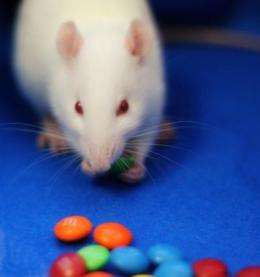
Extracellular enkephalin levels surged when rats began to eat milk chocolate M&Ms. Onset of eating coincided with a robust increase in extracellular enkephalin (met and leu), which remained sustained during eating and gradually tapered off as eating declined. The magnitude of the enkephalin increase in individuals correlated with their latency to eat their first M&M: higher enkephalin increase for the fastest eaters. Credit: Current Biology, DOI: 10.1016/j.cub.2012.08.014

Researchers have new evidence in rats to explain how it is that chocolate candies can be so completely irresistible. The urge to overeat such deliciously sweet and fatty treats traces to an unexpected part of the brain and its production of a natural, opium-like chemical, according to a report published online on September 20th in Current Biology.

A part of the brain usually thought to control movement also may cause people to overeat, say University of Michigan researchers.

A new study appearing in the current issue of the journal Current Biology indicates that a new brain mechanism in the neostriatum produces intense motivation to overeat tasty foods.

The neostriatum, located near the middle and front of the brain, has traditionally been thought to control only motor movements (this is the part of the brain that is damaged in patients with Parkinson's disease and Huntington's disease). Yet for several years, it has been known that the neostriatum is active in brains of obese people when viewing or tasting foods, and in brains of drug addicts when viewing photos of drug-taking.

The research showed that an opium-like chemical—enkaphalin—produced naturally in the brain is a mechanism that generates intense motivation to consume pleasant rewards, says Alexandra DiFeliceantonio, a doctoral student in psychology and the study's lead author.

When researchers gave extra morphine-like drug stimulation to the top of the neostriatum in rats, it caused the animals to eat twice the normal amount of sweet fatty food. For this study, that food was M&M milk chocolate candies.

"The same brain area we tested here is active when obese people see foods and when drug addicts see drug scenes," DiFeliceantonio said. "So it seems likely that our enkephalin findings in rats mean that this neurotransmitter may drive some forms of overconsumption and addiction in people."

Researchers measured levels of enkephalin using a painless microdialysis probe while rats were allowed to eat as much chocolate as they wanted. They found that enkephalin levels surged dramatically as soon as the rats started to eat, and remained high as long as they ate.

In addition, when researchers gave a painless microinjection of an opioid-stimulating drug in the rats' neostriatum, the rats ate double the amount of chocolate.

DiFeliceantonio and colleagues mapped where extra drug stimulation of opioid receptors affected eating habits. They found that overeating was only caused in one region at the front and center part of the neostriatum (called the anterior-medial region of dorsal neostriatum).

"Finding the brain mechanisms for overconsumption is a step towards designing better biological-based treatments for obesity and binge eating disorders," DiFeliceantonio said.

More information: DiFeliceantonio et al.: "Enkephalin surges in dorsal neostriatum as a signal to eat." DOI: 10.1016/j.cub.2012.08.014

Journal reference: Current Biology search and more info website

Provided by Cell Press search and more info website

4.5 /5 (4 votes)  

Filter


Move the slider to adjust rank threshold, so that you can hide some of the comments.


Display comments: newest first

alfie_null
Sep 22, 2012

Rank: not rated yet
Chocolate, or sugar and fat? M&Ms have that sugar coating, and the chocolate is just milk chocolate. If they are testing for some chocolate related effect, they should use higher quality chocolate.

I wonder how many M&Ms those lab rats eat? In human-relative mass/volume, one rat's M&M would equal what?
kochevnik
Sep 23, 2012

Rank: not rated yet
Sugar is more addictive than crack cocaine. And it is put into every processed food. Get the children addicted and you are guaranteed a lifetime of dependent addicts tossing you their savings in exchange for that sugar high.
Rank 4.5 /5 (4 votes)
Relevant PhysicsForums posts

More news stories

Common food supplement fights degenerative brain disorders

Widely available in pharmacies and health stores, phosphatidylserine is a natural food supplement produced from beef, oysters, and soy. Proven to improve cognition and slow memory loss, it's a popular treatment for older ...

Medical research created 3 hours ago | popularity 5 / 5 (1) | comments 0 | with audio podcast

Finding a family for a pair of orphan receptors in the brain

Researchers at Emory University have identified a protein that stimulates a pair of "orphan receptors" found in the brain, solving a long-standing biological puzzle and possibly leading to future treatments for neurological ...

Medical research created 4 hours ago | popularity not rated yet | comments 0 | with audio podcast

Insight into the dazzling impact of insulin in cells

Australian scientists have charted the path of insulin action in cells in precise detail like never before. This provides a comprehensive blueprint for understanding what goes wrong in diabetes.

Medical research created 4 hours ago | popularity 4.5 / 5 (2) | comments 0 | with audio podcast

Do men's and women's hearts burn fuel differently?

Researchers at the University of Illinois at Chicago College of Medicine will study gender differences in how the heart uses and stores fat—its main energy source—and how changes in fat metabolism play ...

Medical research created 7 hours ago | popularity not rated yet | comments 0

Study suggests new source of kidneys for transplant

Nearly 20 percent of kidneys that are recovered from deceased donors in the U.S. are refused for transplant due to factors ranging from scarring in small blood vessels of the kidney's filtering units to the organ going too ...

Medical research created 23 hours ago | popularity 5 / 5 (2) | comments 0 | with audio podcast


Americans still making unhealthy choices, CDC reports

(HealthDay)—The overall health of Americans isn't improving much, with about six in 10 people either overweight or obese and large numbers engaging in unhealthy behaviors like smoking, heavy drinking or ...

Weather worries can threaten a child's mental health

(HealthDay)—The monstrous tornado that devastated Moore, Okla., on Monday, killing dozens of adults and children, is a stunning example of violent weather that can affect a child's mental well-being.

World not ready if flu outbreak strikes, WHO says

The globe remains unprepared to deal with the risk of a massive virus outbreak, the deputy chief of the World Health Organization warned Tuesday, amid fears that H7N9 bird flu striking China could morph into a form that spreads ...

Genetic variation among patients with pulmonary fibrosis associated with improved survival

Variation in the gene MUC5B among patients with idiopathic pulmonary fibrosis was associated with improved survival, according to a study published online by JAMA. The study is being released early online to coincide with i ...

Genetic risk for obesity found in many Mexican young adults

As many as 35 percent of Mexican young adults may have a genetic predisposition for obesity, said a University of Illinois scientist who conducted a study at the Universidad Autónoma de San Luis Potosί.

US court strikes down Arizona 20-week abortion ban

A federal court in San Francisco Tuesday struck down Arizona's ban on abortions after 20 weeks of pregnancy.