US grandmother gives birth to her own grandchild

September 7, 2012 by Martha Irvine in Other
Emily Jordan, left, examines the pregnant belly of her mother Cindy Reutzel on Sunday, Aug. 19, 2012 in Naperville, Ill. After Jordan underwent a radical hysterectomy, she and her husband took up an offer from Reutzel to act as a surrogate for their child. (AP Photo/Sitthixay Ditthavong)
(AP)—Emily and Mike Jordan couldn't help but feel anxious.
More than two years before, at age 29, Emily had been diagnosed with cervical cancer. But just before she was to undergo a radical hysterectomy, she was told that she was pregnant. Faced with saving her life or their unborn child's, the young couple made the excruciating decision to go forward with her surgery. It meant losing the baby and forfeiting any chance at having children.
Or so they thought.
"I can't describe what that was like after finding out you have cancer, after finding out your chance of ever carrying a baby is gone," Emily says.
But now, more than two years later, she and Mike had come to a Chicago hospital to realize the dream they thought was lost—to become parents, though not the way they had imagined.
Alongside them was Emily's mother, Cindy Reutzel—a fit, silver-haired 53-year-old grandmother with a pregnant belly.
Reutzel was about to give birth to her own grandchild.
___
Just 34 years ago, Louise Brown, the first "test tube" baby, was born in Great Britain. The result? A veritable in-vitro baby boom.
It started with would-be mothers in their 20s and 30s. "Then people started pushing the envelope," says Dr. Helen Kim, director of the in vitro fertilization program at the University of Chicago. "If you could help a menopausal woman in her 30s, could you help a menopausal woman in her 40s? And then it became, 'Can you help a menopausal woman in her 50s?'
"And the answer is yes."
Some older women were having their own babies. But more often, they were using egg donors to have their own children, or serving as surrogates or "gestational carriers."
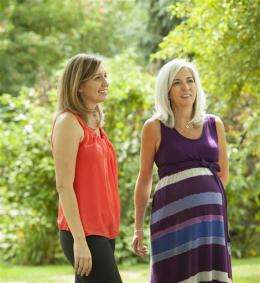
Emily Jordan, left, and her pregnant mother Cindy Reutzel relax at Jordan's home on Sunday, Aug. 19, 2012 in Naperville, Ill. After Jordan underwent a radical hysterectomy, she and her husband took up an offer from Reutzel to act as their surrogate. (AP Photo/Sitthixay Ditthavong)
There was the 51-year-old grandmother in Brazil who gave birth to her twin grandchildren in 2007. There've been others, grandmothers in their 40s or 50s and even 60s.Cindy Reutzel, Emily's mom, had a vague recollection of those stories. So when doctors shared the news that they had been able to keep Emily's ovaries intact, Reutzel immediately made the offer.
"What if I carried your baby for you?" she asked.
Emily and Mike didn't take it too seriously at first. "We didn't really think that was a realistic option," says Emily.
It turned out that it wasn't that far-fetched, particularly for a young grandmother who's in good health.

Emily Jordan, right, chats with her pregnant mother Cindy Reutzel on Sunday, Aug. 19, 2012 in Naperville, Ill. After Jordan underwent a radical hysterectomy, she and her husband took up an offer from Reutzel to act as their surrogate. (AP Photo/Sitthixay Ditthavong)
After a process that included psychological evaluation and hormonal manipulation to prepare their bodies, Kim eventually implanted Reutzel's uterus with an embryo created with an egg from Emily and Mike's sperm."The thought of Emily and Mike not being able to have children and share that piece of their lives with someone just broke my heart," says Reutzel. "I want Emily to have that connection with another human being like I had with her."
As her belly grew, people started asking about "her baby." But she was quick to tell them the story.
She worried about the physical toll pregnancy might take, though her body handled it better than she expected. She wondered how well she'd bounce back from a Caesarean section. That's how she had delivered Emily and her older brother, but that had been three decades ago.

Six-day-old Elle Cynthia Jordan is held by her mother Emily Jordan and grandmother Cindy Reutzel on Wednesday, Sept. 5, 2012 in Naperville, Ill. After Jordan underwent a radical hysterectomy, she and her husband accepted an offer from Reutzel to act as a surrogate for their child. (AP Photo/Sitthixay Ditthavong)
Still, she assured Emily and Mike throughout the pregnancy that the baby was fine, she was fine, everything would be fine."This is a continuation of everything that she has done her entire life for me, which is to make sure that I have the best life possible," Emily says.
All they could do, they said, was to promise to raise their baby as best they could. And that was enough for Reutzel.
"I know I gave a gift," she says. "But I'm also getting so much in return."
Last week, a few days after Emily's 32nd birthday, daughter sat next to mother, holding hands in the delivery room.
And Elle Cynthia Jordan was born.
"She looks just like you! She looks just like you!" Emily shouted, running from the delivery room to introduce their newborn to Mike.
Reutzel is recovering well. She even says she'd consider doing it again.
"When I watch both of them hold that baby and look into her face, it's like everything I could have imagined wanting for them—better than I could have imagined," she says, her eyes filling with tears.
"This is what it was all about for me."
Copyright 2012 The Associated Press. All rights reserved. This material may not be published, broadcast, rewritten or redistributed.
-
GOES-13 Satellite watches Emily fizzle, morph and hope for a comeback
Aug 06, 2011 |
not rated yet |
0
-
For Colorado family, it's allergies all around
Aug 03, 2012 |
not rated yet |
0
-
NASA satellites saw Tropical Depression Emily struggle over the weekend
Aug 08, 2011 |
not rated yet |
0
-
Tammar wallaby’s clever immune tricks revealed
Jul 11, 2011 |
not rated yet |
0
-
Mother of world's first test tube baby dies in Britain
Jun 20, 2012 |
not rated yet |
0
-
Motion perception revisited: High Phi effect challenges established motion perception assumptions
Apr 23, 2013 |
3 / 5 (2) |
2
-
Anything you can do I can do better: Neuromolecular foundations of the superiority illusion (Update)
Apr 02, 2013 |
4.5 / 5 (11) |
5
-
The visual system as economist: Neural resource allocation in visual adaptation
Mar 30, 2013 |
5 / 5 (2) |
9
-
Separate lives: Neuronal and organismal lifespans decoupled
Mar 27, 2013 |
4.9 / 5 (8) |
0
-
Sizing things up: The evolutionary neurobiology of scale invariance
Feb 28, 2013 |
4.8 / 5 (10) |
14
-
Classical and Quantum Mechanics via Lie algebras
Apr 15, 2011
- More from Physics Forums - Independent Research
More news stories
ACP issues recommendations for management of high blood glucose in hospitalized patients
High blood glucose is associated with poor outcomes in hospitalized patients, and use of intensive insulin therapy (IIT) to control hyperglycemia is a common practice in hospitals. But the recent evidence does not show a ...
Other
May 24, 2013 |
4 / 5 (1) |
0
Future doctors unaware of their obesity bias
Two out of five medical students have an unconscious bias against obese people, according to a new study by researchers at Wake Forest Baptist Medical Center. The study is published online ahead of print in the Journal of ...
Other
May 23, 2013 |
not rated yet |
0
Plastic realistic: Medical students to use plastinated human bodies for anatomy learning
Nanyang Technological University's (NTU) new medical school will be pioneering the use of plastinated bodies for medical education in Singapore.
Other
May 23, 2013 |
not rated yet |
0
Survey points out deficiencies in addictions training for medical residents
A 2012 survey of internal medicine residents at Massachusetts General Hospital (MGH) – one of the nation's leading teaching hospitals – found that more than half rated the training they had received in addiction and other ...
Other
May 22, 2013 |
5 / 5 (1) |
0
Early use of tracheostomy for mechanically ventilated patients not associated with improved survival
For critically ill patients receiving mechanical ventilation, early tracheostomy (within the first 4 days after admission) was not associated with an improvement in the risk of death within 30 days compared to patients who ...
Other
May 21, 2013 |
not rated yet |
0
First drug to improve heart failure mortality in over a decade
Coenzyme Q10 decreases all cause mortality by half, according to the results of a multicentre randomised double blind trial presented today at Heart Failure 2013 congress. It is the first drug to improve heart failure mortality ...
Seniors more likely to crash when driving with pet, study finds
(HealthDay)—Animals make great companions for senior citizens, but elderly people who always drive with a pet in the car are far more likely to crash than those who never drive with a pet, researchers have ...
Heart failure accelerates male 'menopause'
Heart failure accelerates the aging process and brings on early andropausal syndrome (AS), according to research presented today at the Heart Failure Congress 2013. AS, also referred to as male 'menopause', was four times ...
New immune system discovered
(Medical Xpress)—A research team, led by Jeremy Barr, a biology post-doctoral fellow, unveils a new immune system that protects humans and animals from infection.
Death highest in heart failure patients admitted in January, on Friday, and overnight
Mortality and length of stay are highest in heart failure patients admitted in January, on Friday, and overnight, according to research presented today at the Heart Failure Congress 2013. The analysis of nearly 1 million ...
Feds fight morning-after pill age ruling in NY
(AP)—Department of Justice lawyers have again asked a federal appeals court in New York to delay lifting age restrictions and prescription requirements on an emergency contraceptive popularly known as the morning-after ...


Sep 08, 2012
Rank: not rated yet