New tool for CSI? Geographic software maps distinctive features inside bones
September 25, 2012 by Pam Frost Gorder in Medical research
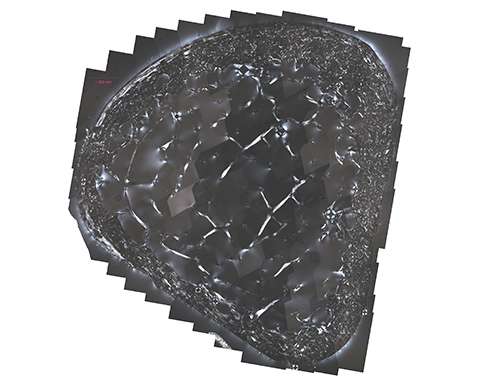
This polarized microscope image shows a cross-section of a metatarsal, or long foot bone. White spots on the periphery of the bone are osteons -- structures that fix small cracks in bone and maintain mineral levels in our blood. Image by David Rose.
(Medical Xpress)—A common type of geographic mapping software offers a new way to study human remains.
In a recent issue of the American Journal of Physical Anthropology, researchers describe how they used commercially available mapping software to identify features inside a human foot bone – a new way to study human skeletal variation.
David Rose, a Captain in the Ohio State University Police Division and doctoral student in anthropology, began the project to determine whether the patterns of change inside the bones of human remains could reveal how the bones were used during life.
"Our bones adapt to the load that's placed on them. Patterns of tension and compression show up in our internal bone structure, and this software lets us look at those patterns in a new way," Rose said.
Julie Field, study co-author and assistant professor of anthropology at Ohio State, explained that archaeologists frequently use geographic information system (GIS) software to map the location of objects uncovered at an excavation site.
"We try to identify important clusters of objects such as household tools or agricultural tools that would indicate patterns of human activity," Field explained. "Based on certain scientific criteria that you give it, the software gives you a statistical measure of whether the objects you're looking at actually constitute a cluster."
In this case, the researchers used a program called ArcGIS. But similar types of mapping software can analyze any kind of spatial data, such as crime statistics or flood models, Rose added. He usesthe same program to map line-of-site views to develop security plans for events on campus.
This is the first time anyone has used GIS software to map bone microstructure.
Co-author Sam Stout, professor of anthropology at Ohio State and Rose's advisor, explained why the study of internal bone structure is important.
"Dave's work allows us to visualize, analyze, and compare the distribution of microscopic features that reflect the development and maintenance of bones, which we can relate to skeletal health and disease – for example, bone fragility in osteoporosis," Stout said.
Advances that relate to the study of foot bones in particular would be useful in forensics, Rose explained, because of one grisly fact: when unidentified human remains are discovered today, the foot bones are sometimes intact, having been protected by the deceased person's shoes. Any information about the person, such as age, sex, or body size could ultimately aid law enforcement in identifying a body.
For this study, the researchers studied the cross-section of a metatarsal – a long bone in the foot – from a deceased woman who generously gave her body to the Division of Anatomy's Body Donation Program. Using this bone cross-section, they demonstrated how the software could be used to show the loads experienced in the foot during gait.
Rose recorded an extremely high-resolution image of the bone cross-section under a microscope, and used the software to map the location of key structures called osteons.
Osteons are microscopic structures created throughout life to fix small cracks or to maintain mineral levels in our blood. The size and shape of osteons, along with the direction of the collagen fibers from which they are made inside bone, are influenced by the loads we place on our bones during life.
In this case, the donor's metatarsal bone showed the predicted pattern of normal bone remodeling, with concentrations of particular types of osteons along the top and bottom of the bone which could have been formed by forces experienced as she walked – just where researchers would expect to see telltale signs of foot flexure and compression.
This study provides a proof of concept, Rose cautioned, and many more bones would have to be studied before GIS software could provide meaningful insight into bone biology.
"Really, we're just combining very basic principles in GIS and skeletal biology," he said. "But I believe that there is a tremendous opportunity for advancements at the intersection of both disciplines. The real advantage to this method is that it offers a new scale for the study of human variation offering to shed light on how we adapt to our surroundings."
Co-author Amanda Agnew, assistant professor of anatomy, agreed and added that the work "combines bone biology, biomechanics, and biomedical informatics to explore new methods to evaluate old questions."
Journal reference:
American Journal of Physical Anthropology
Provided by
Ohio State University
-
Foot bones allow researchers to determine sex of skeletal remains
Feb 29, 2012 |
not rated yet |
0
-
Solving the mystery of how cigarette smoking weakens bones
Jul 26, 2012 |
not rated yet |
0
-
Accelerated bone turnover remains after weight loss
Jul 28, 2008 |
not rated yet |
0
-
New technique yields troves of information from nanoscale bone samples
Jun 22, 2011 |
not rated yet |
0
-
Pioneering research will assess the effects of obesity on bone development
Feb 03, 2012 |
not rated yet |
0
-
Motion perception revisited: High Phi effect challenges established motion perception assumptions
Apr 23, 2013 |
3 / 5 (2) |
2
-
Anything you can do I can do better: Neuromolecular foundations of the superiority illusion (Update)
Apr 02, 2013 |
4.5 / 5 (11) |
5
-
The visual system as economist: Neural resource allocation in visual adaptation
Mar 30, 2013 |
5 / 5 (2) |
9
-
Separate lives: Neuronal and organismal lifespans decoupled
Mar 27, 2013 |
4.9 / 5 (8) |
0
-
Sizing things up: The evolutionary neurobiology of scale invariance
Feb 28, 2013 |
4.8 / 5 (10) |
14
-
Why is zone 1 in liver more prone to ischemic injury?
8 hours ago
-
How can there be villous adenoma in colon, if there are no villi there
May 22, 2013
-
How can there be a term called "intestinal metaplasia" of stomach
May 21, 2013
-
Pressure-volume curve: Elastic Recoil Pressure don't make sense
May 18, 2013
-
If you became brain-dead, would you want them to pull the plug?
May 17, 2013
-
MRI bill question
May 15, 2013
- More from Physics Forums - Medical Sciences
More news stories
Discarded immune cells induce the relocation of stem cells
Spanish researchers have discovered that the daily clearance of neutrophils from the body stimulates the release of hematopoietic stem cells from the bone marrow into the bloodstream, according to a report published today ...
Medical research
20 minutes ago |
not rated yet |
0
Hormone signal drives motor neuron growth, fish study shows
A discovery made in fish could aid research into motor neuron disease.
Medical research
27 minutes ago |
not rated yet |
0
First successful treatment of pediatric cerebral palsy with autologous cord blood
Bochum's medics have succeeded in treating cerebral palsy with autologous cord blood. Following a cardiac arrest with severe brain damage, a 2.5 year old boy had been in a persistent vegetative state – with minimal chances ...
Medical research
36 minutes ago |
not rated yet |
0
New discovery in fight against deadly meningococcal disease
Professor Michael Jennings, Deputy Director of the Institute for Glycomics at Griffith University, was part of an international team that discovered the previously unknown pathway of how the bacterium colonizes people.
Medical research
2 hours ago |
5 / 5 (1) |
0
|
Study reveals active site of enzyme linked to stuttering
(Medical Xpress)—Scientists from the Joint Center for Structural Genomics (JCSG) at SLAC National Accelerator Laboratory have determined the 3-D structure of the chemically active part of an enzyme involved ...
Medical research
3 hours ago |
5 / 5 (1) |
0
|
Motion quotient: IQ predicted by ability to filter motion (w/ video)
A brief visual task can predict IQ, according to a new study. This surprisingly simple exercise measures the brain's unconscious ability to filter out visual movement. The study shows that individuals whose ...
Regenerating spinal cord fibers may be treatment for stroke-related disabilities
A study by researchers at Henry Ford Hospital found "substantial evidence" that a regenerative process involving damaged nerve fibers in the spinal cord could hold the key to better functional recovery by most stroke victims.
The secret lives, and deaths, of neurons
As the human body fine-tunes its neurological wiring, nerve cells often must fix a faulty connection by amputating an axon—the "business end" of the neuron that sends electrical impulses to tissues or other ...
Protein preps cells to survive stress of cancer growth and chemotherapy
Scientists have uncovered a survival mechanism that occurs in breast cells that have just turned premalignant-cells on the cusp between normalcy and cancers-which may lead to new methods of stopping tumors.
Defective cellular waste removal explains why Gaucher patients often develop Parkinson's disease
Gaucher disease causes debilitating and sometimes fatal neurodegeneration in early childhood. Recent studies have uncovered a link between the mutations responsible for Gaucher disease and an increased risk ...
Anxious men fare worse during job interviews, study finds
Nervous about that upcoming job interview? You might want to take steps to reduce your jitters, especially if you are a man.