Topical NSAIDs provide relief from arthritis pain
September 19, 2012 by Glenda Fauntleroy in Arthritis & Rheumatism
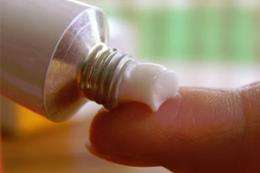
For those suffering from osteoarthritis of the knees or hands, applying topical non-steroidal anti-inflammatory drugs (NSAIDs)—in the form of creams, gels and patches—can bring weeks of pain relief, finds a new review by The Cochrane Library.
While oral NSAIDs are more common for managing musculoskeletal pain, reviewers wanted to examine the effectiveness of the topical variety for managing pain for longer than 8 weeks. And while they have been widely used for years in some parts of the world, topical NSAIDs have been slow to become popular in the U.S.
A team of reviewers evaluated 34 studies involving 7,688 adults with chronic musculoskeletal pain for a period of at least 3 months. Participants were organized into groups using either a topical NSAID applied at least once daily, such as diclofenac, ketoprofen, indomethacin, and ibuprofen; a placebo; or an oral NSAID.
The reviewers found the topical NSAID diclofenac was as effective as oral NSAIDs for arthritis in the knee or hand and it gave more participants good pain relief compared to the placebo in studies lasting 8–12 weeks. In four studies, for example, diclofenac gave 60 percent of participants' pain relief over 8–12 weeks compared to 50 percent of those in the placebo group.
Lead reviewer Sheena Derry, Ph.D., of the Pain Research and Nuffield Department of Clinical Neurosciences at the University of Oxford in the U.K., explained, however, that the use of topical formulations is limited to conditions where the pain is "near to the surface."
"The benefit of topical over oral NSAIDs is that with topical, the drug stays close to the site of application, so levels in blood and more remote tissues remain very low," said Derry. "This means you don't get the gastrointestinal problems that are associated and cause so many problems with oral NSAIDs."
Roger Chou, M.D., an assistant professor of medicine at Oregon Health & Science University and expert in pain management, said the review findings were similar to his past research and were consistent with what he'd expect to see.
"I think one thing to remember is that for topical medications to work, [the pain] has to be fairly localized," said Chou. "It would be tough to use these NSAIDs for fibromyalgia where the pain is all over the body, or back pain, where the pain is typically in the deeper structures."
Chou added that there are many reasons why topical NSAIDs have been slow to gain usage in the U.S., partly because the U.S. Food Administration only approved the first formulations in 2007.
"I also think that many patients and clinicians simply perceive topical NSAIDS to be weaker than pills," Chou said. "But as we learn more about their effectiveness and perhaps as the cost comes down, people will use them more."
More information: Derry S, Moore RA, Rabbie R. Topical NSAIDs for chronic musculoskeletal pain in adults. Cochrane Database of Systematic Reviews 2012, Issue 9.
Journal reference:
Cochrane Library
Provided by
Health Behavior News Service
-
Topical treatments provide effective local pain relief
Jun 15, 2010 |
not rated yet |
0
-
NSAIDs are effective for short-term relief of low-back pain
Jan 23, 2008 |
not rated yet |
0
-
NSAIDs may be more effective than paracetamol for period pain
Jan 20, 2010 |
not rated yet |
0
-
Etoricoxib provides long lasting pain relief after surgery
Apr 15, 2009 |
not rated yet |
0
-
Muscle rubs: Use for pain is questionable
Jul 08, 2009 |
not rated yet |
0
-
Motion perception revisited: High Phi effect challenges established motion perception assumptions
Apr 23, 2013 |
3 / 5 (2) |
2
-
Anything you can do I can do better: Neuromolecular foundations of the superiority illusion (Update)
Apr 02, 2013 |
4.5 / 5 (11) |
5
-
The visual system as economist: Neural resource allocation in visual adaptation
Mar 30, 2013 |
5 / 5 (2) |
9
-
Separate lives: Neuronal and organismal lifespans decoupled
Mar 27, 2013 |
4.9 / 5 (8) |
0
-
Sizing things up: The evolutionary neurobiology of scale invariance
Feb 28, 2013 |
4.8 / 5 (10) |
14
-
Assumptions of Griffith's fracture theory
5 hours ago
-
Current leading voltage or vice versa concept
6 hours ago
-
Angular Frequency of AC voltage
9 hours ago
-
Modeling Rigid Body - Unsure about Euler angles and angular velocity
10 hours ago
-
Function for a bullet's path
11 hours ago
-
Elementary questions relating to Newton's laws of motion
12 hours ago
- More from Physics Forums - Classical Physics
More news stories
Sugar injections for knee arthritis may ease pain
(HealthDay)—Injections of a sugar solution appear to help relieve knee pain and stiffness related to osteoarthritis, a new study suggests.
Arthritis & Rheumatism
3 minutes ago |
not rated yet |
0
|
Blame your parents for bunion woes
A novel study reports that white men and women of European descent inherit common foot disorders, such as bunions (hallux valgus) and lesser toe deformities, including hammer or claw toe. Findings from the Framingham Foot ...
Arthritis & Rheumatism
May 20, 2013 |
not rated yet |
0
|
New theory on genesis of osteoarthritis comes with successful therapy in mice
Scientists at Johns Hopkins have turned their view of osteoarthritis (OA) inside out. Literally. Instead of seeing the painful degenerative disease as a problem primarily of the cartilage that cushions joints, ...
Arthritis & Rheumatism
May 19, 2013 |
4.8 / 5 (6) |
0
|
Ultrasound findings can improve classification of RA
(HealthDay)—Compared to clinical diagnosis of synovitis, ultrasound-detected synovitis provides either improved sensitivity or specificity when used with the American College of Rheumatology/European League ...
Arthritis & Rheumatism
May 15, 2013 |
not rated yet |
0
Strong genetic component of fibromyalgia suggested
(HealthDay)—A genome-wide linkage scan has identified the chromosome 17p11.2-q11.2 region as the susceptibility locus for fibromyalgia, according to research published in the April issue of Arthritis & ...
Arthritis & Rheumatism
May 11, 2013 |
not rated yet |
0
Anti-CD47 antibody may offer new route to successful cancer vaccination
(Medical Xpress)—Scientists at the School of Medicine have shown that their previously identified therapeutic approach to fight cancer via immune cells called macrophages also prompts the disease-fighting killer T cells ...
Evaluating a new way to open clogged arteries
Over the past few decades, scientists have developed many devices that can reopen clogged arteries, including angioplasty balloons and metallic stents. While generally effective, each of these treatments ...
Primary care docs should play role in kids' dental health, experts say
(HealthDay)—When it comes to the care of your children's teeth, dentists aren't the only experts who can help.
Eyes on the sun: Child sunshine exposure and eye development
(Medical Xpress)—Exposure to sunshine as a small child is crucial to the development of a healthy eye according to results of long-term myopia study conducted by University of Sydney researchers.
ATS: Early prone positioning reduces mortality in ARDS
(HealthDay)—For patients with acute respiratory distress syndrome (ARDS), prolonged prone positioning during mechanical ventilation is associated with significantly reduced mortality at 28 and 90 days, ...
Tunisia announces three cases of coronavirus, one death
(AP)—Tunisia's Health Ministry says a 66-year-old man has died after being infected by the new coronavirus following a visit to Saudi Arabia.