U.S. children exposed to about four hours background TV a day
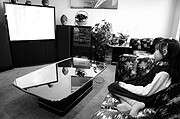
(HealthDay)—Children in the United States are exposed to nearly four hours of background television on average every day, an amount that threatens healthy child development, new research reveals.
Younger kids, black children and the poor grow up with even more hours of background TV—where the television is on but no one is watching or someone else in the home is viewing.
"I was floored with the amount of exposure we found," said study author Deborah Linebarger, associate professor of education at the University of Iowa in Iowa City.
Prior research has found that background TV (as opposed to actual TV viewing) appears to impede social skills, impulse control, and the ability to concentrate, focus and complete tasks.
"We think the problem may come from the sound effects, the changes in dialogue and voice pitch, which as a whole constantly recruits a kid's attention and causes them to shift back and forth between their play task and the TV," Linebarger said. "And that constant shifting makes it more difficult to learn how to concentrate and attend appropriately."
For the study, which was published online Oct. 1 in the journal Pediatrics, Linebarger and colleagues surveyed nearly 1,500 parents and caregivers of children between 8 months and 8 years of age in 2009.
The authors cite estimates suggesting the average American child engages in direct TV watching about 80 minutes per day from birth until age 6. Concerns about how such "foreground" exposure might hamper development have primarily centered on the potential long-term impact of violent and sexually explicit programming.
By contrast, concerns about background TV exposure have focused less on content and more on the overall distraction factor, with the idea being that background TV may threaten a child's ability to stay attentive and execute non-TV-viewing activities.
The survey participants were asked to keep a one-day diary regarding their child's background-TV exposure. They also were asked how many TVs they owned, how many were in a bedroom and how often a TV typically was on.
The result: For every minute of direct foreground TV viewing, children were exposed to roughly three minutes of indirect background TV, with the latter amounting to about 232 minutes per day on average.
Babies under 2 years old were the most exposed to background TV, at a rate of 5.5 hours per day, with exposure declining as children aged. Kids between 6 and 8 years old experienced a little less than three hours of exposure.
Kids in households living below the poverty line clocked in at about six hours per day, said Linebarger. Those in single-parent homes experienced more than five hours of exposure, versus less than four hours among those in two-parent homes.
The team also found that black children faced higher exposure levels than those in white households: 5.5 hours versus 3.5 hours.
Children with televisions in their bedrooms also logged more background TV exposure.
"What we have suggested is to watch with a purpose," Linebarger said. "Turn on a TV to watch a specific show and then turn it off when it's done. Don't have the TV on when you're eating or sleeping. And just try to be aware how much you have it on. It's challenging, but just being more mindful or conscious of when it's on can make a difference in your child's development."
David Bickham, a research scientist at the Center on Media and Child Health at Boston Children's Hospital, seconded Linebarger's suggestions.
"TV is still a big presence in the American family, and there is pretty substantial data that shows that the presence of a TV can interfere with a child's play sessions," he said. "And four hours of background TV exposure a day is an awful lot. Over time, that certainly has the potential to have a long-term impact on children's learning skills and attention skills."
Bickham, who is also an instructor of pediatrics at Harvard Medical School in Boston, agreed that the TV should be off when no one is watching.
"That's not telling people not to watch at all," he said. "Just that we should be intentional viewers when we do."
More information:
Abstract
Full Text (subscription or payment may be required)
Copyright © 2012 HealthDay. All rights reserved.


