Researchers uncover molecular basis of infection of tick-transmitted disease
October 12, 2012 in Immunology
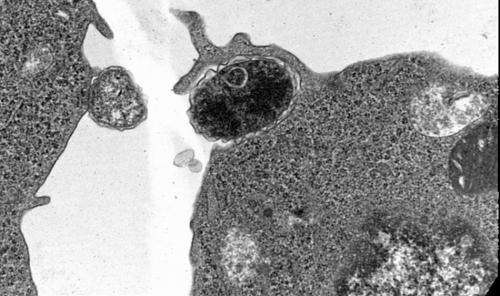
The image depicts two Anaplasma phagocytophilum bacteria (arrows) that are bound to the surfaces of host cells. The bacterium on the right (thick arrow) is invading its host cell by triggering its own uptake. A team of VCU researchers led by Jason Carlyon, Ph.D., has identified a key mechanism by which this pathogen invades host cells. Their findings provide a direction for developing a vaccine for protecting against A. phagocytophilum and related bacterial pathogens. Credit: Image courtesy of Jason Carlyon, Ph.D. and Matthew J. Troese, Ph.D./VCU.
Virginia Commonwealth University School of Medicine researchers have identified the "keys" and "doors" of a bacterium responsible for a series of tick-transmitted diseases. These findings may point researchers toward the development of a single vaccine that protects against members of an entire family of bacteria that cause disease in humans, domestic animals and livestock.
Survival for many bacteria is dependent on their ability to invade human or animal cells. And it needs to be done in a very precise fashion. Bacteria use a specific set of "keys" on their surfaces to unlock specific "doors," or entryways into their host cells.
By understanding how these bacteria invade cells, researchers are able to identify potential targets to block the spread of infection, and from there, develop safe and effective vaccines.
In the study, now published online and appearing in the November (Volume 80, Issue 11) issue of the journal Infection and Immunity, a journal of the American Society for Microbiology, researchers reported that a protein called OmpA on the surface of Anaplasma phagocytophilum is important for invading host cells. Anaplasma phagocytophilum is an Anaplasmataceae bacterium that infects humans to cause granulocytic anaplasmosis. It is the second most common tick-transmitted disease after Lyme disease in the United States, and it also is found in Europe and Asia.
The team also identified the particular sugar residue on the surfaces of host cells to which OmpA binds.
"In other words, we identified both a key and door that together promote Anaplasma phagocytophilum infection," said lead investigator Jason A. Carlyon, Ph.D., associate professor and a George and Lavinia Blick Scholar in the Department of Microbiology and Immunology in the VCU School of Medicine.
"These findings are important because our data also establish a direction for development of a single vaccine that protects against members of an entire family of bacteria that cause disease in humans, domestic animals and livestock," he said.
According to Carlyon, the region of OmpA that mediates infection is shared among other Anaplasmataceae bacteria.
Experts have seen a steady rise in the incidence of human infections caused by tick-transmitted bacterial pathogens in the past several years. Many tick-transmitted bacterial pathogens are considered "emerging pathogens" because it was only recently discovered that they infect humans. Moreover, evidence suggests that many of these infections go unrecognized, signifying that the prevalence of human diseases caused by Anaplasmataceae pathogens is even higher, said Carlyon. Livestock infections carry a significant economic burden, costing the U.S. cattle industry $100 million per year, he added.
Researchers in Carlyon's lab are presently refining their understanding of how OmpA promotes infection and testing its efficacy in protecting against infection by A. phagocytophilum and other Anaplasmataceae members.
The findings of the VCU-led study were also highlighted in a commentary that appeared in the same issue of the journal, authored by two experts in the field, including Guy H. Palmer, DVM, Ph.D., director, Creighton chair and Regents professor in the Paul G. Allen School for Global Animal Health at the Washington State University College of Veterinary Medicine, and Susan M. Noh, Ph.D., also with Washington State University College of Veterinary Medicine.
For this work, VCU has filed a patent. At this time, U.S. and foreign rights are available, and the team is seeking commercial partners to further develop this technology.
Journal reference:
Infection and Immunity
Provided by
Virginia Commonwealth University
-
Surprising study results: More cattle means less Lyme disease
Apr 16, 2012 |
not rated yet |
0
-
Tick-related disease thrives on cholesterol, study suggests
Jul 02, 2007 |
not rated yet |
0
-
Genetic analysis of costly cattle disease may aid in vaccine development
Jul 14, 2011 |
not rated yet |
0
-
On the trail of a vaccine for Lyme disease: Researchers target tick saliva
Nov 19, 2009 |
not rated yet |
0
-
Scientists identify potential key to Lyme disease
Feb 09, 2009 |
not rated yet |
0
-
Motion perception revisited: High Phi effect challenges established motion perception assumptions
Apr 23, 2013 |
3 / 5 (2) |
2
-
Anything you can do I can do better: Neuromolecular foundations of the superiority illusion (Update)
Apr 02, 2013 |
4.5 / 5 (11) |
5
-
The visual system as economist: Neural resource allocation in visual adaptation
Mar 30, 2013 |
5 / 5 (2) |
9
-
Separate lives: Neuronal and organismal lifespans decoupled
Mar 27, 2013 |
4.9 / 5 (8) |
0
-
Sizing things up: The evolutionary neurobiology of scale invariance
Feb 28, 2013 |
4.8 / 5 (10) |
14
-
Change in momentum when a body is thrown up and falls back down.
3 hours ago
-
change in speed and wavelength of light while travelling from one med
3 hours ago
-
Calculus of Variation - Classical Mechanics
6 hours ago
-
Frictional Force Equation Doesn't Make Sense
6 hours ago
-
Calculating Steam Pressure in Closed Container
11 hours ago
-
Learning curve of Electromagnetism?
16 hours ago
- More from Physics Forums - Classical Physics
More news stories
Stem-cell-based strategy boosts immune system in mice
Raising hopes for cell-based therapies, UC San Francisco researchers have created the first functioning human thymus tissue from embryonic stem cells in the laboratory. The researchers showed that, in mice, ...
Immunology
May 16, 2013 |
4.8 / 5 (5) |
0
|
Resistance to visceral leishmaniasis: New mechanisms involved
Researchers from CNRS, Université Toulouse III - Paul Sabatier and IRD have elucidated new molecular mechanisms involved in resistance to visceral leishmaniasis, a serious parasitic infection. They have shown that dectin-1 ...
Immunology
May 16, 2013 |
not rated yet |
0
Women's immune systems remain younger for longer
Women's immune systems age more slowly than men's, suggests research in BioMed Central's open access journal Immunity & Ageing. The slower decline in a woman's immune system may contribute to women living longer than men. ...
Immunology
May 14, 2013 |
not rated yet |
0
Newly described type of immune cell and T cells share similar path to maturity, according to new study
(Medical Xpress)—Labs around the world, and a core group at Penn, have been studying recently described populations of immune cells called innate lymphoid cells (ILCs). Some researchers liken them to foot soldiers that ...
Immunology
May 14, 2013 |
5 / 5 (3) |
0
|
Not all cytokine-producing cells start out the same way, study finds
(Medical Xpress)—Cytokines are molecules produced by immune cells that induce the migration of other cells to sites of infection or injury, promote the production of anti-microbial agents, and signal the production of inflammatory ...
Immunology
May 13, 2013 |
5 / 5 (1) |
0
|
Consuming coffee linked to lower risk of detrimental liver disease, study finds
Regular consumption of coffee is associated with a reduced risk of primary sclerosing cholangitis (PSC), an autoimmune liver disease, Mayo Clinic research shows. The findings were being presented at the Digestive Disease ...
Ketamine shows significant therapeutic benefit in people with treatment-resistant depression
Patients with treatment-resistant major depression saw dramatic improvement in their illness after treatment with ketamine, an anesthetic, according to the largest ketamine clinical trial to-date led by researchers from the ...
Research examines new methods for managing digestive health
Research presented at Digestive Disease Week (DDW) explores new methods for managing digestive health through diet and lifestyle.
New smartphone application improves colonoscopy preparation
The use of a smartphone application significantly improves patients' preparation for a colonoscopy, according to new research presented today at Digestive Disease Week (DDW). The preparation process, which begins days in ...
New research identifies practice changes to improve value and quality of GI procedures
There are significant cost and risk factors associated with two procedures commonly used to diagnose or treat gastrointestinal problems, according to research presented at Digestive Disease Week (DDW).
New research identifies risks, interventions for children's GI health
An increasing number of U.S. children are experiencing gastrointestinal issues that require interventions to resolve, according to research presented at Digestive Disease Week (DDW).
Oct 13, 2012
Rank: not rated yet