Neuroscientists find Broca's area is really two subunits, each with its own function
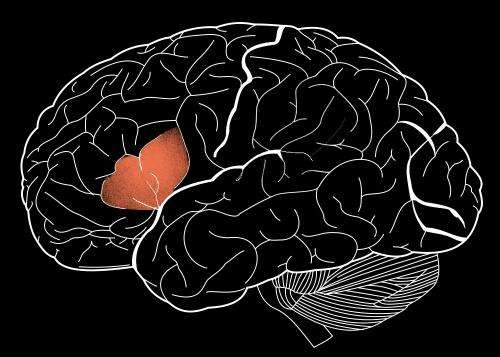
A century and a half ago, French physician Pierre Paul Broca found that patients with damage to part of the brain's frontal lobe were unable to speak more than a few words. Later dubbed Broca's area, this region is believed to be critical for speech production and some aspects of language comprehension.
However, in recent years neuroscientists have observed activity in Broca's area when people perform cognitive tasks that have nothing to do with language, such as solving math problems or holding information in working memory. Those findings have stimulated debate over whether Broca's area is specific to language or plays a more general role in cognition.
A new study from MIT may help resolve this longstanding question. The researchers, led by Nancy Kanwisher, the Walter A. Rosenblith Professor of Cognitive Neuroscience, found that Broca's area actually consists of two distinct subunits. One of these focuses selectively on language processing, while the other is part of a brainwide network that appears to act as a central processing unit for general cognitive functions.
"I think we've shown pretty convincingly that there are two distinct bits that we should not be treating as a single region, and perhaps we shouldn't even be talking about 'Broca's area' because it's not a functional unit," says Evelina Fedorenko, a research scientist in Kanwisher's lab and lead author of the new study, which recently appeared in the journal Current Biology.
Kanwisher and Fedorenko are members of MIT's Department of Brain and Cognitive Sciences and the McGovern Institute for Brain Research. John Duncan, a professor of neuroscience at the Cognition and Brain Sciences Unit of the Medical Research Council in the United Kingdom, is also an author of the paper.
A general role
Broca's area is located in the left inferior frontal cortex, above and behind the left eye. For this study, the researchers set out to pinpoint the functions of distinct sections of Broca's area by scanning subjects with functional magnetic resonance imaging (fMRI) as they performed a variety of cognitive tasks.
To locate language-selective areas, the researchers asked subjects to read either meaningful sentences or sequences of nonwords. A subset of Broca's area lit up much more when the subjects processed meaningful sentences than when they had to interpret nonwords.
The researchers then measured brain activity as the subjects performed easy and difficult versions of general cognitive tasks, such as doing a math problem or holding a set of locations in memory. Parts of Broca's area lit up during the more demanding versions of those tasks. Critically, however, these regions were spatially distinct from the regions involved in the language task.
These data allowed the researchers to map, for each subject, two distinct regions of Broca's area—one selectively involved in language, the other involved in responding to many demanding cognitive tasks. The general region surrounds the language region, but the exact shapes and locations of the borders between the two vary from person to person.
The general-function region of Broca's area appears to be part of a larger network sometimes called the multiple demand network, which is active when the brain is tackling a challenging task that requires a great deal of focus. This network is distributed across frontal and parietal lobes in both hemispheres of the brain, and all of its components appear to communicate with one another. The language-selective section of Broca's area also appears to be part of a larger network devoted to language processing, spread throughout the brain's left hemisphere.
Mapping functions
The findings provide evidence that Broca's area should not be considered to have uniform functionality, says Peter Hagoort, a professor of cognitive neuroscience at Radboud University Nijmegen in the Netherlands. Hagoort, who was not involved in this study, adds that more work is needed to determine whether the language-selective areas might also be involved in any other aspects of cognitive function. "For instance, the language-selective region might play a role in the perception of music, which was not tested in the current study," he says.
The researchers are now trying to determine how the components of the language network and the multiple demand network communicate internally, and how the two networks communicate with each other. They also hope to further investigate the functions of the two components of Broca's area.
"In future studies, we should examine those subregions separately and try to characterize them in terms of their contribution to various language processes and other cognitive processes," Fedorenko says.
More information: www.cell.com/current-biology/a … 0960-9822(12)01074-3
This story is republished courtesy of MIT News (web.mit.edu/newsoffice/), a popular site that covers news about MIT research, innovation and teaching.


