New rapid and point of care hepatitis C tests could be global game changers
October 15, 2012 in Diseases, Conditions, Syndromes
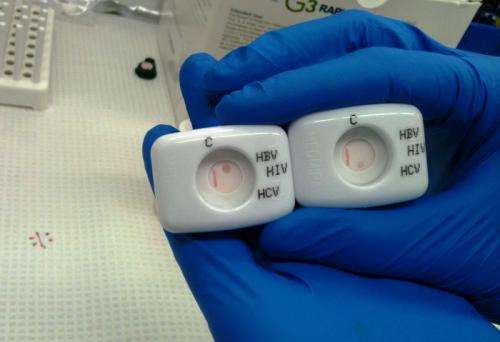
This is the point of care test for hepatitis C virus (HCV) infection. Credit: Dr. Nitika Pant Pai
Timely screening and diagnosis is critical to the success of new treatments and ultimately to the survival of hepatitis C patients. A new study led by the Research Institute of the McGill University Health Centre (RI MUHC) is the first to show that hepatitis C rapid and point of care tests with a quick turnaround time are highly accurate and reliable as conventional first-line laboratory tests. This head-to-head analysis, published in the current issue of the Annals of Internal Medicine, will lead to changes in screening practices and ultimately impact the control of hepatitis C infection worldwide.
"We were able to determine that point-of-care and rapid tests in oral fluids and blood ranged in accuracy from 97 to 99 per cent, which is significant," says senior author, Dr. Nitika Pant Pai, Assistant Professor in the Department of Medicine at McGill University and clinical researcher at the RI MUHC. "With their quick turnaround time and convenience we can now use these tests to screen many patients worldwide."
Although conventional lab testing is in place in developed countries, it is available only to those who visit community clinics and specialized hospitals and have a risk profile, or symptomatology, that warrant screening. Typically, results are available within a week, but may only be communicated to the patient during their next visit, which may be one to three months later. Delays like this may result in reduced patient follow-up and potentially impact transmission of the virus in the community.
Accurate and reliable point-of-care tests and rapid tests offer an alternative to standard tests. "First generation point-of-care tests are convenient, effective and informative for clinical decision making," explains Dr. Pant Pai. "These tests usually don't require specialized equipment, they can provide results within 30 minutes, or maximally within one patient visit or one working day, and many do not require electricity," adds Sushmita Shivkumar, lead author of the study and a medical student at McGill University.
More than 170 million people are infected with hepatitis C worldwide due to unsafe blood transfusion, injection drug use and unsafe therapeutic injections. Hepatitis C and HIV co-infections contribute substantially to disease burden in North America, but the affect of the disease is highest in Africa and Asia. "With promising oral drugs for Hepatitis C on the horizon, accurate and reliable point-of-care and rapid tests will allow millions of infected individuals worldwide to be diagnosed and treated," explains the study's co-author Dr. Rosanna Peeling, Professor and Chair of Diagnostics Research at the London School of Hygiene & Tropical Medicine.
"These tests have the potential to be game changers on a global scale, particularly where first line conventional laboratory based testing is not financed by under-resourced health systems," concludes Dr. Pant Pai. "It is now time to optimize their potential by integrating them in routine practice settings."
More information: Accuracy of rapid and point-of-care screening tests for hepatitis C: A systemic review and meta-analysis, annals.org/article… leid=1379774
Journal reference:
Annals of Internal Medicine
Provided by
McGill University Health Centre
-
Saliva HIV test passes the grade
Jan 24, 2012 |
not rated yet |
0
-
Rapid oral HIV test shows great promise
Apr 11, 2007 |
not rated yet |
0
-
How accurate are rapid flu tests? New research could lead to more timely diagnosis
Feb 27, 2012 |
not rated yet |
0
-
Overcoming barriers to point-of-care testing in low-resource settings
Sep 04, 2012 |
not rated yet |
0
-
Research calls for better assessment of tests for tuberculosis, HIV/AIDS and malaria
Nov 17, 2009 |
not rated yet |
0
-
Motion perception revisited: High Phi effect challenges established motion perception assumptions
Apr 23, 2013 |
3 / 5 (2) |
2
-
Anything you can do I can do better: Neuromolecular foundations of the superiority illusion (Update)
Apr 02, 2013 |
4.5 / 5 (11) |
5
-
The visual system as economist: Neural resource allocation in visual adaptation
Mar 30, 2013 |
5 / 5 (2) |
9
-
Separate lives: Neuronal and organismal lifespans decoupled
Mar 27, 2013 |
4.9 / 5 (8) |
0
-
Sizing things up: The evolutionary neurobiology of scale invariance
Feb 28, 2013 |
4.8 / 5 (10) |
14
-
Classical and Quantum Mechanics via Lie algebras
Apr 15, 2011
- More from Physics Forums - Independent Research
More news stories
FDA warns of infections tied to Tennessee pharmacy
(AP)—Government health officials are investigating several health problems reported with potentially contaminated medications made by a Tennessee specialty pharmacy.
Diseases, Conditions, Syndromes
5 hours ago |
not rated yet |
0
Comorbidities common with alopecia areata
(HealthDay)—Comorbid conditions often accompany alopecia areata, according to a study published online May 22 in JAMA Dermatology.
Diseases, Conditions, Syndromes
6 hours ago |
not rated yet |
0
Top-ranked golfer beats scoliosis
(HealthDay)—As a world-class golfer, Stacy Lewis' accomplishments are remarkable. But it was a physical challenge in her childhood that defined her ascent to the top of her sport.
Diseases, Conditions, Syndromes
6 hours ago |
not rated yet |
0
Saudi to send animal samples to US in coronavirus probe (Update)
Saudi Arabia said Friday it would send samples taken from animals possibly infected with a deadly SARS-like virus to the United States for testing in a bid to find the source of disease.
Diseases, Conditions, Syndromes
10 hours ago |
not rated yet |
0
WHO voices deep concern over spread of SARS-like virus
The World Health Organization voiced deep concern Thursday over the SARS-like virus that has killed 22 people in less than a year, saying it might potentially spread more widely between humans.
Diseases, Conditions, Syndromes
13 hours ago |
5 / 5 (1) |
0
Researchers identify first drug targets in childhood genetic tumor disorder
Two mutations central to the development of infantile myofibromatosis (IM)—a disorder characterized by multiple tumors involving the skin, bone, and soft tissue—may provide new therapeutic targets, according to researchers ...
Engineered cytomegalovirus protects monkeys from HIV equivalent
(Medical Xpress)—A new study by researchers in the US has shown that an ancient virus can be modified to help in the fight against the simian immunodeficiency virus SIV, which is the equivalent in monkeys ...
Hormone levels may provide key to understanding psychological disorders in women
Women at a particular stage in their monthly menstrual cycle may be more vulnerable to some of the psychological side-effects associated with stressful experiences, according to a study from UCL.
Going live: Immune cell activation in multiple sclerosis
Biological processes are generally based on events at the molecular and cellular level. To understand what happens in the course of infections, diseases or normal bodily functions, scientists would need to ...
Driving and hands-free talking lead to spike in errors, study shows
Talking on a hands-free device while behind the wheel can lead to a sharp increase in errors that could imperil other drivers on the road, according to new research from the University of Alberta.
Pollen count apps for smartphones are nothing to sneeze at
Kate O'Reilly's spring allergy survival kit includes the usual stuff - nasal sprays, allergy pills and a box of tissues. This season, she's added a new weapon to her line of defense: an app on her smartphone.