New X-ray breast cancer imaging possible with 25 times reduced radiation dose
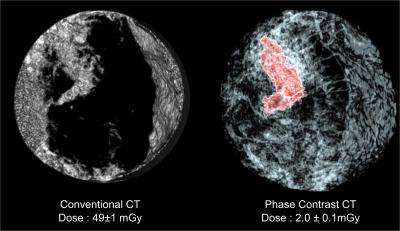
This is a comparison between a conventional CT scan of the breast sample and a scan using equally sloped tomography with phase contrast imaging. In the latter image, the tumor is highlighted in red. The radiation dose needed for the scans is indicated at the bottom. Credit: ESRF-LMU/Brun
Scientists have developed a way to produce three-dimensional X-ray images of the breast at a radiation dose that is lower than the 2D radiographies used in clinics today. The new method enables the production of 3D diagnostic computed tomography (CT) images with a spatial resolution 2-3 times higher than present hospital scanners, but with a radiation dose that is about 25 times lower. This breakthrough has the potential to overcome the main obstacle limiting conventional CT imaging of the breast: the high radiosensitivity of the breast glandular tissue. Synchrotron X-rays at the Medical station of the ESRF have been used for testing the technique which, once deployed in hospitals, will make CT scans a diagnostic tool to complement dual view mammography.
The results of this innovative method are published in the online Early Edition of the Proceedings of the National Academy of Sciences (PNAS) of week October 22, 2012.
The multidisciplinary team comprised physicists, radiologists and mathematicians from the European Synchrotron Radiation Facility ESRF (Grenoble, France), the Ludwig Maximilians University in Munich (LMU, Cluster of Excellence MAP) and the University of California at Los Angeles (UCLA). The first authors are Yunzhe Zhao of UCLA and Emmanuel Brun of the LMU/ESRF.
Early detection largely contributes to an improved prognosis and results in reduced breast cancer mortality. The breast cancer screening method typically used today is "dual-view digital mammography". The limitation is that it only provides two images of the breast tissue, which can explain why 10 percent to 20 percent of breast tumours are not detectable on mammograms. Mammograms can also sometimes appear abnormal, when no breast cancers are actually present.
This video is not supported by your browser at this time.
Video sequence of the 3-D CT scan of the breast sample using equally sloped tomography with phase contrast imaging. The radiation dose during the scan is 2mGy, corresponding to the dose everybody accumulates from natural and environmental sources during about one year. Credit: ESRF-LMU/Brun
Computed tomography (CT), an X-ray technique that allows a precise 3D visualization of the human body organs, cannot be routinely applied in breast cancer diagnosis because the risk of long-term effects in radiosensitive organs like the breast is considered too high.Recognizing these limitations, scientists went in a new direction. CT scans for early detection of breast cancer may now become possible thanks to the combination of three ingredients: high energy X-rays, a special detection method called "phase contrast imaging" and the use of a sophisticated novel mathematical algorithm, known as "equally sloped tomography" (EST), to reconstruct the CT images from X-ray data. Tissues are more transparent to high energy X-rays and therefore less dose is deposited (a factor of 6 in radiation dose reduction). Phase contrast imaging, mastered by the ESRF and the LMU-MAP teams, allows producing images with much less X-rays to obtain the same image contrast. Finally the EST method, originally developed by researchers at UCLA, needs 4 times less radiation to obtain the same image quality.
The team X-rayed a human breast at multiple different angles using phase contrast tomography and applied the EST algorithm to 512 images to produce higher resolution 3-D images of the organ than ever before and at a lower dose than a mammogram. In a blind evaluation, five independent radiologists from the LMU ranked the generated images as having the highest sharpness, contrast, and overall image quality compared to 3-D images of breast tissue created through other standard methods.
"This new technique can open up the doors to the clinical use of computed tomography in the breast diagnosis, which would be a powerful tool to fight even better and earlier against breast cancer", says Prof. Maximilian Reiser, Director of the Radiology Department of the LMU, which provided the medical expertise for this research. "This result has been obtained thanks to the synergy of the expertise by researchers from very different disciplines. These high-quality X-ray CT images at high energies are the result of a 10-year effort at the ESRF" says Alberto Bravin, head of the ESRF medical research laboratory who led the team in Grenoble. "After dramatically reducing the dose delivered during the examination of the breast, our next objective is to develop this technique in the early visualization of other human diseases and to work towards its clinical implementation." adds Paola Coan, Professor of X-ray imaging at LMU and member of "Munich-Centre for Advanced Photonics (MAP)" who led the group from Munich.
"Three-dimensional reconstructions, like the ones created in this research, are produced using sophisticated software and a powerful computer that can combine many images into one 3-D image, much like slices of an orange. By rethinking the mathematic equations of the software in use today" says Jianwei (John) Miao, UCLA professor of physics and astronomy and researcher with the California NanoSystems Institute at UCLA "we developed a more powerful algorithm that requires fewer slices to get a clearer 3-D picture".
Today, the new technology is in the research phase and will not be available to patients for some time. To be implemented in clinics, it needs an X-ray source small enough to become commonly used for breast cancer screening. "Many research groups are actively working to develop this device and once this hurdle is cleared, the new X-ray technique is poised to make a big impact on society", concludes Emmanuel Brun.
Journal reference:
Proceedings of the National Academy of Sciences
Provided by
European Synchrotron Radiation Facility
-
New tool for early diagnosis of breast cancer
Sep 17, 2008 |
not rated yet |
0
-
Cone-Beam CT faster, potentially more accurate than conventional mammography
Dec 27, 2007 |
not rated yet |
0
-
Safer CT scanning for children developed
Apr 04, 2011 |
not rated yet |
0
-
High-contrast, high-resolution CT scans now possible at reduced dose
Jun 04, 2012 |
not rated yet |
0
-
Angled gantry technique reduced breast radiation exposure by 50 percent
Dec 04, 2008 |
not rated yet |
0
-
Motion perception revisited: High Phi effect challenges established motion perception assumptions
Apr 23, 2013 |
3 / 5 (2) |
2
-
Anything you can do I can do better: Neuromolecular foundations of the superiority illusion (Update)
Apr 02, 2013 |
4.5 / 5 (11) |
5
-
The visual system as economist: Neural resource allocation in visual adaptation
Mar 30, 2013 |
5 / 5 (2) |
9
-
Separate lives: Neuronal and organismal lifespans decoupled
Mar 27, 2013 |
4.9 / 5 (8) |
0
-
Sizing things up: The evolutionary neurobiology of scale invariance
Feb 28, 2013 |
4.8 / 5 (10) |
14
-
Pressure-volume curve: Elastic Recoil Pressure don't make sense
May 18, 2013
-
If you became brain-dead, would you want them to pull the plug?
May 17, 2013
-
MRI bill question
May 15, 2013
-
Ratio of Hydrogen of Oxygen in Dessicated Animal Protein
May 13, 2013
-
Alcohol and acetaminophen
May 13, 2013
-
Marie Curie's leukemia
May 13, 2013
- More from Physics Forums - Medical Sciences
More news stories
Older prostate cancer patients should think twice before undergoing treatment
Older prostate cancer patients with other underlying health conditions should think twice before committing to surgery or radiation therapy for their cancer, according to a multicenter study led by researchers in the UCLA ...
Cancer
2 hours ago |
not rated yet |
0
|
Two radiotherapy treatments show similar morbidity, cancer control after prostatectomy
Intensity-modulated radiation therapy has become the most commonly used type of radiation in prostate cancer, but research from the University of North Carolina suggests that the therapy may not be more effective than older, ...
Cancer
4 hours ago |
not rated yet |
0
The compound in the Mediterranean diet that makes cancer cells 'mortal'
New research suggests that a compound abundant in the Mediterranean diet takes away cancer cells' "superpower" to escape death. By altering a very specific step in gene regulation, this compound essentially re-educates cancer ...
Cancer
4 hours ago |
4.7 / 5 (7) |
1
|
CT radiation risk less than risk of examination indicator
(HealthDay)—For young adults needing either a chest or abdominopelvic computed tomography (CT), the short-term risk of death from underlying morbidity is greater than the long-term risk of radiation-induced ...
Cancer
6 hours ago |
not rated yet |
0
Team finds mechanism linking key inflammatory marker to cancer
In a new study described in the journal Oncogene, researchers reveal how a key player in cell growth, immunity and the inflammatory response can be transformed into a primary contributor to tumor growth.
Cancer
11 hours ago |
not rated yet |
0
|
New immune system discovered
(Medical Xpress)—A research team, led by Jeremy Barr, a biology post-doctoral fellow, unveils a new immune system that protects humans and animals from infection.
Practice makes perfect? Not so much
Turns out, that old "practice makes perfect" adage may be overblown. New research led by Michigan State University's Zach Hambrick finds that a copious amount of practice is not enough to explain why people ...
Scientists identify molecular trigger for Alzheimer's disease
Researchers have pinpointed a catalytic trigger for the onset of Alzheimer's disease – when the fundamental structure of a protein molecule changes to cause a chain reaction that leads to the death of neurons ...
Do salamanders hold the solution to regeneration?
Salamanders' immune systems are key to their remarkable ability to regrow limbs, and could also underpin their ability to regenerate spinal cords, brain tissue and even parts of their hearts, scientists have ...
New test better detects elephantiasis worm infection
A new diagnostic test for a worm infection that can lead to severe enlargement and deformities of the legs and genitals is far more sensitive than the currently used test, according to results of a field ...
Researchers develop model for better testing, targeting of malignant peripheral nerve sheath tumors
University of Minnesota Medical School researchers from the Masonic Cancer Center, University of Minnesota, in partnership with the University's Brain Tumor Program, have developed a new mouse model of malignant peripheral ...