Alzheimer's disease in mice alleviated promising therapeutic approach for humans
November 25, 2012 in Alzheimer's disease & dementia

Alzheimer's disease in mice alleviated promising therapeutic approach for humans

Enlarge

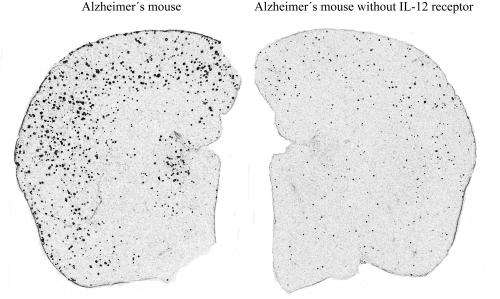
Deficiency (or inhibition) of molecules of the interleukin (IL)-12 and/or IL-23 signal pathway reduces Alzheimer-like pathological changes – depicted here as so-called β-amyloid plaques (spot-like areas, stained in black) – substantially. Left: Brain hemisphere of an Alzheimer’s mouse; right: Brain hemisphere of an Alzheimer’s mouse without IL-12 receptor. Credit: UZH

Pathological changes typical of Alzheimer's disease were significantly reduced in mice by blockade of an immune system transmitter. A research team from Charité - Universitätsmedizin Berlin and the University of Zurich has just published a new therapeutic approach in fighting Alzheimer's disease in the current issue of Nature Medicine. This approach promises potential in prevention, as well as in cases where the disease has already set in.

Alzheimer's disease is one of the most common causes of dementia. In Germany and Switzerland alone, around 1.5 million people are affected, and forecasts predict a doubling of the number of patients worldwide within the next 20 years. The accumulation of particular abnormal proteins, including amyloid-ß (Aβ) among others, in patients' brains plays a central role in this disease.

Prof. Frank Heppner from the Department of at Charité and his colleague Prof. Burkhard Becher from the Institute for at the University of Zurich were able to show that turning off particular cytokines (immune system signal transmitters) reduced the Alzheimer's typical amyloid-ß deposits in mice with the disease. As a result, the strongest effects were demonstrated after reducing amyloid-ß by approximately 65 percent, when the immune molecule p40 was affected, which is a component of the cytokines interleukin (IL)-12 and -23.

Relevant for human therapy

Follow-up experiments also relevant for humans showed that substantial improvements in behavioral testing resulted when mice were given the antibody blocking the immune molecule p40. This effect was also achieved when the mice were already showing symptoms of the disease. Based on the current study by Prof. Heppner's and Prof. Becher's team, the level of p40 molecules is higher in Alzheimer's patients' brain fluid, which is in agreement with a recently published study by American colleagues demonstrating increased p40 levels in of subjects with Alzheimer's disease, thus showing obvious relevance for human therapy.

The significance of the immune system in Alzheimer's research is the focus of current efforts. Prof. Heppner and Prof. Becher suspect that cytokines IL-12 and IL-23 themselves are not causative in the pathology, and that the mechanism of the immune molecule p40 in Alzheimer's requires additional clarification. However, they are convinced that the results of their six-years of research work justify the step toward clinical studies in humans, for which they plan to collaborate with a suitable industrial partner.

IIn the context of other illnesses, such as psoriasis, a medication that suppresses p40 in humans has already been applied. "Based on the safety data in patients," comment Profs. Heppner and Becher, "clinical studies could now be implemented without delay. Now, the goal is to bring the new to Alzheimer patients quickly."

More information: Johannes vom Berg, Stefan Prokop, Kelly R. Miller, Juliane Obst, Roland E. Kälin, Ileana Lopategui-Cabezas, Anja Wegner, Florian Mair, Carola G. Schipke, Oliver Peters, York Winter, Burkhard Becher, and Frank L. Heppner. Inhibition of IL-12/IL-23 signaling reduces Alzheimer's disease-like pathology and cognitive decline. Nature Medicine. November 25, 2012. doi: 10.1038/nm.2965

Journal reference: Nature Medicine search and more info website

Provided by University of Zurich search and more info website

5 /5 (10 votes)  

Rank 5 /5 (10 votes)
Relevant PhysicsForums posts

More news stories

Scientists discover cinnamon compounds' potential ability to prevent Alzheimer's

Cinnamon: Can the red-brown spice with the unmistakable fragrance and variety of uses offer an important benefit? The common baking spice might hold the key to delaying the onset of –– or warding off ...

Alzheimer's disease & dementia created 11 hours ago | popularity 5 / 5 (4) | comments 0 | with audio podcast

Drug reverses Alzheimer's disease deficits in mice, research confirms

An anti-cancer drug reverses memory deficits in an Alzheimer's disease mouse model, University of Pittsburgh Graduate School of Public Health researchers confirm in the journal Science.

Alzheimer's disease & dementia created 13 hours ago | popularity not rated yet | comments 0 | with audio podcast

Multiple research teams unable to confirm high-profile Alzheimer's study

Teams of highly respected Alzheimer's researchers failed to replicate what appeared to be breakthrough results for the treatment of this brain disease when they were published last year in the journal Science.

Alzheimer's disease & dementia created 13 hours ago | popularity 5 / 5 (1) | comments 2 | with audio podcast

Major human drug trial underway for Alzheimer's

A potentially ground-breaking human drug trial is currently underway, which aims to discover whether blood pressure medication can slow or halt the progression of Alzheimer's Disease (AD). This is the latest ...

Alzheimer's disease & dementia created 16 hours ago | popularity not rated yet | comments 0

Drugs found to both prevent and treat Alzheimer's disease in mice

Researchers at USC have found that a class of pharmaceuticals can both prevent and treat Alzheimer's Disease in mice.

Alzheimer's disease & dementia created May 21, 2013 | popularity 5 / 5 (7) | comments 0 | with audio podcast


Controlling mood through the motions of mitochondria

(Medical Xpress)—Regulating the distribution of power in neurons is done by a system that makes the national electric grid look simple by comparison. Each neuron has several thousand mitochondria confined ...

Motion quotient: IQ predicted by ability to filter motion (w/ video)

A brief visual task can predict IQ, according to a new study. This surprisingly simple exercise measures the brain's unconscious ability to filter out visual movement. The study shows that individuals whose ...

Scientists discover molecule triggers sensation of itch

Scientists at the National Institutes of Health report they have discovered in mouse studies that a small molecule released in the spinal cord triggers a process that is later experienced in the brain as ...

Researchers find common childhood asthma unconnected to allergens or inflammation

Little is known about why asthma develops, how it constricts the airway or why response to treatments varies between patients. Now, a team of researchers at Weill Cornell Medical College, Columbia University Medical Center ...

Diabetes' genetic underpinnings can vary based on ethnic background, studies say

Ethnic background plays a surprisingly large role in how diabetes develops on a cellular level, according to two new studies led by researchers at the Stanford University School of Medicine.

Study reveals new mechanism for estrogen suppression of liver lipid synthesis

By discovering the new mechanism by which estrogen suppresses lipid synthesis in the liver, UC Irvine endocrinologists have revealed a potential new approach toward treating certain liver diseases.