Alzheimer gene may boost young brains but contributes to 'burnout' in later years
November 13, 2012 by Jacqui Bealing in Neuroscience

Alzheimer gene may boost young brains but contributes to ‘burnout’ in later years

Enlarge

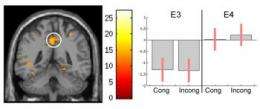
Brain activity in those with APOE e4 gene is more marked in the region of the brain associated with tasks involving attention.

(Medical Xpress)—A gene that confers a higher risk for dementia in old age could also promote better-than-average memory and verbal skills in youth, according to a new University of Sussex-led study.

Neuroscientists tested the cognitive abilities of those with a particular , known as 'APOE e4', found in approximately 25 per cent of the population, against those without it. They also looked at the and of both groups during the tasks.

They found that young people with the e4 variant performed better in attention tests (one involving episodic memory of words, the other requiring participants to spot number sequences), which correlated with increased task-related as detected by MRI scans. The researchers also noticed subtle differences in the white matter of the brains of those with the variant.

Lead researcher Professor Jennifer Rusted said: "Earlier studies suggested that those with the e4 variant outperform those without it in tasks such as memory, speed of processing, mental arithmetic and .  But it is also well-established that this gene is a risk factor for Alzheimer's disease. The suggestion is that while this confers cognitive advantages in early life, leading to higher achievement, it may also increase susceptibility to memory failure as we enter old age.

"Our study is the first to show that subtle differences in the structure and activation of the brain during in APOE e4 carriers are linked to their cognitive performance. It is possible that the brain over-activations that we see in youth have negative effects over the longer term and contribute to a kind of 'burnout' in older adulthood."

The study, "APOE e4 polymorphism in young adults is associated with improved attention and indexed by distinct neural signatures," was funded by the BBSRC (Biotechnology and Biological Sciences Research Council) and is published in NeuroImage.

More information: www.sciencedirect.… 81191201004X

Journal reference: NeuroImage search and more info website

Provided by University of Sussex search and more info website

4 /5 (3 votes)  

Filter


Move the slider to adjust rank threshold, so that you can hide some of the comments.


Display comments: newest first

theskepticalpsychic
Nov 13, 2012

Rank: not rated yet
Great. Another thing to worry about.
Rank 4 /5 (3 votes)
Relevant PhysicsForums posts

More news stories

Reducing caloric intake delays nerve cell loss

Activating an enzyme known to play a role in the anti-aging benefits of calorie restriction delays the loss of brain cells and preserves cognitive function in mice, according to a study published in the May ...

Neuroscience created 8 hours ago | popularity 5 / 5 (3) | comments 0 | with audio podcast

B vitamins could delay dementia

(Medical Xpress)—Despite spending billions of dollars on research and development, drug companies have been unable to come up with effective treatments for dementia and Alzheimer's Disease (AD). Now, A. ...

Neuroscience created 12 hours ago | popularity 4.9 / 5 (10) | comments 0 | with audio podcast report

Waiting for a sign? Researchers find potential brain 'switch' for new behavior

You're standing near an airport luggage carousel and your bag emerges on the conveyor belt, prompting you to spring into action. How does your brain make the shift from passively waiting to taking action when ...

Neuroscience created 12 hours ago | popularity 5 / 5 (1) | comments 0 | with audio podcast

If you can remember it, you can remember it wrong

(Medical Xpress)—Native peoples in regions where cameras are uncommon sometimes react with caution when their picture is taken. The fear that something must have been stolen from them to create the photo ...

Neuroscience created 14 hours ago | popularity 4.2 / 5 (5) | comments 0 | with audio podcast report

Study shows where scene context happens in our brain

In a remote fishing community in Venezuela, a lone fisherman sits on a cliff overlooking the southern Caribbean Sea. This man –– the lookout –– is responsible for directing his comrades on the water, ...

Neuroscience created 16 hours ago | popularity 4 / 5 (1) | comments 0 | with audio podcast


New sleeping pill poised to hit US markets

An experimental sleeping pill from US drug company Merck is effective at helping people fall and stay asleep, according to reviewers at the US Food and Drug Administration, which could soon approve the new drug.

Insight into the dazzling impact of insulin in cells

Australian scientists have charted the path of insulin action in cells in precise detail like never before. This provides a comprehensive blueprint for understanding what goes wrong in diabetes.

Antidepressant reduces stress-induced heart condition

A drug commonly used to treat depression and anxiety may improve a stress-related heart condition in people with stable coronary heart disease, according to researchers at Duke Medicine.

Drugs found to both prevent and treat Alzheimer's disease in mice

Researchers at USC have found that a class of pharmaceuticals can both prevent and treat Alzheimer's Disease in mice.

Small cancer risk following CT scans in childhood and adolescence confirmed

The gap between life expectancy in patients with a mental illness and the general population has widened since 1985 and efforts to reduce this gap should focus on improving physical health, suggest researchers in a paper ...

Dietary advice on added sugar is damaging our health, warns heart expert

Dietary advice on added sugar is damaging our health, warns a cardiologist in BMJ today. Dr. Aseem Malhotra believes that "not only has this advice been manipulated by the food industry for profit but it is actually a risk ...