New finding gives clues for overcoming tamoxifen-resistant breast cancer
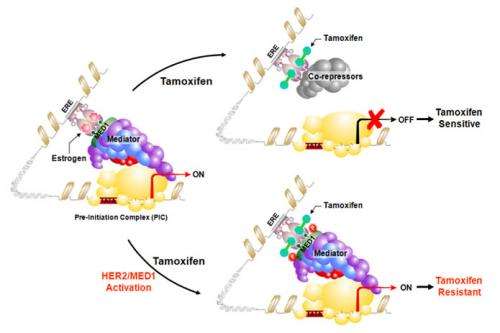
This is an illustration of Xiaoting Zhang's research model showing HER2 activation of MED1 drives estrogen receptor corepressor/coactivator switch by tamoxifen Credit: University of Cincinnati, Xiaoting Zhang
(Medical Xpress)—A University of Cincinnati (UC) cancer biology team reports breakthrough findings about specific cellular mechanisms that may help overcome endocrine (hormone) therapy-resistance in patients with estrogen-positive breast cancers, combating a widespread problem in effective medical management of the disease.
Xiaoting Zhang, PhD, and his colleagues have identified a specific estrogen receptor co-activator—known as MED1—as playing a central role in mediating tamoxifen resistance in human breast cancer. The team reports its findings in the Nov. 1, 2012, issue of Cancer Research, a scientific journal of the American Association for Cancer Research.
According to the National Cancer Institute, nearly 227,000 women are diagnosed with breast cancer annually in the United States. About 75 percent have estrogen-positive tumors and require adjuvant hormone therapy such as tamoxifen, a drug that works by interfering with estrogen's ability to stimulate breast cancer cell growth.
Despite advances in hormone therapy drugs, cancer surveillance research has shown that 50 percent of patients will develop resistance to the drug and experience a cancer relapse.
The hormones estrogen and progesterone can stimulate the growth of some breast cancers. Hormone therapy is used to stop or slow the growth of these tumors. Hormone-sensitive (i.e., positive) breast cancer cells contain specific proteins known as hormone receptors that become activated once hormones bind to them, leading to cancer growth.
Based on new findings, UC Cancer Institute scientists believe that tamoxifen resistance may be driven by a novel molecular "crosstalk" point between the estrogen and HER2 (human epidermal growth factor receptor 2) signaling pathways.
Testing in both pre-clinical models and human breast cancer tissue samples showed that MED1 co-amplifies and co-expresses with HER2, a gene that has an increased presence in 20-30 percent of invasive human breast cancer and plays a major role in tamoxifen resistance.
HER2 over-expression led to MED1 activation while reduction of MED1 caused breast cancer cells that were otherwise tamoxifen-resistant to respond and stop dividing. Further mechanistic studies showed that HER2 activation of MED1 resulted in the recruitment of co-activators instead of co-repressors by tamoxifen-bound estrogen receptor. This, explains Zhang, drives expression of not only traditional estrogen receptor-positive cancer target genes, but also HER2 and those estrogen receptor target genes abnormally activated by HER2.
"Together, these findings suggest this 'crosstalk' could play a central role in mediating tamoxifen resistance in human breast cancer, especially because recent published data also indicated that high MED1 expression levels correlate with poor treatment outcome and disease-free survival of patients who underwent endocrine therapy," explains Zhang, an assistant professor of cancer biology at the UC College of Medicine and breast cancer researcher with the UC Cancer Institute.
"We are currently utilizing RNA-based nanotechnology to target MED1 in an effort to simultaneously block both estrogen and HER2 pathways to overcome endocrine-resistant breast cancer."
More information: cancerres.aacrjour… 21/5625.full
Journal reference:
Cancer Research
Provided by
University of Cincinnati Academic Health Center
-
HOXB7 gene promotes tamoxifen resistance
Dec 11, 2010 |
not rated yet |
0
-
Breast cancer recurrence defined by hormone receptor status
Oct 01, 2012 |
not rated yet |
0
-
Cell study finds receptor can fight tamoxifen-resistant breast cancer cells
Apr 27, 2010 |
not rated yet |
0
-
Team discovers new inhibitors of estrogen-dependent breast cancer cells
Jun 16, 2008 |
not rated yet |
0
-
New biomarker predicts effectiveness of breast cancer drugs
Dec 07, 2006 |
not rated yet |
0
-
Motion perception revisited: High Phi effect challenges established motion perception assumptions
Apr 23, 2013 |
3 / 5 (2) |
2
-
Anything you can do I can do better: Neuromolecular foundations of the superiority illusion (Update)
Apr 02, 2013 |
4.5 / 5 (11) |
5
-
The visual system as economist: Neural resource allocation in visual adaptation
Mar 30, 2013 |
5 / 5 (2) |
9
-
Separate lives: Neuronal and organismal lifespans decoupled
Mar 27, 2013 |
4.9 / 5 (8) |
0
-
Sizing things up: The evolutionary neurobiology of scale invariance
Feb 28, 2013 |
4.8 / 5 (10) |
14
-
Pressure-volume curve: Elastic Recoil Pressure don't make sense
17 hours ago
-
If you became brain-dead, would you want them to pull the plug?
May 17, 2013
-
MRI bill question
May 15, 2013
-
Ratio of Hydrogen of Oxygen in Dessicated Animal Protein
May 13, 2013
-
Alcohol and acetaminophen
May 13, 2013
-
Marie Curie's leukemia
May 13, 2013
- More from Physics Forums - Medical Sciences
More news stories
New colonoscope provides ground-breaking view of colon
A ground-breaking advance in colonoscopy technology signals the future of colorectal care, according to research presented today at Digestive Disease Week(DDW). Additional research focuses on optimizing the minimal withdrawal ...
Cancer
10 hours ago |
5 / 5 (1) |
0
ASCO: combo antibody therapy effective for melanoma
(HealthDay)—Concurrent use of two immune checkpoint antibodies—ipilimumab and nivolumab—may be effective for the treatment of advanced melanoma, according to a proof-of-principal study presented in ...
Cancer
May 17, 2013 |
not rated yet |
0
Risk factors ID'd for poor cutaneous cell CA outcomes
(HealthDay)—The risks of metastasis and death associated with cutaneous squamous cell carcinoma (CSCC) are low, but significant, and risk factors for poor outcome include tumor diameter, invasion beyond ...
Cancer
May 17, 2013 |
not rated yet |
0
|
Physical & emotional impairments common, often untreated in people with cancer
A new review finds cancer survivors suffer a diverse and complex set of impairments, affecting virtually every organ system. Writing in CA: A Cancer Journal for Clinicians, Julie Silver, M.D., associate professor at Harvar ...
Cancer
May 17, 2013 |
not rated yet |
0
Calif. doc with 'cancer cure' gets 14 years prison (Update)
(AP)—A California doctor has been sentenced to 14 years in federal prison for bilking her patients out of more than $1 million by promising that an herbal supplement could cure late-stage cancer and other diseases.
Cancer
May 17, 2013 |
not rated yet |
0
New research identifies risks, interventions for children's GI health
An increasing number of U.S. children are experiencing gastrointestinal issues that require interventions to resolve, according to research presented at Digestive Disease Week (DDW).
US psychiatry gets makeover in new manual
The latest makeover to a massive psychiatric tome honored by some, reviled by others and even called the "Bible" of mental disorders is being released Saturday with a host of new changes.
New case of SARS-like virus in Saudi: ministry
A new case of the deadly coronavirus has been detected in Saudi Arabia where 15 people have already died after contracting it, the health ministry announced on Saturday on its Internet website.
AIDS science at 30: 'Cure' now part of lexicon
Big names in medicine are set to give an upbeat assessment of the war on AIDS on Tuesday, 30 years after French researchers identified the virus that causes the disease.
For combat veterans suffering from post-traumatic stress disorder, 'fear circuitry' in the brain never rests
Chronic trauma can inflict lasting damage to brain regions associated with fear and anxiety. Previous imaging studies of people with post-traumatic stress disorder, or PTSD, have shown that these brain regions can over-or ...
Flesh-eating disease victim gets prosthetic hands
(AP)—A woman who lost both hands, her left leg and right foot after contracting a flesh-eating disease has been fitted with prosthetic hands.