EEG provides insight into drug-related choice in addiction, potential implications for rehabilitation
November 14, 2012 by Aviva Hope Rutkin in Addiction
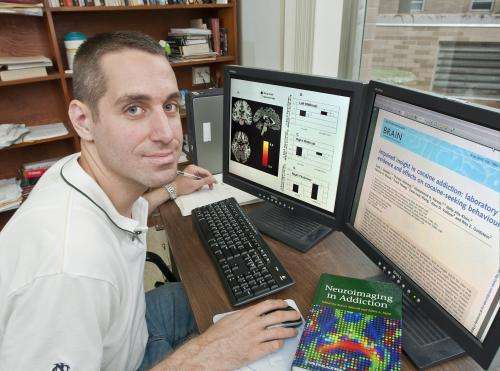
Scott J. Moeller.
(Medical Xpress)—Scientists at the U.S. Department of Energy's (DOE) Brookhaven National Laboratory, Stony Brook University, and collaborators may have found a way to predict drug-addicted individuals' responses to drug-related stimuli.
Their research, which was published online in the journal Brain November 12, 2012, may help improve rehabilitation outcomes for individuals with limited awareness of their own choices. This condition, known as impaired insight, makes drug rehabilitation especially difficult.
Using electroencephalography (EEG), a non-invasive way to measure activity in the brain, scientists tracked neurological activity in dozens of individuals as they viewed a series of images on a screen. The scientists were looking for a particular electrical spike known as the late positive potential (LPP), which occurs in response to attention-grabbing stimuli.
"Very pleasant images evoke the LPP, and very unpleasant images do too," explained lead author Scott J. Moeller, a postdoctoral fellow at Brookhaven. "Likewise, cocaine-related images specifically capture the attention of people who are addicted to cocaine."
After each image was shown and viewed passively, participants were asked to rate how emotionally arousing they had found it. Then, once the task was over, they completed a choice task to assess which type of pictures—pleasant, unpleasant, neutral, or drug-related—they preferred to view the most. A final task enabled the researchers to categorize participants into those with impaired insight and those with intact insight.
Arousal ratings from the participants with intact insight were good predictors of which images those participants preferred. However, for those with impaired insight, LPPs proved to be much better predictors than the individual's own ratings.
The research team hopes their results will prove valuable for people in drug rehabilitation in the future.
"You can have all good intentions to abstain from drug use," Moeller said, "but if at the end of the day you can't monitor your behavior, then other kinds of therapy are going to be needed to bring your behavior in line with your intentions. That's what we're thinking of in terms of a long-range clinical translation down the road."
Next, the team plans to use functional magnetic resonance imaging (fMRI), a brain mapping technique that measures changes in blood oxygenation as a proxy for neural activity, to pinpoint which brain regions are compromised in individuals with impaired insight. They are also developing new tests to ascertain the severity of a given person's insight impairment.
Journal reference:
Brain
Provided by
Brookhaven National Laboratory
-
Drug-related preference in cocaine addiction extends to images
Nov 17, 2008 |
not rated yet |
0
-
Cocaine images capture motivated attention among users
Apr 04, 2011 |
not rated yet |
0
-
Mental fatigue impairs midbrain function in cocaine-addicted individuals, researchers find
Nov 09, 2012 |
not rated yet |
0
-
Ritalin improves brain function, task performance in cocaine abusers
Sep 07, 2010 |
not rated yet |
0
-
Altered Perception of Reward in Human Cocaine Addiction
Oct 16, 2006 |
not rated yet |
0
-
Motion perception revisited: High Phi effect challenges established motion perception assumptions
Apr 23, 2013 |
3 / 5 (2) |
2
-
Anything you can do I can do better: Neuromolecular foundations of the superiority illusion (Update)
Apr 02, 2013 |
4.5 / 5 (11) |
5
-
The visual system as economist: Neural resource allocation in visual adaptation
Mar 30, 2013 |
5 / 5 (2) |
9
-
Separate lives: Neuronal and organismal lifespans decoupled
Mar 27, 2013 |
4.9 / 5 (8) |
0
-
Sizing things up: The evolutionary neurobiology of scale invariance
Feb 28, 2013 |
4.8 / 5 (10) |
14
-
Calculating on-axis elements of a solenoid
3 hours ago
-
latitude & longitude & air pressure
4 hours ago
-
Differences of Classical Mechanics when learned with Calc vs algebra?
7 hours ago
-
what is the distance traveled
11 hours ago
-
Image of a Convex Lens Cut in Half Horizontally
15 hours ago
-
Ray tracing throught optical system of thick lenses
15 hours ago
- More from Physics Forums - Classical Physics
More news stories
Beer-industry advertising guidelines: Rating panels may help industry assess itself
In order to avoid exposing vulnerable groups such as children and young adults to alcohol advertising, industry groups have developed their own self-regulation guidelines. However, these guidelines have been criticized for ...
Addiction
May 17, 2013 |
not rated yet |
0
College women exceed NIAAA drinking guidelines more frequently than college men
In order to avoid harms associated with alcohol consumption, in 2009 the National Institute on Alcohol Abuse and Alcoholism issued guidelines that define low-risk drinking. These guidelines differ for men and women: no more ...
Addiction
May 17, 2013 |
not rated yet |
0
|
Individuals who drink heavily and smoke may show 'early aging' of the brain
Treatment for alcohol use disorders works best if the patient actively understands and incorporates the interventions provided in the clinic. Multiple factors can influence both the type and degree of neurocognitive abnormalities ...
Addiction
May 17, 2013 |
not rated yet |
0
|
Researchers analyze how Spanish smoking relapse booklets are distributed
Researchers from Moffitt Cancer Center and the University of South Florida have evaluated how Florida health care and social service agencies distribute "Libres para Siempre", a Spanish smoking relapse prevention booklet ...
Addiction
May 17, 2013 |
not rated yet |
0
No significant change seen in overall smokeless tobacco use among US youths
Tobacco use remains the leading preventable cause of death and disease in the United States. Declines in smoking among youths were observed from the late 1990s. "However, limited information exists on trends in smokeless ...
Addiction
May 14, 2013 |
not rated yet |
0
Rate of bicycle-related fatalities significantly lower in states with helmet laws
Existing research shows that bicyclists who wear helmets have an 88 percent lower risk of brain injury, but researchers at Boston Children's Hospital found that simply having bicycle helmet laws in place showed a 20 percent ...
Slowing the aging process—only with antibiotics
Swiss scientists reveal the mechanism responsible for aging hidden deep within mitochondria—and dramatically slow it down in worms by administering antibiotics to the young.
Researchers complete largest genetic sequencing study of human disease
Researchers from Queen Mary, University of London have led the largest sequencing study of human disease to date, investigating the genetic basis of six autoimmune diseases.
Brain can be trained in compassion, study shows
Until now, little was scientifically known about the human potential to cultivate compassion—the emotional state of caring for people who are suffering in a way that motivates altruistic behavior.
Having both migraines, depression may mean smaller brain
(HealthDay)—Migraines and depression can each cause a great deal of suffering, but new research indicates the combination of the two may be linked to something else entirely—a smaller brain.
Novel approach for influenza vaccination shows promise in early animal testing
A new approach for immunizing against influenza elicited a more potent immune response and broader protection than the currently licensed seasonal influenza vaccines when tested in mice and ferrets. The vaccine ...